By Dovydas Kersys · Chapter 38 of 58 in Machine Commissioning.
Before you begin: Follow the machine documentation, risk assessment, site procedures and lockout/tagout requirements. Commissioning can expose personnel to electrical energy, stored pressure and unexpected motion. Never defeat a safety function merely to make a test easier. Examples and diagrams are generic and must be checked against the actual machine.
Pneumatic systems should be brought up gradually. Verify supply pressure, filtration/regulation, leak condition, valve identity, actuator direction, speed controls, cushioning and end sensors.
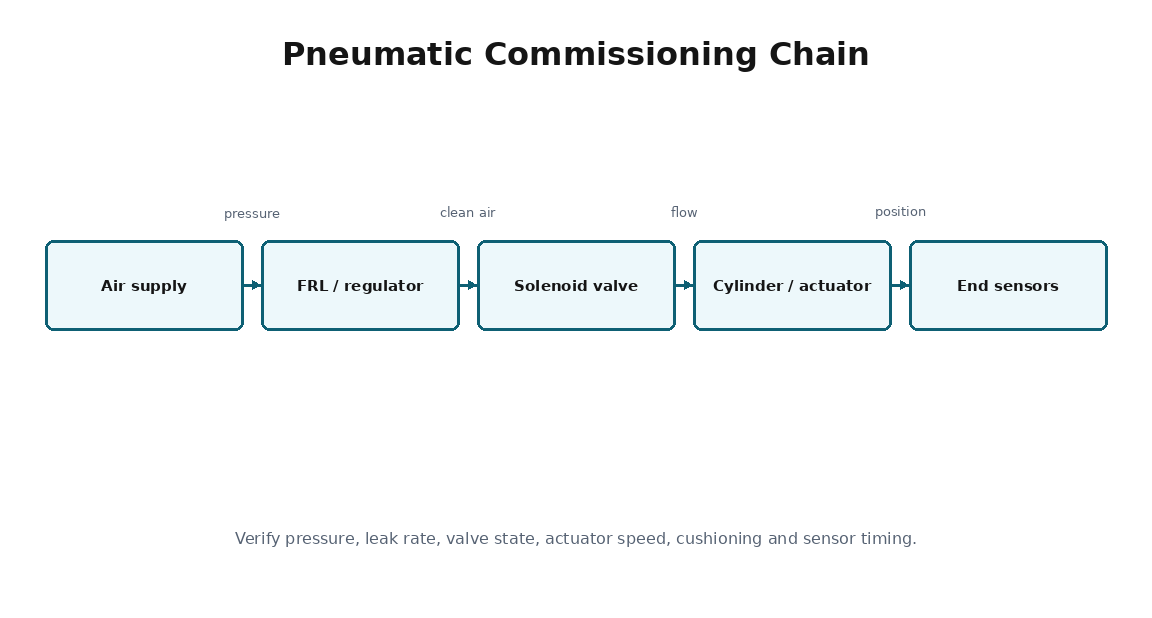
Bring pneumatic energy up in a controlled way and prove each motion before automatic cycling.
Why this matters during commissioning
Full pressure on an unproven cylinder can create rapid unexpected motion. Controlled pressurization gives technicians time to detect reversed tubing or interference.
Commissioning procedure
- Inspect tubing, fittings, regulators and valve ports.
- Set regulator low for initial motion where appropriate.
- Pressurize gradually and listen/check for leaks.
- Energize valves individually and verify actuator direction.
- Adjust flow controls and cushioning at safe speed.
- Verify end sensors and timing before sequence operation.
Common failure patterns
- Cylinder moves immediately when air is applied due to valve center state.
- Meter-in/meter-out flow control installed or adjusted incorrectly.
- Exhaust blocked by silencer contamination.
- Sensor triggers before actuator reaches mechanical end.
Evidence to record
- Measured value and test point
- Expected value / expected state
- Observed value / observed state
- Pass/fail result and any deviation
- Name/date or responsible person where required
FIELD RULE: Air pressure is stored energy. Treat re-pressurization like electrical re-energization.
Continue the series
- Previous chapter: Trends, Diagnostics and Time Synchronization: Commissioning Guide
- Next chapter: Hydraulic Commissioning
- Browse all Machine Commissioning chapters
Adapted from Machine Commissioning for Maintenance and Automation Technicians, by Dovydas Kersys. © 2026 Dovydas Kersys. Featured cover image is an AI-generated editorial illustration.