
By Dovydas Kersys · Chapter 54 of 58 in Machine Commissioning.
Before you begin: Follow the machine documentation, risk assessment, site procedures and lockout/tagout requirements. Commissioning can expose personnel to electrical energy, stored pressure and unexpected motion. Never defeat a safety function merely to make a test easier. Examples and diagrams are generic and must be checked against the actual machine.
Symptom
All emergency stops appear released, but the safety relay refuses to reset.
Diagnostic approach
Reset faults are solved fastest by reading the safety device diagnostics and proving each input channel instead of repeatedly pressing reset.
What the team found
One guard switch shows both mechanical indicators closed, but channel 2 remains open at the safety relay. A connector pin was not seated after cable assembly. The connector is repaired, both channels are tested independently, EDM is verified, and reset behavior is proven.
Commissioning lesson
Do not bypass a safety input to “finish commissioning.” Use the refusal to reset as diagnostic information.
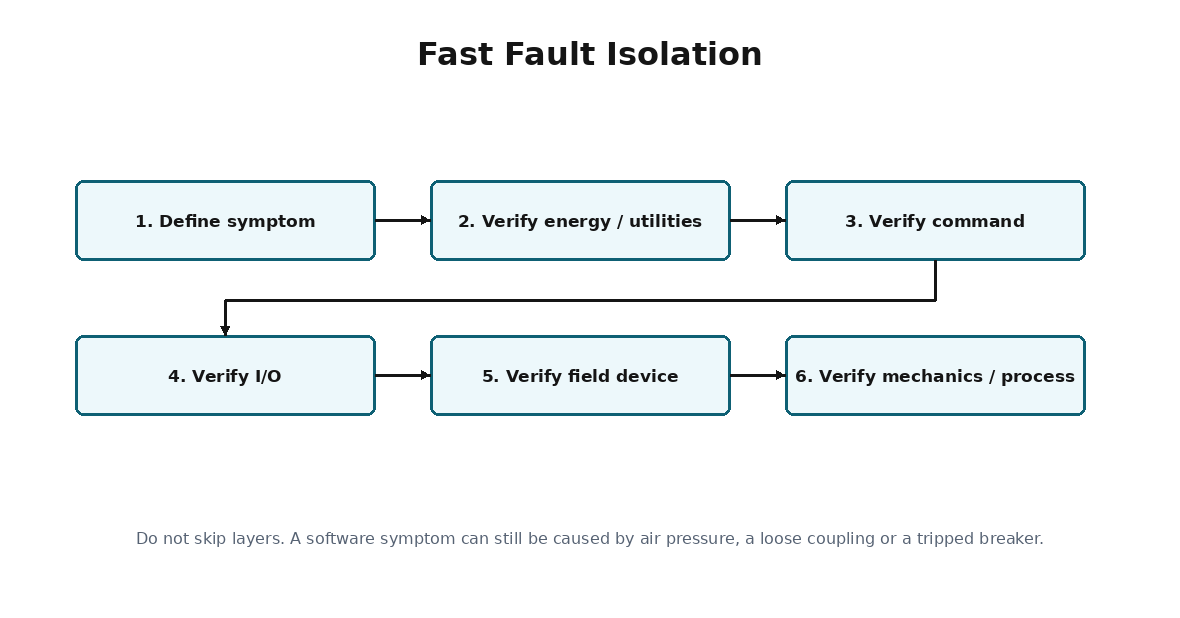
Use the same layered isolation method even when the symptom seems to point at software.
FIELD RULE: Preserve evidence before making changes: values, states, diagnostics, timestamps and the exact machine condition.
Continue the series
- Previous chapter: Analog Reading Is Wrong — Commissioning Case Study
- Next chapter: VFD Starts but Motor Will Not Turn — Commissioning Case Study
- Browse all Machine Commissioning chapters
Adapted from Machine Commissioning for Maintenance and Automation Technicians, by Dovydas Kersys. © 2026 Dovydas Kersys. Featured cover image is an AI-generated editorial illustration.