
By Dovydas Kersys · Chapter 58 of 58 in Machine Commissioning.
Before you begin: Follow the machine documentation, risk assessment, site procedures and lockout/tagout requirements. Commissioning can expose personnel to electrical energy, stored pressure and unexpected motion. Never defeat a safety function merely to make a test easier. Examples and diagrams are generic and must be checked against the actual machine.
Symptom
An automatic sequence stops on different steps during repeated cycles with no clear alarm.
Diagnostic approach
Random-looking sequence faults often share a common timing or feedback issue. Trend the step number, transition conditions and relevant sensor states.
What the team found
The trend shows a cylinder end sensor flickers for 40-70 ms as vibration begins. Several steps depend on the same “cylinder extended” bit, so the fault appears in different places. Mechanical sensor alignment is corrected and repeatability is tested before any timer is changed.
Commissioning lesson
A timer would have hidden the symptom. Trending exposed the shared physical cause.
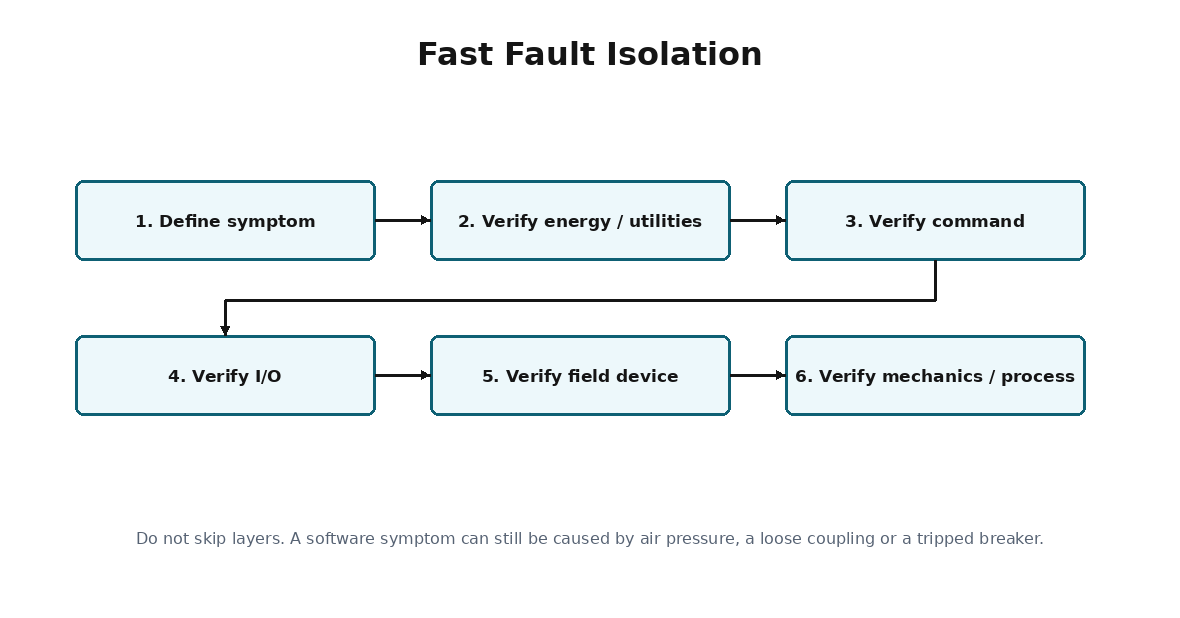
Use the same layered isolation method even when the symptom seems to point at software.
FIELD RULE: Preserve evidence before making changes: values, states, diagnostics, timestamps and the exact machine condition.
APPENDICES
Reusable Field Checklists and Records
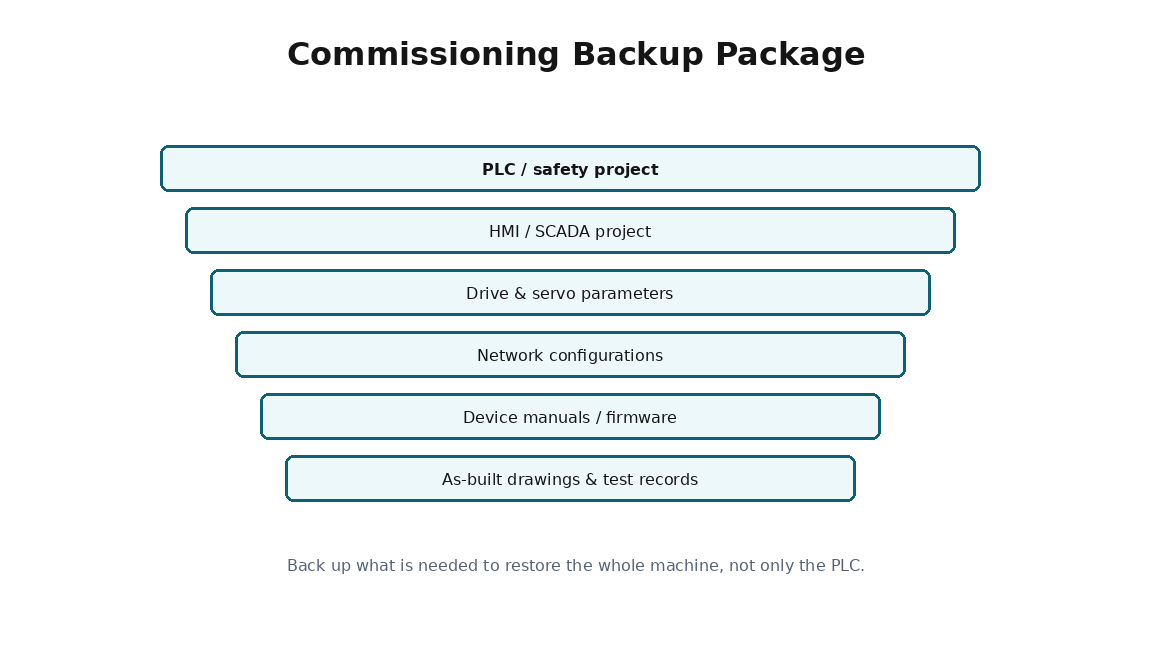
Reusable Field Checklists and Records
Continue the series
- Previous chapter: Network Device Drops Intermittently — Commissioning Case Study
- Browse all Machine Commissioning chapters
Adapted from Machine Commissioning for Maintenance and Automation Technicians, by Dovydas Kersys. © 2026 Dovydas Kersys. Featured cover image is an AI-generated editorial illustration.