A normal relay needs coil power all the time if we want it to stay energized.
For example, if a standard relay coil is powered, the contacts change position. When the coil power is removed, the relay returns back to its normal state.
A latching relay works differently.
A latching relay can change position and then stay in that position even after coil power is removed. This makes it useful in circuits where we want the relay to remember its last state.
In simple words:
A normal relay forgets its state when power is removed.
A latching relay remembers its state.
What Is a Latching Relay?
A latching relay is a relay that keeps its contact position after it has been switched.
It does not need continuous coil voltage to stay ON or OFF.
Instead, it only needs a short control signal to change state.
For example:
Press ON → relay switches ON and stays ON.
Release the button → relay still stays ON.
Press OFF → relay switches OFF and stays OFF.
Release the button → relay still stays OFF.
This is why latching relays are sometimes compared to a bistable circuit or a flip-flop. They have two stable states:
ON state
OFF state
The relay remains in the last commanded state until it receives another command.
Normal Relay vs Latching Relay
A standard relay normally needs constant power on the coil to keep the contacts changed.
For example, if the relay coil is energized, the NO contact closes. When the coil loses power, the contact opens again.
A latching relay does not work like that.
It can be switched ON with a short pulse and then remain ON mechanically or magnetically.
This gives one big advantage:
The relay does not consume coil power while it is holding its state.
This is useful in systems where the relay may stay in the same position for a long time.
How a Latching Relay Works
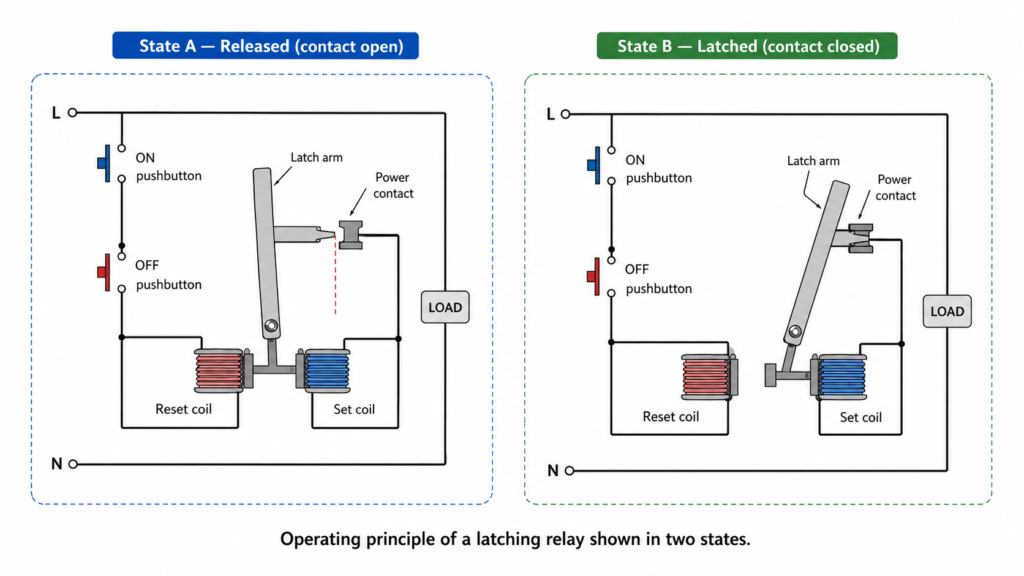
The basic idea is simple.
A latching relay has a mechanism that holds the contacts in their last position.
This can be done in two main ways:
Mechanical latching
Magnetic latching
Both types do the same basic job, but the holding method is different.
1. Mechanical Latching Relays
A mechanical latching relay uses a physical locking mechanism to hold the relay contacts in place.
When the relay is switched ON, the mechanism locks the contacts in the ON position.
The coil does not need to stay powered.
To switch the relay OFF, the locking mechanism must be released. This is usually done by:
A second coil
A reset coil
A manual release button
A mechanical unlatching device
A common mechanical latching relay has two coils:
Set coil
Used to switch the relay ON.
Reset coil
Used to switch the relay OFF.
Example: ON and OFF Button Control
Imagine a latching relay with two push buttons:
ON button
OFF button
When you press the ON button, the set coil is energized for a short moment. The relay changes state and the contacts close.
Even after you release the ON button, the relay remains ON.
When you press the OFF button, the reset coil is energized. The latch is released and the contacts open.
Even after you release the OFF button, the relay remains OFF.
This is very useful because the relay does not need continuous coil power to keep the output active.
Mechanical Latching Relay States
A mechanical latching relay usually has two stable positions:
1. Tripped / Reset State
In this state, the relay is OFF.
The power contact is open, so current does not flow through the load circuit.
2. Set / Latched State
In this state, the relay is ON.
The power contact is closed, so current can flow through the load circuit.
The relay stays in this position because the internal latch holds it there.
Latching Contactors
Some contactors can also be made into latching contactors.
This is usually done by adding a special mechanical latch block to the contactor.
The latch block can hold the contactor in the ON position without needing the contactor coil to stay energized.
The contactor can then be released by:
An electrical impulse
A manual release
An unlatching coil
This is useful in power circuits where the contactor needs to stay closed for a long time without wasting energy in the coil.
2. Magnetic Latching Relays
A magnetic latching relay uses magnetism to hold the contacts in position.
Many magnetic latching relays use a permanent magnet inside the relay.
The permanent magnet helps keep the relay in its last state after the coil pulse is removed.
Instead of continuous coil voltage, the relay only needs a short pulse to change state.
Single-Coil Magnetic Latching Relay
A single-coil magnetic latching relay uses one coil.
The relay changes state depending on the polarity of the voltage applied to the coil.
For example:
Positive polarity pulse → relay switches ON.
Reverse polarity pulse → relay switches OFF.
This means the control circuit must be able to reverse the polarity of the voltage.
The permanent magnet holds the relay in position after the pulse ends.
Dual-Coil Magnetic Latching Relay
A dual-coil magnetic latching relay has two separate coils:
Set coil
Reset coil
The set coil switches the relay ON.
The reset coil switches the relay OFF.
This is easier to understand because each coil has one clear function.
Set coil = ON
Reset coil = OFF
In many cases, a dual-coil design can be easier to wire into control circuits because you do not need to reverse polarity on one coil.
Pulse Control
Latching relays usually do not need continuous voltage.
They only need short pulses.
For example:
One pulse sets the relay.
Another pulse resets the relay.
If the relay is already ON, another ON pulse usually does not change anything.
If the relay is already OFF, another OFF pulse usually does not change anything.
The relay only changes when it receives the opposite command.
Why Use a Latching Relay?
Latching relays are useful because they can hold their state without continuous coil power.
This gives several advantages.
1. Lower Power Consumption
A normal relay consumes power as long as the coil is energized.
A latching relay only consumes power during switching.
After switching, the coil can be turned off.
This is useful in:
Battery-powered systems
Energy-saving circuits
Remote control systems
Long-duration ON/OFF applications
2. Relay State Is Kept During Power Loss
One of the most useful features of a latching relay is memory.
If the control power disappears, the relay can stay in its last mechanical or magnetic state.
This can be useful when a system must remember whether something was ON or OFF before a power interruption.
However, this must be used carefully.
In some safety circuits, you do not want a machine to restart automatically after power returns. Always check the safety requirements of the system.
3. Less Coil Heating
Because the coil is not energized continuously, there is less coil heating.
This can be useful when the relay would otherwise stay energized for a long time.
4. Useful for Long-Hold Applications
Latching relays are good when the output stays in the same state for long periods.
For example:
Lighting control
Energy management
Remote switching
Power-saving circuits
Control panels
Battery systems
Memory circuits
Load switching
Where Are Latching Relays Used?
Latching relays are used in many electrical and automation applications.
Common examples include:
Lighting control systems
Energy meters
Remote switching circuits
Battery-powered equipment
Power distribution systems
Control panels
Industrial control circuits
Alarm systems
Building automation
Load-shedding systems
Contactors with latch mechanisms
They are especially useful when the relay state must stay the same without keeping the coil powered all the time.
Simple Example in Automation
Imagine you have a control circuit where a load must stay ON after one short command.
With a normal relay, you may need:
A holding contact
Continuous coil power
A seal-in circuit
With a latching relay, the relay can stay ON mechanically after the ON command.
Then it only needs a reset command to switch OFF.
This can make some circuits simpler and reduce power consumption.
Important Things to Check Before Using a Latching Relay
Before choosing a latching relay, check:
Coil voltage
AC or DC coil
Single-coil or dual-coil design
Polarity requirements
Contact rating
Number of contacts
Set and reset pulse duration
Manual reset option
Mechanical life
Electrical life
Mounting type
Wiring diagram
Load type
Safety behavior after power loss
For magnetic latching relays, polarity is especially important.
If you wire the polarity incorrectly, the relay may not set or reset as expected.
Latching Relay vs Standard Relay
Here is the simple difference:
A standard relay needs coil power to stay active.
A latching relay only needs power when changing state.
A standard relay returns to its normal position when coil power is removed.
A latching relay stays in its last position until it receives a reset or set command.
That is the main idea.
Final Thoughts
A latching relay is useful when you want a relay to remember its last state.
It can stay ON or OFF without continuous coil power.
Mechanical latching relays use a physical locking mechanism.
Magnetic latching relays use magnetic holding force.
Both types are useful in control circuits where energy saving, state memory, or long holding time is important.
For beginners learning industrial automation, the most important idea is this:
A latching relay does not need constant coil power to keep its contacts in position.
It only needs a command to change state.