A very common three-wire arrangement is a regulated 5-volt reference, a low-current sensor ground and a signal return. Pressure and position sensors often use this pattern. The sensor electronics divide or condition the 5 V supply and return a signal that changes with the measured condition.
The 5 V reference is important because several sensors may share it. If one sensor internally shorts the reference to ground, the entire 5 V line can collapse. The scan tool may then report multiple sensor codes at the same time. A technician who replaces every sensor named in the codes can spend a great deal of money without fixing the shorted branch.
Sensor grounds are also different from the assumption that ‘ground is ground.’ A high-resistance ground path can shift the signal of several sensors. This can create values that are believable but wrong, which is harder to diagnose than a completely dead circuit. Voltage-drop testing under operating conditions is often more useful than an unloaded continuity check.
A practical workflow is to verify the reference voltage at the connector, verify the ground with a loaded or voltage-drop test when appropriate, then observe the signal. If the reference is missing on several sensors, investigate the shared circuit before blaming an individual sensor.
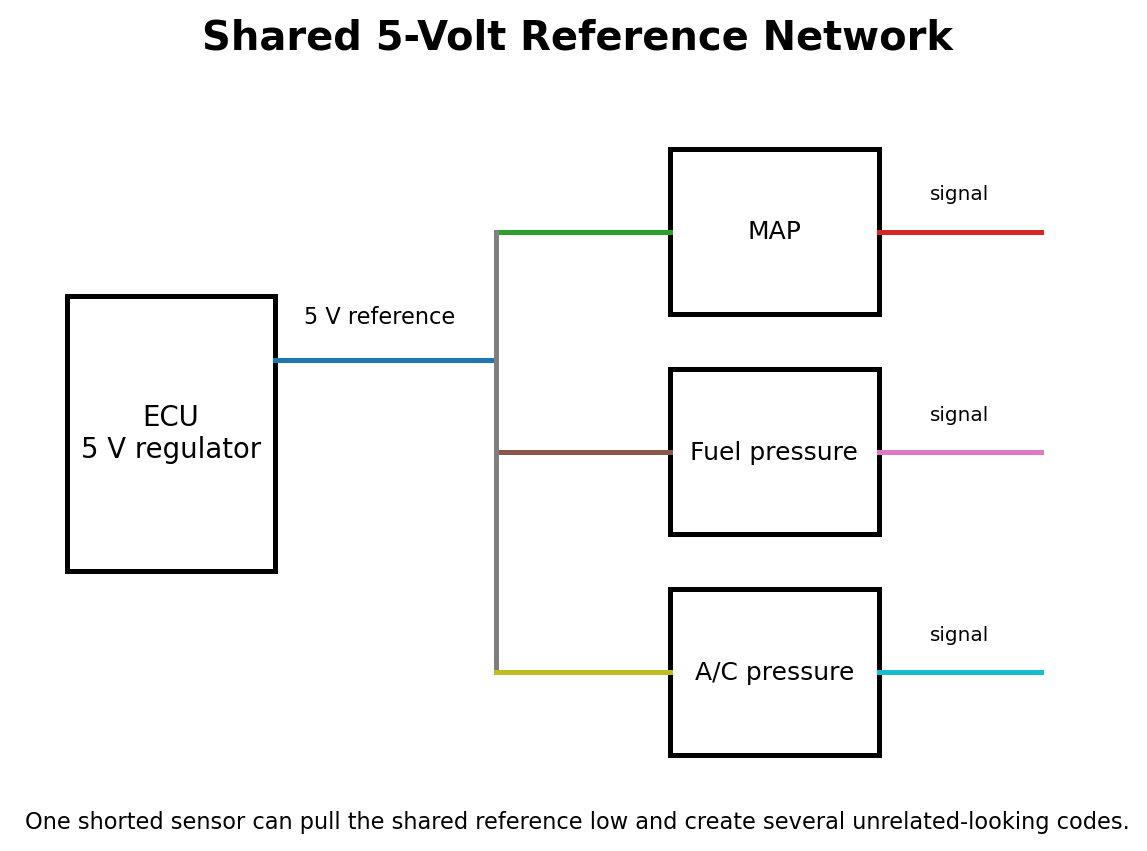
Figure: The 5-Volt Reference, Sensor Ground and Signal Wire