Limit switches are one of the most basic sensors used in automation.
And basic does not mean useless. Actually, it is often the opposite. A limit switch is simple, cheap, easy to understand, and very reliable when used in the right place. No complicated electronics. No special programming. No fancy sensing field. Just mechanical movement changing an electrical contact.
That’s it.
A moving machine part touches the switch, the switch changes state, and the control system receives a signal. In many machines, that small signal is enough to stop movement, confirm position, trigger the next sequence, or prevent a mechanical crash.
Old technology? Yes.
Still useful? Absolutely.
What Is a Limit Switch?
A limit switch is a mechanical position sensor used to detect the end position, travel limit, or presence of a moving object.
It is called a “limit” switch because it often detects the limit of movement. For example, when a machine slide reaches the end of its stroke, when a door is fully closed, when a lifting mechanism reaches its upper position, or when a cylinder rod reaches a certain point.
Unlike inductive, capacitive, photoelectric, or ultrasonic sensors, a limit switch works through physical contact.
The moving object must mechanically actuate the switch.
When the actuator is pushed, rotated, or moved, the internal contacts change state. This creates a digital electrical signal for the control circuit, PLC, relay, or machine controller.
In simple words:
Object moves.
Object presses switch.
Contacts change.
Machine reacts.
Very straightforward. Which is exactly why limit switches are still everywhere.
How Does a Limit Switch Work?
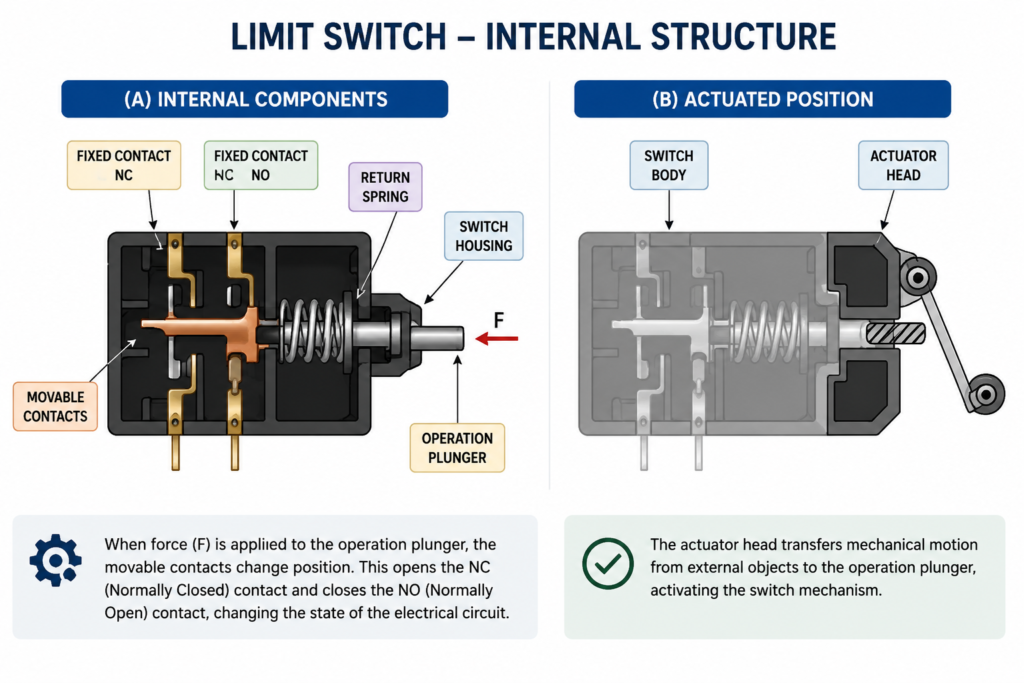
A limit switch contains a mechanical actuator, an internal mechanism, return spring, and electrical contacts.
The actuator is the external part that receives force from the moving object. Depending on the type, it may be a plunger, roller, lever, fork, rod, or spring arm.
When the actuator is moved, the force is transferred into the internal switching mechanism. This mechanism changes the state of the electrical contacts.
Most limit switches have:
- A normally closed contact
- A normally open contact
- A common terminal
When the switch is in its normal position, the NC contact is closed and the NO contact is open.
When the switch is actuated, the NC contact opens and the NO contact closes.
After the object moves away, a return spring brings the actuator back to its original position, and the contacts return to their normal state.
Nothing magical happening inside. Just good mechanical design.
Main Parts of a Limit Switch
A typical limit switch includes several important parts.
The main parts are:
- Switch housing – protects the internal mechanism
- Switch body – contains the contact system
- Actuator head – receives movement from the machine part
- Operating plunger or lever – transfers force into the mechanism
- Return spring – resets the switch after actuation
- Movable contacts – change position during switching
- Fixed contacts – provide the electrical connection points
- Terminals or connector – connect the switch to the control circuit
The housing may be made from plastic, aluminum, or other durable materials. Industrial limit switches are designed to resist mechanical stress, dust, oil, moisture, vibration, and other rough conditions.
Some are small enough for compact machines. Others are heavy-duty units used on large mechanical systems.
Same principle. Different size and strength.
Why Actuator Heads Are Needed
A basic push plunger can only be pressed from one direction.
But in real machines, moving objects do not always approach the switch perfectly. A shaft may rotate. A cam may pass sideways. A conveyor part may hit from an angle. A machine slide may overtravel slightly after touching the switch.
That is why many limit switches use different actuator heads.
The actuator head adapts the motion of the machine part into the correct movement for the switch body. It allows the switch to be actuated safely and repeatably, even when the object approaches from the side, front, back, or at a slight angle.
This is very important.
Without the right actuator head, the moving object may damage the switch, miss it completely, or apply force in the wrong direction.
And then the machine stops. Or worse, it does not stop when it should.
Common Types of Limit Switch Actuators
There are many actuator head styles available. The switch body may be similar, but the actuator head changes depending on the application.
Common types include:
- Push plunger
- Roller plunger
- Roller lever
- Adjustable roller arm
- Fork lever
- Adjustable rod
- Flexible spring rod
- Rotary lever
- Side-actuated lever
Each type is designed for a different movement pattern.
Push Plunger Limit Switch
A push plunger is one of the simplest actuator types.
The object moves directly toward the switch and presses the plunger in a straight line. When the plunger reaches the operating point, the contacts change state.
This type is useful when the moving object can approach the switch accurately and directly.
Typical uses include:
- End position detection
- Machine slide position
- Simple mechanical stops
- Door position detection
- Fixture confirmation
The weakness is that alignment must be good. If the object comes from the side or hits the plunger at an angle, the switch can wear quickly or get damaged.
Simple, yes. But not forgiving.
Roller Plunger Limit Switch
A roller plunger works like a push plunger, but it has a small roller on the end.
The roller reduces friction when the moving object slides across the actuator. This makes it better for applications where the object does not press straight into the switch but moves across it.
Typical uses include:
- Cam detection
- Sliding machine parts
- Moving plates
- Conveyor mechanisms
- Mechanical position detection with side movement
The roller helps prevent scraping and wear. A small improvement, but in a machine running thousands of cycles, small improvements matter.
Roller Lever Limit Switch
A roller lever limit switch uses a lever arm with a roller at the end.
This is one of the most common industrial limit switch styles. It allows a moving object to actuate the switch from the side. The roller reduces friction, and the lever gives more mechanical flexibility.
Roller lever switches are useful when:
- The object moves past the switch
- Some overtravel is expected
- The switch must be actuated from the side
- The target does not line up perfectly with a plunger
The lever can also help absorb small misalignments. In many machines, that is a real advantage because nothing stays perfectly aligned forever.
Vibration, wear, loose brackets — machines have their moods.
Adjustable Roller Arm
An adjustable roller arm is similar to a roller lever, but the lever length or position can be adjusted.
This makes setup easier because the switching point can be fine-tuned mechanically.
Typical uses include:
- Conveyor systems
- Rotating cams
- Packaging machines
- Adjustable machine stops
- Position detection where setup changes
The adjustable arm is useful when the exact actuation point may need to be changed during commissioning or maintenance.
Instead of moving the whole switch body, you can adjust the lever position.
Small convenience. Big time saver sometimes.
Fork Type Limit Switch
A fork type limit switch is used where a moving object or cam enters between two arms or actuates a fork-shaped mechanism.
This design can be useful in specific mechanical arrangements where movement must be detected in a controlled path.
It is less common than a roller lever but very useful in the right application.
Typical uses include:
- Rotating cam mechanisms
- Machine indexing systems
- Position confirmation
- Mechanical sequence detection
Fork designs can provide stable actuation when the object path is well-defined.
Adjustable Rod and Flexible Spring Rod
Some limit switches use a long rod or flexible spring actuator.
These are useful when the moving object may approach from different angles or when a softer, more forgiving actuator is needed.
A flexible spring rod can bend when contacted and return to its original position after the object moves away.
Typical uses include:
- Object presence detection
- Conveyor line detection
- Irregular object detection
- Light mechanical contact applications
- Applications with direction variation
The flexible actuator helps protect the switch from damage if the object overtravels or hits from an imperfect angle.
Not indestructible, of course. But more forgiving.
Electrical Contacts in Limit Switches
A limit switch is mostly mechanical, but its useful output comes from electrical contacts.
Most industrial limit switches provide changeover contacts. This means they can offer both normally open and normally closed contact functions.
Typical terminal arrangement may include:
- Common
- Normally closed
- Normally open
When the switch is not actuated:
- NC contact is closed
- NO contact is open
When the switch is actuated:
- NC contact opens
- NO contact closes
This gives flexibility in wiring.
For example, the NC contact may be used in a safety-related stop chain or control circuit where wire break detection is useful. The NO contact may be used to send a position signal to a PLC input.
The exact contact use depends on the machine design.
Contact Ratings
Limit switches usually have contacts rated for a certain voltage and current.
Many industrial limit switches are rated for AC control circuits, often around 250 V AC, with current ratings that may be around 10 A or more, depending on the model.
However, ratings depend heavily on the type of load.
Switching a resistive load is not the same as switching an inductive load such as a relay coil, contactor coil, solenoid, or motor control device. Inductive loads create arcs when switched, which can wear contacts faster.
So it is important to check:
- Voltage rating
- Current rating
- AC or DC rating
- Load type
- Mechanical life
- Electrical life
- Environmental rating
- Contact material
A switch may be physically strong but electrically overloaded if used incorrectly.
And burnt contacts are not a personality trait. They are a design problem.
Digital Signal to the Control System
A limit switch provides a digital signal.
It is either actuated or not actuated. Contact open or contact closed. PLC input on or off.
This signal can be used for many control functions:
- Stop motion at an end position
- Confirm machine position
- Start the next sequence step
- Detect object presence
- Detect guard or door position
- Signal overtravel
- Count mechanical movements
- Provide fault indication
In PLC systems, the limit switch contact is wired to a digital input. The program then uses that input to control the machine logic.
For example, a cylinder may extend until the extended limit switch becomes active. Once the PLC sees that signal, it stops the extend command and starts the next step.
A very small signal, but it controls the whole sequence.
Limit Switches With Indicator Lamps
Some limit switches include built-in LED or neon indicators.
These indicators show whether the switch is actuated or whether voltage is present, depending on the design.
This can be very helpful during troubleshooting. Instead of measuring immediately, you can often see the switch state visually.
However, indicator lamps should not replace proper measurement. A lamp can fail, wiring can be wrong, or the PLC input may still not receive the signal.
The indicator is useful.
The multimeter still wins arguments.
Limit Switch vs Proximity Sensor
Limit switches and proximity sensors are often used for similar jobs, but they work differently.
A limit switch needs physical contact. A proximity sensor detects without contact.
Simple comparison:
| Feature | Limit Switch | Proximity Sensor |
|---|---|---|
| Detection method | Mechanical contact | Non-contact |
| Detects | Physical movement/contact | Depends on sensor type |
| Wear | Mechanical wear possible | No mechanical wear |
| Cost | Usually lower | Usually higher |
| Alignment | Important | Important, but no contact force |
| Harsh mechanical use | Good with correct actuator | Depends on sensor |
| High-speed operation | Limited by mechanics | Often faster |
| Simple troubleshooting | Very easy | Depends on electronics |
| Electrical output | Contact signal | Electronic output |
Limit switches are often cheaper and very easy to understand. Proximity sensors are better when contact is not acceptable, when the target moves very fast, or when long mechanical life without contact is required.
So which one is better?
Depends on the job. As usual.
Advantages of Limit Switches
Limit switches have many practical advantages.
They are simple, affordable, strong, and easy to troubleshoot. They can switch AC or DC circuits depending on rating. They do not need a special sensing material like metal or a magnetic field. If something physically moves the actuator, the switch changes state.
Main advantages include:
- Low cost
- Simple working principle
- Easy wiring
- Clear on/off contact signal
- Many actuator styles
- Suitable for AC or DC control circuits
- Good mechanical strength
- Easy to test with a multimeter
- Available in small and heavy-duty versions
- Useful for many motion limit applications
In many applications, a limit switch is still the most practical choice.
Not the newest. Not the smartest. Just practical.
Limitations of Limit Switches
Limit switches also have limitations.
Because they require physical contact, they can wear over time. The actuator can break if hit too hard. Contacts can wear, burn, or become dirty. Mechanical alignment is important. High-speed operation can reduce life. They may not be suitable where contact with the object is not allowed.
Common limitations include:
- Mechanical wear
- Contact wear
- Possible actuator damage
- Requires physical contact
- Alignment must be correct
- Not ideal for very high-speed detection
- Can be affected by vibration or shock
- May need sealing in wet or dirty environments
- Overtravel must be considered
The switch is only as reliable as its mounting and actuation method.
A badly placed limit switch will not forgive you forever.
Overtravel and Mechanical Protection
Overtravel is the movement that continues after the switch has already actuated.
This is very important with limit switches.
If the moving object keeps pushing the actuator beyond its allowed travel, the switch can be damaged. Some actuator types are designed to tolerate overtravel better than others.
For example, a roller lever or flexible spring rod can often handle side movement and some extra travel better than a simple plunger.
When installing a limit switch, check:
- Operating travel
- Total travel
- Overtravel allowance
- Direction of actuation
- Reset position
- Mechanical stop position
- Actuator force
- Return force
Do not use the limit switch itself as a mechanical stop unless it is specifically designed for that. Usually, the machine should have a separate mechanical stop, and the switch should only detect position.
That detail saves switches from a painful life.
Environmental Considerations
Limit switches are available for many different environments.
When selecting one, consider:
- Moisture
- Dust
- Oil
- Coolant
- Temperature
- Shock
- Vibration
- Chemical exposure
- Outdoor use
- Mechanical impact
- Required IP rating
A small plastic limit switch may be fine inside a clean machine. A heavy-duty metal-bodied switch may be needed for large mechanical systems, outdoor equipment, or dirty industrial environments.
Wrong environment, short life.
It’s not complicated, but it gets overlooked.
Common Applications of Limit Switches
Limit switches are used in many industrial and mechanical systems.
Typical applications include:
- End position detection
- Machine slide position
- Conveyor position sensing
- Door and guard detection
- Lift and hoist travel limits
- Crane travel limits
- Valve position indication
- Cylinder position confirmation
- Packaging machines
- Material handling systems
- CNC machine guards
- Presses and forming machines
- Overtravel protection
- Mechanical sequence control
They are especially useful where direct mechanical actuation is acceptable and a low-cost, reliable contact signal is enough.
Installation Tips
Correct installation is essential for reliable operation.
Good installation practice includes:
- Choose the correct actuator type for the motion
- Align the actuator with the moving object
- Avoid excessive impact force
- Allow correct overtravel
- Do not use the switch as a hard stop
- Mount the switch firmly
- Protect the cable from movement and damage
- Use the correct contact rating
- Seal the cable entry properly
- Keep dirt and moisture out
- Test both actuation and reset
- Confirm the PLC input or control circuit changes state
A limit switch should be actuated smoothly and repeatably. If it is being smashed, scraped sideways, or barely touched at the edge, it will eventually cause problems.
Maybe not today.
But it will.
Final Thoughts
Limit switches are simple mechanical sensors used to detect position, end travel, and object movement.
A moving object presses or moves the actuator. The actuator transfers force to the internal mechanism. The contacts change state. A return spring resets the switch when the object moves away.
That is the whole working principle.
Their strength is simplicity. They are inexpensive, available in many actuator styles, easy to wire, and easy to troubleshoot. From small machines to heavy mechanical systems, limit switches still have a solid place in industrial automation.
Their weakness is also obvious: they need physical contact. That means mechanical wear, contact wear, actuator stress, and the need for correct mounting.
Use them where contact is acceptable. Choose the right actuator head. Respect overtravel. Protect them from harsh environments. And do not expect a tiny plunger switch to survive being used as a steel stopper.
A limit switch may be old-school, but when installed properly, it is still one of the most dependable little devices in a control system.