Reed switches are tiny devices, but they do a surprisingly useful job.
They can detect a magnetic field without touching anything. No lever. No plunger. No optical lens. Just two thin metal blades sealed inside a small glass tube, waiting for a magnet to come close.
Simple? Yes.
Primitive? Not really.
Reed switches and reed relays are still used in industrial automation, security systems, vehicles, measuring instruments, pneumatic cylinders, and many other applications where a clean magnetic switching signal is needed.
But first, one small confusion needs to be cleared up: a reed switch and a reed relay are not exactly the same thing.
What Is a Reed Switch?
A reed switch is a magnetically actuated electrical switch.
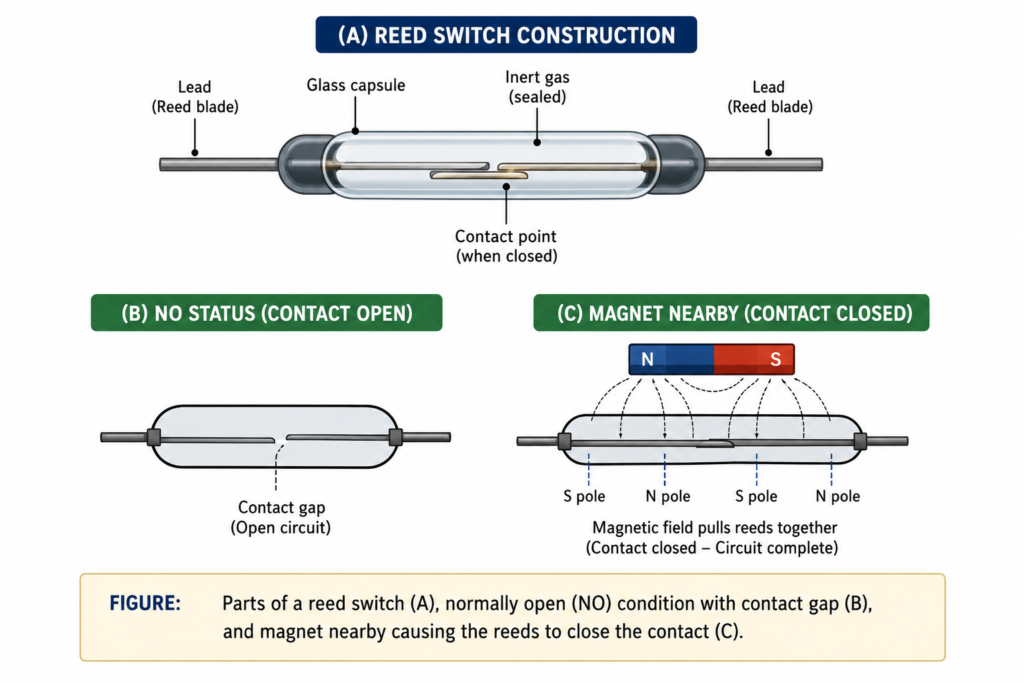
It is made from two thin ferromagnetic metal blades, called reeds. These reeds are sealed inside a glass capsule. The free ends of the reeds overlap slightly, but there is a small gap between them when the switch is not actuated.
When a magnetic field comes close, the reeds become magnetized. Opposite magnetic poles are created on the two reed blades, and the magnetic attraction pulls them together. When they touch, the electrical contact closes.
When the magnet moves away, the magnetic force becomes weaker. The natural spring force of the reeds pulls them apart again, and the contact opens.
That is the working principle.
Magnet close → contact closes.
Magnet away → contact opens.
Very neat little mechanism.
What Is a Reed Relay?
A reed relay is a reed switch combined with an electromagnetic coil.
This is where the naming can get a little messy. People often use the word “reed relay” when they are talking about reed switches, but technically there is a difference.
A reed switch is only the sealed glass contact element.
A reed relay includes the reed switch plus a coil that creates the magnetic field electrically.
In a reed relay, when voltage is applied to the coil, current flows through it and creates a magnetic field. That magnetic field closes the reed switch inside the relay. When the coil is de-energized, the magnetic field disappears and the reed contact opens again.
So:
- Reed switch = magnetically operated contact
- Reed relay = reed switch operated by an electromagnetic coil
Small difference. Important difference.
Construction of a Reed Switch
A reed switch has a very simple structure.
The main parts are:
- Two ferromagnetic reed blades
- Contact points
- Glass capsule
- Inert gas or vacuum inside the capsule
- External terminals for soldering or connection
The reed blades are usually made from a nickel-iron alloy. The contact area may be coated with special metals such as ruthenium, rhodium, or other contact materials to improve switching performance and reduce contact wear.
The glass capsule is hermetically sealed. This means the contact area is protected from dust, moisture, oil, and air contamination.
Inside the capsule, there may be either:
- Vacuum, often used for higher-voltage switching
- Inert gas, used to reduce oxidation and protect the contacts
This sealed design is one of the reasons reed switches can have a very long service life.
The contacts are not exposed to normal dirty air. No dust getting in. No moisture sitting on the contact. No oily factory mist creeping inside. Nice.
How a Reed Switch Works
In its normal state, a standard reed switch contact is open. The two reed blades are close to each other, but not touching.
When a permanent magnet is moved near the reed switch, the magnetic field passes through the ferromagnetic reeds. The reeds become magnetized with opposite polarity at the contact ends.
The attraction between the two reeds pulls them together. Once they touch, the electrical circuit is closed.
When the magnet is moved away, the magnetic field becomes too weak to keep the reeds together. The reeds return to their normal open position because of their own spring force.
The magnetic field must be strong enough to overcome the restoring force of the reed blades. If the magnet is too weak, too far away, or badly aligned, the contact may not close reliably.
That is one of those practical details that matters a lot in real machines.
A reed switch is simple, yes, but it still obeys physics.
Normally Open and Normally Closed Reed Switches
The most common reed switch type is normally open.
This means the contact is open when no magnetic field is present and closes when a magnet comes close.
However, other versions exist too.
Some reed switches are normally closed, meaning the contact opens when a magnetic field is applied. There are also changeover versions, although they are less common than simple normally open types.
In automation and sensing applications, normally open reed switches are very widely used because they are simple and easy to connect to PLC inputs, counters, alarm circuits, and control relays.
Reed Switch Contact Ratings
Reed switches are useful, but they are not made for switching heavy loads.
Their contacts are small. Very small. That means the current and voltage ratings must be respected.
Typical reed switches are used for low-current control signals, not for switching motors, heaters, solenoids, or large contactor coils directly unless the rating allows it.
Important ratings to check include:
- Maximum switching voltage
- Maximum switching current
- Maximum switching power
- Contact resistance
- Insulation resistance
- Operating temperature
- Mechanical shock and vibration limits
If a reed switch is used to switch a load that is too large, the contacts can weld, burn, or fail early.
For PLC inputs and signal circuits, they are usually a great fit. For power switching, not so much.
Use the reed switch to send the signal. Let a relay, transistor, or contactor handle the muscle work.
Advantages of Reed Switches and Reed Relays
Reed switches have several strong advantages.
They are simple, compact, sealed, fast, and inexpensive. Since the contact is inside a sealed glass capsule, it is well protected from contamination. They also require no physical contact with the moving object, only a magnetic field.
Main advantages include:
- Simple construction
- Low cost
- Compact size
- Fast switching
- Long service life
- Hermetically sealed contacts
- Low contact resistance
- No external mechanical actuator required
- Can switch without physical contact
- Useful for position and level detection
- Easy to interface with control circuits
Reed switches can often survive millions or even billions of switching operations when used within their ratings.
That is impressive for something that looks like a tiny glass bead with wires.
Disadvantages and Limitations
Reed switches also have weaknesses.
They are sensitive to magnetic fields, which is the whole point, but it can also become a problem. A nearby magnet, strong coil, motor, transformer, or magnetic tool may cause unwanted switching.
They are also sensitive to vibration and shock in some applications. Since the reed blades are thin and flexible, vibration can sometimes cause contact bounce or false switching.
Common limitations include:
- Low current rating
- Low switching power compared with larger relays
- Sensitivity to external magnetic fields
- Possible contact bounce
- Sensitivity to shock and vibration
- Glass capsule can be fragile
- Contact welding if overloaded
- Detection distance depends on magnet strength and alignment
So, like many components, reed switches are excellent when used correctly and annoying when used badly.
Not their fault, mostly.
Reed Switches as Magnetic Sensors
A reed switch is one of the simplest magnetic field sensors.
When paired with a permanent magnet, it can detect position, movement, level, or counting pulses.
The magnet may be mounted on a moving part, float, piston, door, wheel, or rotating element. The reed switch is fixed nearby. When the magnet reaches the switch position, the contact changes state.
This gives a clean digital signal.
Typical uses include:
- Position detection
- Door and window sensing
- Pneumatic cylinder position detection
- Liquid level detection
- Counting pulses
- Security alarms
- Speed sensing
- Limit position detection
- Machine state feedback
The idea is very straightforward: attach a magnet to the thing that moves, mount the reed switch where you want detection, and read the contact signal.
Sometimes the simplest solution really is the best one.
Reed Switches in Pneumatic Cylinders
One very common industrial use is pneumatic cylinder position detection.
Many pneumatic cylinders have a permanent magnet built into the piston. As the piston moves inside the cylinder, the magnet moves with it. Reed switches or magnetic cylinder sensors can be mounted externally along the cylinder body.
When the piston reaches the position of the reed switch, the magnetic field activates the switch.
This allows the control system to know whether the cylinder is:
- Retracted
- Extended
- At an intermediate position
For example, one reed switch may be mounted near the back end of the cylinder to confirm the retracted position. Another may be mounted near the front end to confirm the extended position.
Additional reed switches can be installed along the cylinder to detect intermediate piston positions, depending on the cylinder design and application.
This is very useful in automation because the PLC needs confirmation that a movement has actually happened before starting the next step.
Cylinder moved? Sensor confirms. Next action starts.
Without that feedback, machines become guesswork. And guesswork in automation usually ends with something crashing.
Reed Switches for Liquid Level Detection
Reed switches are also widely used in liquid level detection.
A common design uses a float with a built-in magnet. As the liquid level rises or falls, the float moves. When the magnet reaches the reed switch position, the contact changes state.
This can be used for:
- Minimum level detection
- Maximum level detection
- Pump dry-run protection
- Tank full indication
- Tank empty indication
- Level alarm systems
The reed switch may be mounted inside a stem or outside a non-magnetic tube, depending on the design.
This method is simple and reliable because the electrical contact does not need to be exposed directly to the liquid. The magnet does the actuation through the material.
Of course, the liquid type, float movement, temperature, and chemical compatibility still matter. A float that gets stuck is not going to give good level detection, no matter how good the reed switch is.
Reed Relays in Electronic Circuits
Reed relays are often used in electronic and instrumentation circuits.
Because the reed switch contacts are sealed and can have low contact resistance, reed relays are useful for switching small signals.
They are common in:
- Test equipment
- Measuring instruments
- Signal switching boards
- Communication equipment
- Medical devices
- Low-current automation signals
- Isolation circuits
Compared with larger electromechanical relays, reed relays can be faster and more compact. They can also provide good isolation between the coil and contact circuit.
However, their contact rating is still limited, so load selection is important.
Contact Bounce
Like most mechanical contacts, reed switches can bounce.
Contact bounce means the contact may open and close several times very quickly when switching, before settling into its final state.
In a simple lamp circuit, this may not matter. In a PLC counter, speed input, or digital electronics circuit, bounce can create multiple false pulses.
Possible solutions include:
- Software debounce in the PLC
- Hardware debounce circuit
- Input filtering
- Slower counting settings
- Correct magnet speed and position
- Using a sensor designed for counting applications
For normal cylinder end-position detection, contact bounce is often not a serious problem. For high-speed counting, it can be.
Tiny contacts, tiny bounce, big counting error. Classic.
Installation Tips
Correct installation is important for reliable reed switch operation.
Good installation practice includes:
- Use the correct magnet strength
- Keep the magnet within the rated sensing distance
- Align the magnet properly with the reed switch
- Avoid strong external magnetic fields
- Protect the glass capsule from mechanical stress
- Do not exceed contact voltage or current ratings
- Use proper suppression for inductive loads
- Avoid heavy vibration where possible
- Use debounce filtering for counting signals
- Test the switch with the real magnet and real movement
When installing reed switches on cylinders, slide the sensor slowly along the cylinder body while moving the piston to the desired position. Find the switching point and place the sensor in a stable detection area, not just at the weak edge of the magnetic field.
That little bit of margin can save a lot of random faults later.
Reed Switch vs Hall Sensor
Reed switches and Hall sensors are both used for magnetic detection, but they are different.
A reed switch is a mechanical contact operated by a magnetic field.
A Hall sensor is an electronic sensor that detects magnetic fields using semiconductor technology.
Simple comparison:
| Feature | Reed Switch | Hall Sensor |
|---|---|---|
| Principle | Magnetic mechanical contact | Semiconductor magnetic sensing |
| Output | Contact signal | Electronic output |
| Requires power | Not for basic contact operation | Yes |
| Moving parts | Reed blades move | No moving parts |
| Contact wear | Possible | No contact wear |
| Current rating | Limited contact rating | Depends on electronics |
| Bounce | Possible | No mechanical bounce |
| Magnetic sensitivity | Depends on design | Depends on sensor type |
| Common use | Simple position sensing | Higher-speed electronic sensing |
Reed switches are excellent for simple, low-cost contact-based sensing. Hall sensors are better when a solid-state output, higher switching frequency, or no mechanical contact movement is preferred.
Again, not better or worse. Just different tools.
Common Applications
Reed switches and reed relays are used in many areas.
Typical applications include:
- Pneumatic cylinder position detection
- Hydraulic cylinder position detection
- Liquid level switches
- Door and window security contacts
- Alarm systems
- Counting mechanisms
- Speed sensing
- Flow sensors
- Position sensors
- Automotive systems
- Test equipment
- Instrumentation
- Low-current signal switching
- Industrial automation feedback
- Float switches
- Magnetic proximity detection
They are especially useful when a magnet can be attached to the moving part and a simple digital signal is enough.
Final Thoughts
Reed switches are simple magnetic switches made from two ferromagnetic contact blades sealed inside a glass capsule. When a magnetic field comes close, the blades attract each other and close the contact. When the magnetic field is removed, the blades spring back and the contact opens.
A reed relay adds an electromagnetic coil around or near the reed switch, allowing the contact to be operated electrically instead of by a separate permanent magnet.
The main strengths of reed switches are their simplicity, low cost, sealed contacts, fast switching, and long life when used within ratings. Their main weaknesses are low current capacity, sensitivity to external magnetic fields, possible contact bounce, and vulnerability to mechanical shock.
In automation, reed switches are often used as magnetic position sensors. With a permanent magnet, they can detect cylinder position, tank level, door position, moving parts, and counted pulses.
They are not the most modern sensor technology in the world, but they are still practical, reliable, and easy to understand.
And sometimes in industrial automation, that is exactly what you want.