Copper wire doesn’t look particularly exciting. Leave a piece on a workbench and it will do absolutely nothing—quite reliably, in fact.
Send electrical current through it, though, and the situation changes.
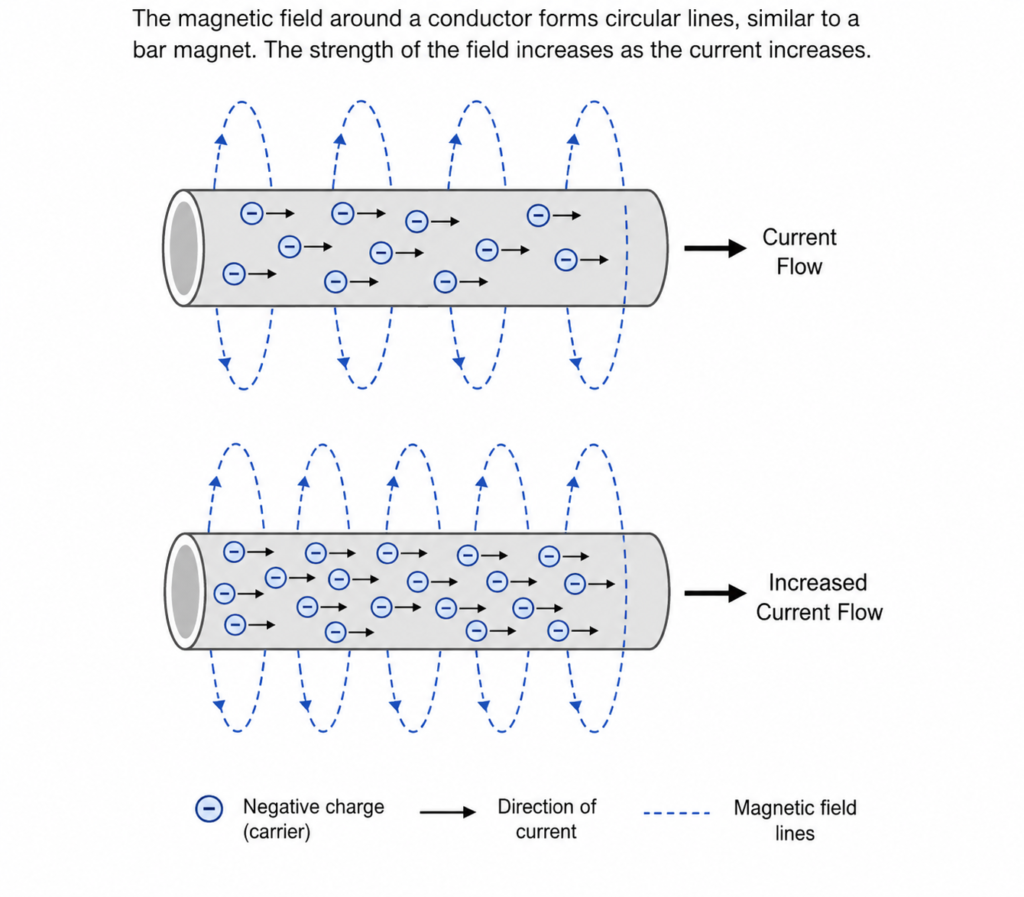
A magnetic field immediately forms around the conductor. You cannot normally see it, but it is there, extending into the space surrounding the wire. Increase the current and the field becomes stronger. Reduce the current and it weakens. Reverse the current direction, and the magnetic field reverses as well.
This relationship between electricity and magnetism is called electromagnetism, and it sits at the heart of AC motor operation.
Without it, there would be no rotating magnetic field, no voltage induced in the rotor, and no torque at the shaft. An induction motor would be little more than a rather expensive metal drum.
What Is Electromagnetism?
Electromagnetism describes the relationship between electric current and magnetic fields.
Whenever current flows through a conductor, a magnetic field develops around that conductor. The field consists of magnetic lines of flux, much like the field surrounding a permanent magnet.
The strength of this magnetic field depends partly on the amount of current flowing through the wire:
- More current produces a stronger magnetic field.
- Less current produces a weaker magnetic field.
- No current means no current-produced magnetic field.
The field does not remain separate from the electrical circuit. It responds directly to changes in current.
When current rises, the magnetic field builds. When current falls, the field collapses. When current reverses, the polarity and direction of the field reverse with it.
That changing magnetic behaviour is particularly important in AC circuits because alternating current is, as the name suggests, always changing direction.
The Magnetic Field Around a Straight Conductor
Picture a straight wire carrying current.
Magnetic lines of flux form circular paths around the wire. The conductor sits at the centre, while the field wraps around it in rings.
The direction of those rings is not random. It is determined by the direction of current flow.
Reverse the current and the magnetic field circles the conductor in the opposite direction.
This matters because electrical machines depend not only on the presence of a magnetic field, but also on its direction. A field pointing or rotating the wrong way can reverse force, change motor rotation, or alter how two electromagnetic parts interact.
The Left-Hand Rule for Conductors
The left-hand rule for conductors is one way to determine the direction of the magnetic field around a current-carrying wire.
Grasp the conductor with your left hand:
- Point your thumb in the direction of electron flow.
- Your curled fingers show the direction of the magnetic lines of flux.
One detail is worth mentioning here. This version of the rule uses electron flow, which travels from negative to positive. Conventional current is defined in the opposite direction, from positive to negative, so textbooks using conventional current may present a right-hand rule instead.
Both approaches describe the same physical relationship. The important thing is not to mix the two conventions halfway through the calculation—a surprisingly easy way to send yourself in the wrong direction.
When electron flow travels away from the viewer, the magnetic flux circles the conductor counterclockwise. When electron flow travels toward the viewer, the flux reverses and circles clockwise.
Electrical drawings often use simple symbols to show this direction:
- A dot represents motion coming out toward the viewer, like the point of an arrow.
- A cross or similar mark represents motion going away, like the tail feathers of an arrow.
It is a small drawing convention, but once understood, it makes motor and magnetic-field diagrams far easier to read.
Turning a Wire Into an Electromagnet
The magnetic field around one straight conductor is useful, but it may not be particularly strong.
Now wind that conductor into a coil.
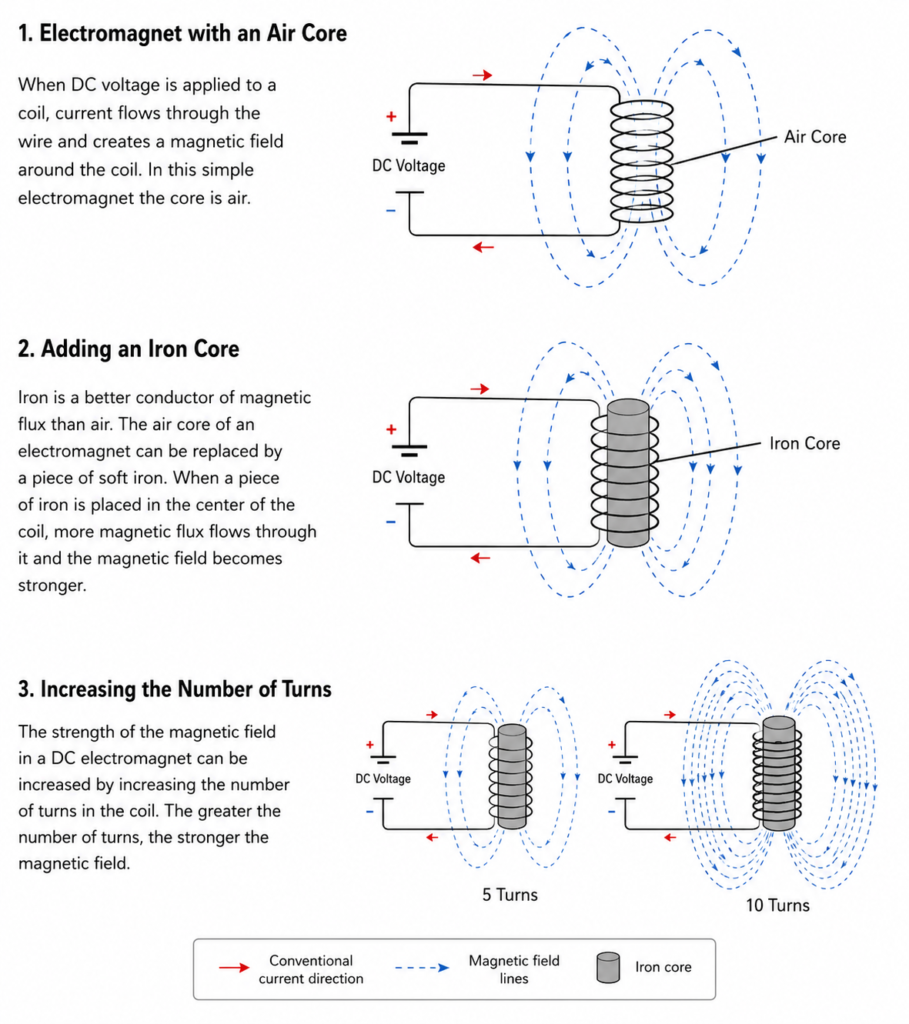
As current flows through every turn, each section of wire produces its own magnetic field. Those individual fields combine, creating one larger and more concentrated magnetic field through the centre of the coil.
Apply DC voltage to the coil and it becomes a basic electromagnet.
The centre of the coil is called the core. If nothing but air occupies this space, the device has an air core.
An air-core electromagnet still works, although its magnetic field is relatively weak compared with a coil built around a suitable magnetic material.
The coil now behaves much like a bar magnet. It develops a north pole at one end and a south pole at the other, and magnetic flux travels in closed paths around and through it.
The difference is control.
A permanent magnet is always magnetic. An electromagnet can be switched on, switched off, strengthened, weakened, or reversed simply by controlling the current flowing through its winding.
That flexibility is precisely why electromagnets appear in motors, transformers, relays, solenoids, contactors, lifting equipment, and all sorts of industrial machinery.
Why an Iron Core Makes the Field Stronger
Air does not guide magnetic flux particularly well.
Iron does.
If a piece of soft iron is inserted into the centre of the coil, the magnetic field becomes considerably stronger. The iron provides a much easier path for magnetic flux than the surrounding air.
In technical terms, iron has much higher magnetic permeability than air.
More flux can therefore pass through the centre of the coil, producing a stronger and more concentrated magnetic field without necessarily increasing the electrical current.
This is why motor stators are built around steel cores rather than unsupported coils hanging in empty space. The steel gives the magnetic flux a practical path and allows the motor to produce a useful field efficiently.
Soft iron is especially useful because it becomes strongly magnetised when current flows, yet loses most of that magnetism when the current is removed.
That is exactly what an alternating-current device needs. The magnetic field must be able to build, collapse, and reverse repeatedly without the core stubbornly remaining magnetised in one direction.
How the Number of Coil Turns Affects Field Strength
Another way to strengthen an electromagnet is to increase the number of turns in its coil.
Each turn contributes to the total magnetic field. Add more turns, and the fields combine to produce a greater magnetising effect.
In simple terms:
More coil turns generally produce a stronger magnetic field.
Current matters too. A coil carrying a larger current will normally create a stronger field than the same coil carrying a smaller current.
This relationship is often described using ampere-turns:
Magnetising effect = current × number of turns
For example, a coil with 100 turns carrying 2 amperes produces 200 ampere-turns. A 200-turn coil carrying 1 ampere also produces 200 ampere-turns, at least in the simplified theoretical sense.
Real equipment is messier. Wire resistance, core saturation, heat, leakage flux, and physical dimensions all affect the final result. Engineering has a habit of adding footnotes just when the simple explanation starts feeling comfortable.
Still, the basic principle remains sound: increasing current or adding turns increases the magnetising force.
Electromagnet Polarity
An electromagnet has the same basic pole arrangement as a permanent magnet.
One end acts as a north pole, while the other acts as a south pole. Magnetic lines of flux leave the north pole, pass through the surrounding magnetic path, and return through the south pole.
The polarity depends on the direction of current through the winding.
Reverse the current and the poles swap places.
The end that was north becomes south. The end that was south becomes north.
With a DC supply, current normally flows in one direction, so the electromagnet maintains a steady polarity while energised.
Connect the same coil to an AC source and things become much more lively.
What Alternating Current Does to an Electromagnet
Alternating current repeatedly rises, falls, crosses zero, and reverses direction.
The electromagnet’s field follows those changes.
At the beginning of an AC cycle, current is zero. With no current flowing, the coil produces no magnetic field.
As current begins increasing in the positive direction, a magnetic field develops around the coil. One end becomes the north pole and the other becomes the south pole.
The current continues rising until it reaches its positive peak. At that moment, the magnetic field is also at or near its maximum strength.
Current then begins decreasing. The magnetic field weakens and starts collapsing until both current and field reach zero again.
But the cycle is only halfway finished.
Current now begins flowing in the opposite direction. Because the direction has reversed, the electromagnet’s polarity reverses too. The former north pole becomes south, and the former south pole becomes north.
The current rises to its negative peak, falls again, and eventually returns to zero. The entire sequence then repeats.
On a 60 Hz supply, one complete cycle occurs 60 times every second. The magnetic field therefore builds, collapses, and reverses polarity 60 times per second.
On a 50 Hz supply, commonly used in Europe and many other regions, the process repeats 50 times per second.
That is rather quick. There is no visible pause where the coil appears to think about changing direction—it simply happens continuously.
A Simple AC Electromagnet Cycle
The process can be followed step by step:
1. Current is zero
No current flows through the coil, so there is no current-produced magnetic field.
2. Positive current begins rising
A magnetic field develops, and the electromagnet takes on a particular north-south polarity.
3. Positive current reaches its peak
The magnetic field reaches its greatest strength in that direction.
4. Positive current decreases
The field begins weakening and collapsing.
5. Current returns to zero
The magnetic field falls to zero.
6. Current reverses
A field develops in the opposite direction, and the magnetic poles exchange positions.
7. Negative current reaches its peak
The reversed magnetic field reaches maximum strength.
8. Negative current decreases
The field collapses again.
9. Current returns to zero
The cycle is complete and immediately begins again.
This constant variation is what allows AC windings to produce changing magnetic conditions. In a properly arranged three-phase motor, several such fields combine to create something even more useful: a magnetic field that rotates around the stator.
What Is Induced Voltage?
Electromagnetism works in both directions.
Current flowing through a conductor creates a magnetic field. At the same time, a changing magnetic field crossing a conductor can create—or induce—voltage in that conductor.
This principle is known as electromagnetic induction.
A conductor does not need to be physically wired to the source circuit for voltage to appear in it. It only needs to experience changing magnetic flux.
That point is fundamental.
It explains how a transformer transfers electrical energy between separate windings. It also explains how an AC induction motor transfers energy from the stationary stator to the rotating rotor without a direct electrical connection between them.
No brushes are required in a standard squirrel-cage motor. No cable runs from the terminal box to the spinning rotor. The energy crosses the air gap through the magnetic field.
Neat, really.
Induction Between Two Separate Coils
Imagine two electromagnets positioned close together.
The lower coil is connected to an AC source. The upper coil belongs to a separate electrical circuit. There is no physical electrical connection between them.
At first, voltage and current are zero. Neither coil produces a magnetic field.
As AC current begins rising in the lower coil, its magnetic field starts building. The expanding magnetic flux passes through the surrounding space and cuts across the turns of the upper coil.
Because the flux passing through the upper coil is changing, a voltage is induced across it.
If the upper circuit is closed, current begins flowing through that coil as well.
That current then creates its own magnetic field.
Energy has now passed from one circuit to another, even though the conductors never touched.
This is the same broad principle used by transformers, although a transformer normally uses a shared magnetic core to guide flux efficiently from one winding to the other.
Why the Magnetic Field Must Change
A steady magnetic field does not continuously induce voltage in a stationary conductor.
The magnetic flux linking the conductor must change.
This change can happen in several ways:
- The magnetic field can grow or collapse.
- The conductor can move through the field.
- The magnet can move relative to the conductor.
- The field can reverse direction.
- The conductor and field can rotate relative to one another.
In the two-coil example, both coils remain physically stationary. Voltage is induced because the AC current causes the magnetic field to expand, collapse, and reverse repeatedly.
Inside an induction motor, the magnetic field rotates relative to the rotor conductors. This relative movement causes magnetic flux to cut across the rotor bars, inducing voltage and current in them.
That induced rotor current then produces another magnetic field.
Now the motor has two interacting fields: one from the stator and one from the rotor.
And that is where torque begins.
Electromagnetic Attraction Between the Coils
The current induced in the second coil creates a magnetic field with its own north and south poles.
Its polarity develops in a direction that opposes the change responsible for producing it. This behaviour is described by Lenz’s law.
In the simplified two-electromagnet example, the facing poles develop opposite polarities. Because unlike poles attract, the upper electromagnet is pulled toward the lower one.
Move the energised lower electromagnet sideways and the upper electromagnet tends to follow.
There is still no mechanical connection between them. The force is produced entirely by the interaction of their magnetic fields.
This demonstration provides a useful stepping stone toward understanding an induction motor.
Instead of one electromagnet simply following another in a straight line, the stator creates a magnetic field that moves around the motor. The rotor’s induced magnetic field tries to follow that moving field, producing continuous rotation.
How This Applies to an AC Induction Motor
Inside a three-phase induction motor, the stator windings are connected to an AC power source.
Current flowing through those windings creates magnetic fields. Because the three supply phases reach their peaks at different times, the combined field does not merely pulse in one place—it rotates around the stator.
The rotating field cuts across the conductor bars of the squirrel-cage rotor.
Voltage is induced in those bars. Since the bars are connected by conductive end rings, rotor current flows through the closed cage.
That rotor current creates its own magnetic field.
The rotor field interacts with the stator’s rotating field, producing force and torque. The rotor begins turning in the same direction as the field.
It cannot quite reach the field’s exact speed during normal motor operation. Some relative motion must remain so that flux continues cutting across the rotor conductors and inducing current.
This speed difference is known as slip.
No slip would mean no induced rotor voltage. No induced voltage would mean no rotor current. And without rotor current, there would be no useful torque.
So the rotor’s small speed deficit is not a flaw. It is part of how the motor works.
The Core Ideas to Remember
Electromagnetism can become a deep subject, but the principles needed to understand basic motor operation are fairly manageable.
Current flowing through a conductor creates a magnetic field.
The field direction depends on the direction of current flow.
Winding the conductor into a coil concentrates the magnetic flux and creates an electromagnet.
Adding an iron or steel core strengthens the field by providing a better path for the flux.
Increasing the number of turns or increasing current generally increases magnetic strength.
Reversing current reverses electromagnetic polarity.
With AC power, the magnetic field continually builds, collapses, and changes direction.
Finally, a changing magnetic field can induce voltage in a separate conductor without any direct electrical connection.
Put those ideas together inside a three-phase motor and stationary electrical energy becomes rotating mechanical force.
A copper winding creates a field. The field crosses an air gap. Current appears in a rotor that is not wired to the supply, and a steel shaft begins to turn.
That is electromagnetism doing the heavy lifting.