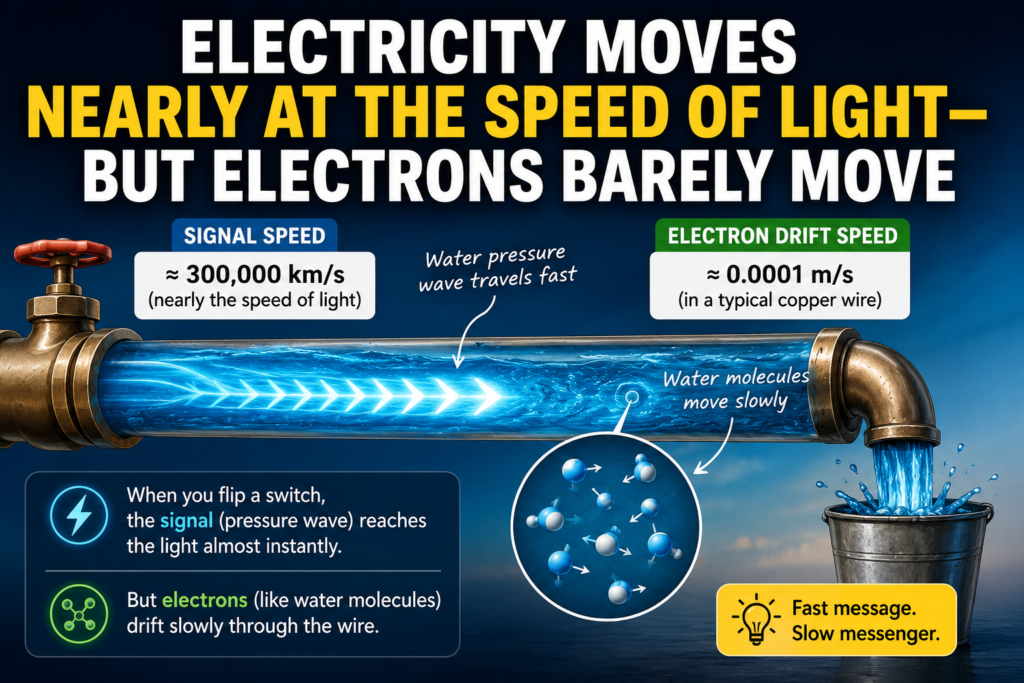
Flip a light switch and the lamp turns on almost immediately.
That seems obvious until you stop and think about the electrons inside the wire. If electricity comes from moving electrons, do those electrons race from the switch to the lamp at nearly the speed of light?
Not even close.
In an ordinary copper wire, individual electrons may drift at only a fraction of a millimetre per second. Some move so slowly that, over a short period, their progress would be difficult to see even under extreme magnification.
Yet the electrical effect can travel through the circuit at a substantial fraction of the speed of light.
Both statements are true.
The confusion disappears once we separate electron drift speed from electrical signal propagation.
What Actually Moves Through a Wire?
A metal conductor already contains an enormous number of mobile electrons.
When the circuit is disconnected, these electrons are not perfectly still. They move randomly due to thermal energy, bouncing around inside the conductor in every direction.
Because their movement is random, there is no overall flow of charge in one direction.
When voltage is applied, an electric field develops throughout the circuit. That field gives the electrons a slight net motion in one direction. This average directional movement is called drift velocity.
The electrons still move chaotically, colliding with the metal’s atomic structure, but they now make a tiny amount of net progress.
Very tiny.
In a typical copper conductor carrying an ordinary current, the drift speed may be measured in fractions of a millimetre per second.
So the electron entering a wire near a switch is probably not the same electron reaching the lamp a moment later. It may take that electron minutes, hours, or much longer to travel through the full circuit.
The lamp still turns on immediately because it does not need to wait for that particular electron.
The Water-Pipe Analogy
Imagine a long pipe completely filled with water.
There is water at the entrance, water in the middle, and water waiting at the far end. The pipe is already full before anything happens.
Now push a small amount of water into one end.
Almost immediately, water begins coming out of the other end.
Did the exact water molecule you pushed into the pipe travel through the entire pipe instantly?
No.
Your push created pressure throughout the water already inside the pipe. Each nearby molecule pushed on the next one, which pushed on the next, and so on. Water at the far end began moving even though the original water molecules had barely travelled.
An electrical circuit works in a somewhat similar way.
The wire is already full of mobile electrons. When a voltage source creates an electric field, electrons throughout the conductor begin responding. The electrical influence travels quickly along the circuit, while each individual electron moves only a small distance.
The analogy is not perfect—electrical fields and electromagnetic energy behave differently from water pressure—but it is a useful starting point.
Signal Speed Versus Electron Speed
There are two completely different speeds to keep in mind.
Electron drift speed
This is the average speed at which electrons make net progress through the conductor.
It is usually slow.
Depending on the current, conductor size, and material, the drift speed may be less than one millimetre per second. A higher current generally produces a higher drift speed, while a thicker conductor contains more available charge carriers and therefore requires less drift speed for the same current.
Electrical signal propagation speed
This is the speed at which a change in voltage or current travels along the circuit.
It is extremely fast.
In many cables, an electrical signal travels somewhere around 50% to 90% of the speed of light in a vacuum. The exact value depends on the conductor arrangement and the insulating material surrounding it.
Light travels through a vacuum at approximately 300,000 kilometres per second. An electrical signal in a cable may therefore travel at roughly 150,000 to 270,000 kilometres per second.
That is why a lamp responds almost immediately when a nearby switch is closed.
Why Isn’t the Signal Exactly as Fast as Light?
Electromagnetic effects do not normally travel through a practical cable at the full speed of light in a vacuum.
The cable’s insulating material affects the propagation speed.
Common insulation materials include:
- PVC
- Polyethylene
- Rubber compounds
- Cross-linked polyethylene
- Fluoropolymers
These materials interact with the electric and magnetic fields around the conductors. As a result, the signal travels more slowly than light moving through empty space.
Cable manufacturers sometimes describe this using a velocity factor.
A cable with a velocity factor of 0.66 carries signals at approximately 66% of the speed of light. Coaxial cables and data cables often have specified velocity factors because signal timing becomes important over long distances and at high frequencies.
For a short household lighting circuit, the delay is far too small for a person to notice.
A Simple Example
Suppose a lamp is connected to a switch through 10 metres of cable.
If the electrical signal travels through that cable at 200 million metres per second, the approximate travel time is:
Time = distance ÷ speed
Time = 10 ÷ 200,000,000
That works out to about 0.00000005 seconds, or 50 nanoseconds.
Human reaction time is usually measured in tenths of a second. The signal reaches the lamp millions of times faster than a person could notice.
The lamp itself may take longer to produce visible light because of its electronics, heating, or internal construction. Even then, the delay usually feels instantaneous.
How Slowly Do Electrons Drift?
Consider a copper wire with a cross-sectional area of approximately one square millimetre carrying one ampere of current.
The average electron drift speed may be around 0.07 millimetres per second.
At that speed, an electron would travel:
- About 4 millimetres in one minute
- Around 25 centimetres in one hour
- Roughly 6 metres in one day
These are approximate values because the actual drift speed depends on the conductor material, its size, temperature, and current.
Still, the scale is useful.
The electrical signal may travel through the cable in a tiny fraction of a second, while an individual electron could take days to make comparable progress.
Bit of a difference.
Then How Does Energy Reach the Lamp?
It is tempting to imagine electrons carrying little packages of energy through the wire, like delivery vans driving from a power station to your television.
That picture is misleading.
Electrical energy is transferred through the electromagnetic fields associated with the circuit. The conductors guide these fields and allow current to flow, but the energy transfer is not simply a line of electrons physically transporting energy from one end to the other.
When the switch closes, the voltage source establishes an electric field along the circuit. Electrons already present in the lamp’s wires and components begin moving in response.
The energy needed to operate the lamp is delivered through the electromagnetic interaction of the complete circuit.
This is why the lamp does not wait for electrons from the power source to arrive. The charge carriers near the lamp are already there.
Another Analogy: A Row of Marbles
Imagine a tube tightly packed with marbles.
Push one marble into the left end and another marble pops out of the right end almost immediately.
The marble that falls out is not the marble you just pushed in. Your input caused force to travel through the entire row.
Each marble moved only a short distance, but the effect reached the opposite end quickly.
Electrons in a wire are not rigid marbles, and their interactions are governed by electromagnetic fields rather than simple mechanical contact. Still, the analogy demonstrates the main point:
Fast transmission of an effect does not require each particle to travel the entire distance quickly.
What Happens in an AC Circuit?
The situation becomes even more interesting with alternating current.
In an AC circuit, the electric field repeatedly reverses direction. The electrons therefore do not continuously travel around the circuit in one direction.
Instead, they move back and forth over a very small distance.
On a 50 Hz power system, the current completes 50 cycles every second. During each cycle, the electron drift reverses twice: once during the positive half-cycle and again during the negative half-cycle.
An individual electron may only oscillate microscopically around its average position.
Yet electrical energy continues to be transferred from the source to the load.
It is a little like wiggling one end of a rope. The wave can travel along the rope even though the individual pieces of rope only move up and down rather than travelling to the far end.
What Happens in a DC Circuit?
In a direct-current circuit, the average electric field points in one direction.
Electrons therefore have a net drift in one direction through the conductor. Remember that electron flow is opposite to the direction of conventional current.
Even in DC, however, the drift remains slow.
When a battery is connected to a lamp, electrons throughout the completed circuit begin responding to the electric field. The lamp does not need to wait for an electron to travel all the way from the battery terminal.
Again, the conductor was already full of charge carriers.
Does Current Flow at the Speed of Light?
This question depends on what someone means by “current flows.”
If they mean the propagation of a change in voltage or current, then the effect travels at a significant fraction of the speed of light.
If they mean the physical drift of individual electrons, then no. The electrons move remarkably slowly.
Saying that “electricity moves at the speed of light” is therefore an oversimplification.
A better statement would be:
Electrical signals and electromagnetic energy can propagate through a circuit at nearly the speed of light, while the charge carriers themselves drift much more slowly.
Not as catchy, admittedly, but far more accurate.
Why Does a Thicker Wire Affect Drift Speed?
Electric current represents the rate at which electric charge passes a point.
A thick conductor contains more mobile charge carriers across its cross-sectional area than a thin conductor.
For the same current, the electrons in a thicker conductor do not need to drift as quickly because more electrons are available to contribute to the total charge flow.
In a thinner conductor, fewer charge carriers are available across the same section, so their average drift speed must be higher to carry the same current.
This does not mean thick wires always produce slower electrical signals. Signal propagation and electron drift are separate phenomena.
Conductor size strongly affects resistance, heating, and current-carrying capacity, while signal speed depends heavily on the cable geometry and surrounding dielectric material.
Why Do Wires Heat Up If Electrons Move So Slowly?
Slow drift does not mean nothing is happening inside the conductor.
Electrons repeatedly interact with the metal’s atomic lattice. These interactions transfer energy to the conductor and produce heat.
The heating effect is described by electrical power relationships such as:
P = I²R
A larger current causes much greater heating because current is squared in this equation.
That is why undersized wires can overheat even though the electrons themselves are barely creeping along. Billions upon billions of charge carriers are moving and colliding throughout the conductor at the same time.
Their individual drift is slow. Their combined effect is not.
What About Lightning?
Lightning makes the distinction slightly more complicated.
During a lightning strike, an ionised conductive path develops through the air. Electrical breakdown and discharge processes propagate extremely quickly, but the individual electrons still do not necessarily travel from the cloud to the ground at the speed of light.
The visible flash, electromagnetic disturbance, and developing discharge channel involve several different physical processes.
So even in lightning, “the electrons travel at light speed” is not an accurate description.
Why This Difference Matters
Understanding the difference between electron drift and signal propagation helps explain several everyday electrical phenomena.
It explains why:
- A distant load responds quickly when a circuit closes
- Long communication cables have small but measurable delays
- AC electrons can oscillate locally while power is still delivered
- Electrical signals can be fast even when charge carriers are slow
- A wire is not an empty tube waiting for electrons from the source
It also provides a better mental picture of electricity.
Current is not a stream of tiny bullets fired through an empty copper pipe. The conductor already contains charge carriers, and the electromagnetic field coordinates their movement throughout the circuit.
The Main Idea
Electrons and electrical signals do not travel at the same speed.
Individual electrons drift slowly through a conductor—often only fractions of a millimetre per second. In an AC circuit, they may simply move back and forth over an extremely small distance.
The electrical signal, however, travels through the circuit as an electromagnetic disturbance at a substantial fraction of the speed of light.
Think of a water pipe that is already full.
Push water into one end and water comes out of the other almost immediately, even though no individual water molecule has raced through the entire pipe.
The same broad idea applies to electrical circuits. The electrons barely move, but the message to move travels very, very quickly.