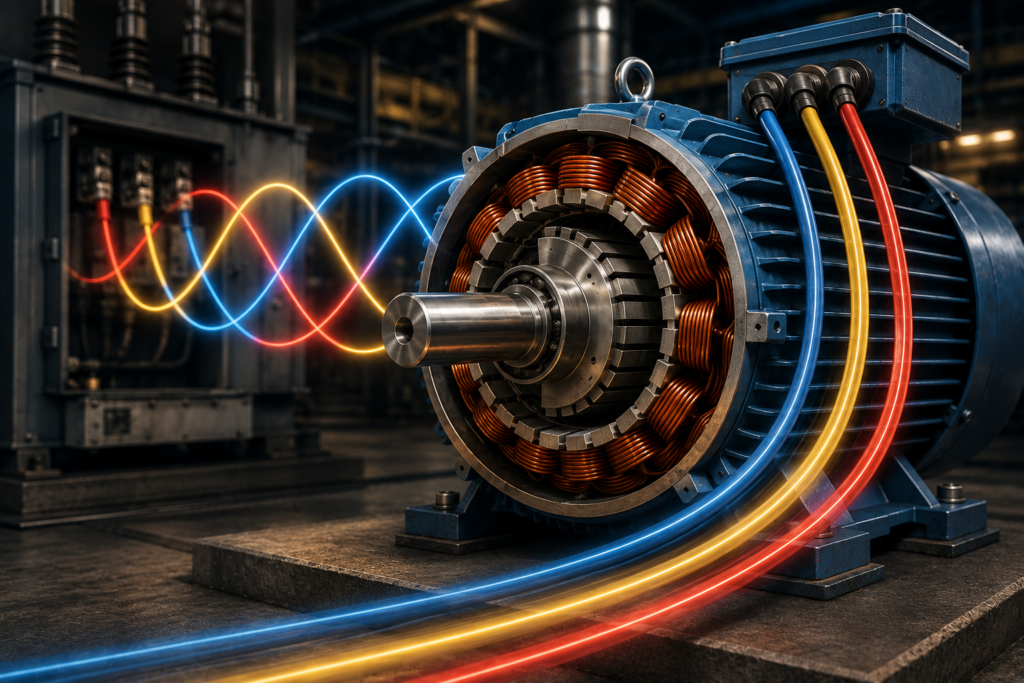
Walk through almost any factory and you’ll notice the same pattern.
Small lamps, hand tools, office equipment, and ordinary sockets may use single-phase power. The large pumps, compressors, conveyors, ventilation fans, and production machines, however, are usually driven by three-phase motors.
That is not just an industrial habit left over from another era.
Three-phase power is particularly well suited to large electric motors because it naturally creates a rotating magnetic field, delivers power more smoothly, carries more power with less current, and allows motors to be built efficiently without complicated starting arrangements.
A three-phase motor is not automatically superior in every possible situation. For a tiny desk fan or domestic appliance, single-phase power may be simpler and perfectly adequate.
Once motor power starts climbing, though, three-phase becomes difficult to beat.
What Is Three-Phase Power?
A three-phase supply contains three alternating voltages.
Each phase follows the same sinusoidal pattern, but the phases do not reach their peaks at the same moment. They are separated from one another by 120 electrical degrees.
They are commonly identified as:
- L1, L2, and L3
- Phase A, Phase B, and Phase C
- R, S, and T
The names vary. The principle does not.
When the voltage on the first phase is near its positive peak, the other two phases are at different points in their cycles. A moment later, the second phase takes the lead, then the third, and the sequence repeats continuously.
On a 50 Hz supply, the full electrical pattern repeats 50 times every second. On a 60 Hz supply, it repeats 60 times every second.
This carefully spaced timing is what gives three-phase power its most important motor-related advantage: it can create a magnetic field that actually rotates.
Three-Phase Windings Are Arranged Around the Stator
Inside a three-phase AC motor, the stator contains three groups of windings.
These winding groups are positioned around the stator so that their magnetic axes are separated in space. When the three-phase supply is connected, each winding produces a magnetic field that rises and falls with its phase current.
One winding’s field grows while another weakens. Then the next phase takes over, followed by the third.
The individual magnetic fields combine.
Instead of producing one field that merely becomes stronger, weaker, and then reverses, the combined field moves around the stator.
It rotates smoothly.
The rotor sits inside this rotating field. In an induction motor, the moving magnetic flux cuts across the rotor conductors and induces voltage in them. Because the rotor bars form a closed circuit, current flows and creates a second magnetic field.
The interaction between the stator field and rotor field produces torque.
The rotor begins following the rotating magnetic field, although it remains slightly slower than the field during normal operation. That speed difference is called slip.
No brushes are required in a standard squirrel-cage induction motor. No separate electrical connection is needed between the power supply and rotor.
The rotating stator field does the work across the air gap.
Three-Phase Motors Are Naturally Self-Starting
A balanced three-phase supply creates a rotating magnetic field as soon as the stator windings are energised.
That gives the motor a clear starting direction.
The rotor does not need to guess which way to turn, and the motor does not require a separate starting winding simply to create initial torque.
This is a major difference from a basic single-phase induction motor.
A single-phase supply applied to one stator winding creates a magnetic field that pulses back and forth. It does not naturally produce a continuously rotating field at standstill.
In theory, a stationary single-phase induction motor has no preferred direction of rotation. The forward and reverse magnetic effects balance each other.
That is why many single-phase motors need additional starting components, such as:
- A start winding
- A run winding
- A start capacitor
- A run capacitor
- A centrifugal switch
- An electronic starting circuit
- A shaded pole
These methods create a temporary phase shift that gives the rotor an initial push.
They work, but they add components, cost, and potential failure points.
A three-phase motor normally starts from the natural phase sequence of the supply. Swap any two incoming phases and the rotating field reverses, causing the motor to run in the opposite direction.
Simple. Effective. Very industrial.
The Rotating Field Is More Uniform
The magnetic field in an ideal balanced three-phase motor maintains a relatively constant magnitude while rotating around the stator.
That produces smoother electromagnetic torque.
A single-phase motor, by comparison, experiences more pronounced pulsations in its magnetic field and torque. Even after it has started, the motor effectively relies on interacting forward and backward field components.
The resulting torque is less uniform.
You may notice this as:
- More vibration
- More audible hum
- Rougher starting
- Lower starting torque
- Reduced efficiency
- A larger motor frame for the same useful output
Three-phase motors are not completely free from torque ripple. Slot geometry, harmonics, supply distortion, rotor construction, and variable-frequency drives can all introduce pulsating torque.
Still, the fundamental three-phase system provides a much smoother starting point.
For a large pump or conveyor, that matters.
Smooth torque reduces mechanical shock on couplings, shafts, belts, gearboxes, and the driven machine. It also helps the motor accelerate more predictably.
Three-Phase Power Delivery Is Smoother
The advantage is not limited to the rotating magnetic field.
The total instantaneous power delivered by a balanced three-phase supply is nearly constant.
Each individual phase delivers pulsating power. However, because the phases are separated by 120 degrees, the power variations overlap.
When one phase is delivering less power, the other phases compensate.
Add all three together and the total remains almost steady.
A single-phase AC load behaves differently. Its instantaneous power rises and falls twice during each electrical cycle.
On a 50 Hz supply, this creates power pulsation at 100 Hz. On a 60 Hz supply, the pulsation occurs at 120 Hz.
The average power may be perfectly useful, but the delivery is less uniform.
In a motor, uneven electrical power tends to produce more pulsating torque and mechanical vibration.
Three-phase power feels less like repeatedly pushing a swing and more like applying a steady turning force.
That smoother delivery becomes increasingly valuable as the motor grows larger and the connected machinery becomes heavier.
More Power With Less Current
Three-phase systems can transfer a large amount of power without requiring the very high current that an equivalent single-phase load would demand.
For a balanced three-phase load, electrical input power is approximately:
P = √3 × V × I × power factor
For a motor, mechanical output also depends on efficiency:
Motor output = √3 × V × I × power factor × efficiency
In these formulas:
- P is power
- V is line-to-line voltage
- I is line current
- Power factor describes the relationship between real and apparent power
- Efficiency accounts for losses inside the motor
The square-root-of-three factor—approximately 1.732—is one reason a three-phase system carries more power at a given voltage and line current.
Suppose a motor needs roughly 30 kilowatts of mechanical output.
At the same nominal voltage, power factor, and efficiency, a single-phase version would require approximately 1.73 times as much line current as the three-phase version.
A three-phase motor might draw around 55 amperes in a simplified example, while an equivalent single-phase load could require around 95 amperes.
The exact figures depend on voltage, efficiency, power factor, and motor design. The comparison remains useful.
Lower current makes almost everything easier.
Lower Current Means Lower Cable Losses
Conductors have resistance.
Whenever current flows through them, some electrical energy is converted into heat. These conductor losses are described by:
P loss = I²R
Current is squared.
That small number in the formula causes large consequences.
If current doubles, cable heating does not merely double. It becomes four times greater, assuming the same resistance.
Reducing current therefore provides major benefits:
- Lower cable heating
- Lower voltage drop
- Less wasted energy
- Smaller conductor requirements
- Easier cable installation
- Smaller switchgear and terminals in many cases
Large motors may run for thousands of hours per year. Even modest reductions in distribution losses can become financially significant over the equipment’s lifetime.
The cable is not doing useful mechanical work. Any energy lost heating it is simply an unwanted electricity bill.
Can Three-Phase Power Really Use Smaller Conductors?
Yes, although the comparison needs to be stated carefully.
A three-phase circuit normally uses three phase conductors, while a single-phase circuit uses two current-carrying conductors. At first glance, three wires hardly sound like a material-saving arrangement.
However, each three-phase conductor carries less current for the same transmitted power at the same line voltage.
Because current is lower, each conductor can have a smaller cross-sectional area while maintaining acceptable heating and voltage drop.
For the same transmitted power, conductor material, voltage, and allowable losses, a three-phase system generally requires less total conductor material than an equivalent single-phase system.
A balanced three-phase motor also does not normally require a neutral conductor.
It needs:
- Three phase conductors
- A protective earth conductor
The currents in the three phases balance each other. At every instant, their algebraic sum is approximately zero in an ideal balanced system.
A neutral becomes necessary only when the system design includes loads connected from individual phases to neutral or when other specific conditions require it.
For a standard three-phase motor, three power conductors are enough.
Higher Voltage Reduces Current Further
Industrial three-phase motors commonly operate at higher voltages than small domestic motors.
Depending on the country and installation, typical systems may include:
- 230 V three-phase
- 400 V three-phase
- 460 V three-phase
- 480 V three-phase
- 690 V three-phase
- Medium-voltage systems measured in kilovolts
For the same power, increasing voltage reduces current.
Lower current means smaller conductors and lower distribution losses.
This is one reason very large motors may operate at medium voltage rather than at ordinary low voltage. Supplying several megawatts at 400 V would require enormous current, huge cables, and equally substantial switchgear.
Raise the voltage and the current becomes much more manageable.
Of course, higher voltage requires greater insulation distances, specialised equipment, stricter safety procedures, and more expensive switchgear.
Engineering never hands out free advantages. There is usually an invoice somewhere.
Three-Phase Motors Are Usually More Efficient
Large three-phase motors are generally more efficient than equivalent single-phase motors.
Several factors contribute.
Better use of the stator
The three winding groups create a rotating magnetic field efficiently and use the stator circumference effectively.
The magnetic loading is more uniform than in a comparable single-phase design.
No separate starting circuit
A standard three-phase motor does not need a start capacitor, centrifugal switch, or dedicated starting winding.
Fewer auxiliary components mean fewer losses and fewer parts that can fail.
Smoother torque
Steadier torque reduces vibration and unnecessary mechanical stress.
The motor can convert electrical energy into useful shaft power more consistently.
Lower current for the same power
Reduced current can lower resistive losses in cables, terminals, and switchgear.
Inside the motor, conductor size and winding design can also be optimised more effectively.
Better scalability
Three-phase induction motors work particularly well as power increases.
Manufacturers can build compact, robust machines with high efficiency and strong power density.
Large modern motors can reach very high efficiency levels, especially those designed to premium or super-premium efficiency standards.
That does not mean every three-phase motor is automatically efficient.
A poor-quality, oversized, lightly loaded, damaged, or badly rewound motor may perform terribly. The supply system alone cannot rescue a bad design.
Still, three-phase provides a better foundation.
Three-Phase Motors Can Be Smaller for the Same Output
Because the magnetic field is used more effectively and power delivery is smoother, a three-phase motor can often be smaller and lighter than a single-phase motor producing the same mechanical output.
The exact difference depends on motor type and construction.
In general, three-phase motors offer better:
- Power-to-weight ratio
- Torque-to-size ratio
- Cooling performance
- Winding utilisation
- Mechanical simplicity
A compact motor is easier to install, align, support, and integrate into machinery.
This advantage becomes particularly noticeable above a few kilowatts.
Large single-phase motors certainly exist, but they become less attractive as power rises. Starting currents, capacitors, switching mechanisms, conductor sizes, and supply limitations all begin making life unnecessarily complicated.
At some point, the obvious question becomes: why are we still trying to do this with one phase?
Starting Current Is Still High
Three-phase motors have many advantages, but they do not start without electrical consequences.
When a standard induction motor is connected directly to the supply, it may draw several times its rated current during acceleration.
This is called inrush current or locked-rotor current.
Depending on the motor design, the starting current may be roughly five to eight times the normal full-load current, sometimes more.
A large current surge can cause:
- Voltage dips
- Mechanical shock
- Heating
- Stress on contactors and cables
- Disturbance to other equipment
Large motors may therefore use starting methods such as:
- Star-delta starting
- Autotransformer starting
- Soft starters
- Rotor resistance on wound-rotor motors
- Variable-frequency drives
These methods reduce current, reduce mechanical stress, or provide controlled acceleration.
Three-phase power makes large motors practical. It does not make the laws of starting current disappear.
Variable-Frequency Drives Work Naturally With Three-Phase Motors
A variable-frequency drive, or VFD, controls motor speed by adjusting the frequency and voltage supplied to the motor.
Most industrial VFDs produce a three-phase output.
The drive switches semiconductor devices in a carefully controlled pattern to create three output waveforms separated by 120 electrical degrees.
Changing output frequency changes the rotating magnetic field’s speed.
For an induction motor, synchronous speed is determined by:
Synchronous speed = 120 × frequency ÷ number of poles
A four-pole motor connected to a 50 Hz supply has a synchronous speed of 1,500 revolutions per minute. The actual rotor speed is slightly lower because of slip.
Reduce the VFD output to 25 Hz and the field rotates at roughly half the original speed.
This gives precise control over:
- Pumps
- Fans
- Conveyors
- Mixers
- Compressors
- Machine tools
- Process equipment
A VFD can also provide smooth acceleration, reduced starting current, controlled stopping, and energy savings on variable-torque loads.
Three-phase motors and VFDs fit together rather nicely.
Direction Reversal Is Simple
Reversing a three-phase motor normally requires swapping any two phase conductors.
Changing two phases reverses the phase sequence.
The stator’s rotating magnetic field then turns in the opposite direction, and the rotor follows it.
Motor starters use this principle in reversing circuits. Two contactors are arranged so that one supplies the normal phase order and the other swaps two phases.
Electrical and mechanical interlocking prevents both contactors from closing simultaneously.
With a VFD, direction can be changed electronically through the control system.
The motor itself does not need a special reverse winding or mechanical reversing mechanism.
Three-Phase Systems Balance Large Loads
A large single-phase motor places its entire load between one phase and another conductor.
On a three-phase distribution system, several large single-phase loads can create phase imbalance if they are not carefully distributed.
A three-phase motor draws power from all three phases at the same time.
Under healthy operating conditions, the phase currents are nearly equal. This provides a balanced load to the supply transformer and distribution network.
Balanced operation helps reduce:
- Neutral current
- Uneven voltage drop
- Transformer heating
- Generator stress
- Phase voltage imbalance
Utilities and industrial power systems prefer balanced loads for good reason.
A well-balanced three-phase motor is far friendlier to the network than an equivalent large load concentrated on one phase.
What Happens If One Phase Is Lost?
Three-phase motors depend on all three phases being present.
If one phase disappears while the motor is running, the motor may continue turning on the remaining two phases. This condition is called single phasing.
The motor cannot produce normal balanced torque. Current in the remaining phases rises, and the windings can overheat rapidly.
Symptoms may include:
- Reduced torque
- Increased humming
- Slower speed
- Excessive current
- Vibration
- Overheating
- Failure to restart after stopping
If a motor attempts to start with one phase missing, it may simply hum without rotating while drawing damaging current.
Proper motor protection is therefore essential.
Common protective devices include:
- Overload relays
- Phase-failure relays
- Phase-sequence relays
- Motor-protection circuit breakers
- Electronic motor-management relays
- VFD protection functions
Three-phase power is excellent when all three phases arrive for work.
Two phases trying to cover the shift is not a sustainable arrangement.
Power Factor Still Matters
Induction motors require magnetising current to establish the magnetic field in the air gap.
Part of the supply current therefore does not produce useful mechanical power directly. This contributes to a lagging power factor.
A lightly loaded induction motor may have a particularly poor power factor because it still needs magnetising current even though it is producing little shaft power.
As load increases toward the motor’s rated operating range, the power factor usually improves.
Poor power factor causes higher current for the same real power, increasing:
- Cable losses
- Voltage drop
- Transformer loading
- Generator loading
- Utility demand charges in some installations
Industrial facilities may use capacitor banks, synchronous equipment, or active correction systems to improve overall power factor.
Three-phase power provides efficient delivery, but the motor still needs to be selected and operated sensibly.
Running a huge motor at 15% load all year is not clever just because it has three wires attached.
Why Single-Phase Motors Are Still Used
With all these advantages, why use single-phase motors at all?
Availability and simplicity.
Most homes and small commercial spaces have easy access to single-phase power. Small motors do not consume enough power for the disadvantages to become overwhelming.
Single-phase motors remain common in:
- Domestic fans
- Refrigerators
- Washing machines
- Small pumps
- Air-conditioning units
- Garage equipment
- Small compressors
- Kitchen appliances
For modest power, a capacitor and auxiliary winding may be cheaper than installing a three-phase supply.
Modern electronic drives can also operate small motors efficiently from a single-phase input.
Three-phase begins to dominate when equipment becomes larger, runs for long periods, needs smooth torque, or forms part of an industrial process.
Is Three-Phase Always Cheaper?
Not automatically.
A three-phase installation may require:
- A three-phase utility connection
- More complex distribution equipment
- Three-pole protection devices
- Three-pole contactors
- Appropriate metering
- Skilled installation and maintenance
For one small motor, the infrastructure cost may outweigh the efficiency advantage.
For a factory containing dozens or hundreds of motors, the calculation changes completely.
Lower current, smaller conductors, efficient motors, smoother operation, simpler starting construction, and better load balance quickly justify the system.
Three-phase power is not better merely because it looks more industrial.
It is better when the amount and type of work make its advantages useful.
The Main Advantages of Three-Phase Motors
For large motor applications, three-phase power provides several connected benefits.
A natural rotating magnetic field
The three phase currents create a rotating stator field without needing a separate starting winding.
Smooth torque
Balanced three-phase power produces steadier electromagnetic torque and less vibration.
Nearly constant power delivery
The combined instantaneous power of all three phases remains almost constant under balanced conditions.
Lower current
More power can be delivered at a given line voltage and current than with an equivalent single-phase circuit.
Smaller conductors
Lower current reduces cable cross-sectional requirements, voltage drop, and resistive losses.
Higher efficiency
Three-phase motors generally make better use of magnetic and electrical materials, particularly at larger ratings.
Simple and robust construction
Squirrel-cage motors contain no start capacitor, centrifugal switch, brushes, or commutator.
Easy reversal and speed control
Motor direction can be reversed by changing phase sequence, while VFDs provide efficient electronic speed control.
The Main Point
Three-phase power is better suited to large motors because the three currents naturally create a rotating magnetic field.
That rotating field starts the motor, establishes a clear direction, and produces smoother torque than a basic single-phase supply.
At the same time, three-phase systems deliver nearly constant power and transfer large amounts of energy with lower line current. Lower current means smaller conductors, reduced voltage drop, and lower cable losses.
The motors themselves can be compact, efficient, mechanically simple, and extremely reliable.
That is why factories do not normally run a 200-kilowatt compressor from a giant single-phase capacitor motor.
Technically, engineers can make many unusual things work.
The more useful question is whether they should.