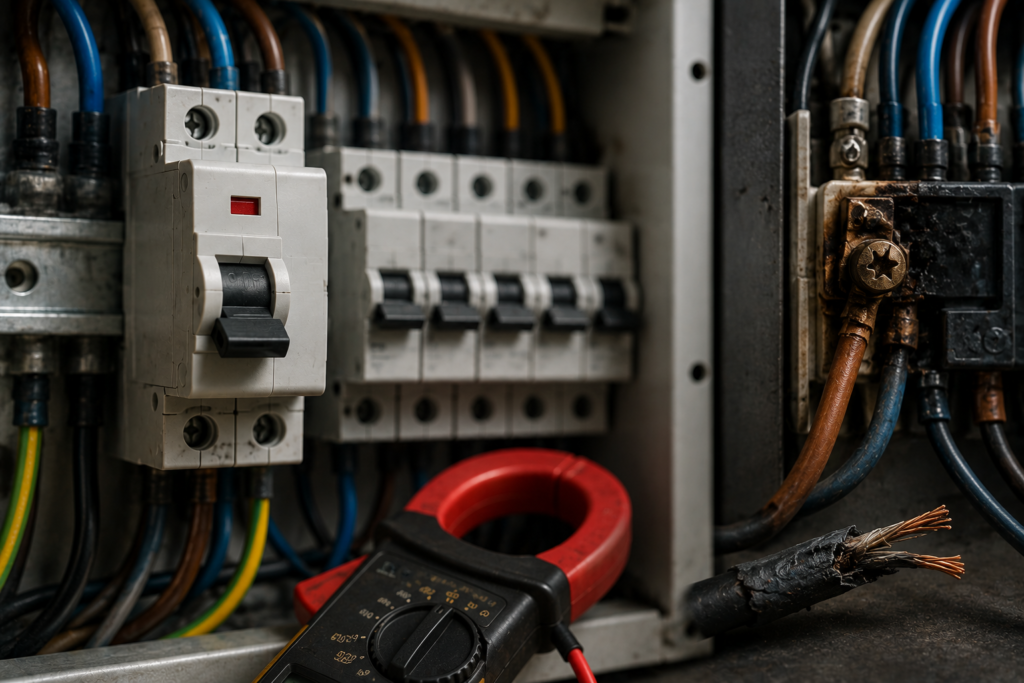
You’re sitting at home, everything seems normal, and then—click.
The lights go out. The television dies. Maybe the washing machine stops halfway through a cycle. You walk over to the electrical panel, find a tripped circuit breaker, reset it, and everything starts working again as though nothing happened.
No smoke. No burning smell. No obvious short circuit.
So why did it trip?
The slightly frustrating answer is that something probably did go wrong, but it happened too quickly, too quietly, or too gradually for you to notice. A circuit breaker doesn’t need dramatic sparks flying out of a socket to react. It may trip because of a short burst of high current, heat slowly accumulating inside the panel, a loose terminal, damaged insulation, or even a tiny amount of current escaping where it shouldn’t.
Sometimes the breaker itself is simply being overprotective. That happens too.
A Circuit Breaker Reacts to Electricity, Not Appearances
Electrical faults are not always visible.
A cable may look perfectly fine on the outside while the insulation inside an appliance is beginning to crack. A connection behind a socket may be loose. A motor may briefly pull several times its normal operating current when it starts. None of this necessarily produces an obvious warning for the person standing in the room.
The breaker, however, sees the current.
More accurately, different protective devices react to different things:
- A standard circuit breaker usually reacts to excessive current.
- An RCD or GFCI reacts to current leaking to earth or ground.
- An RCBO combines overcurrent and leakage protection in one device.
- An arc-fault breaker may react to electrical arcing patterns.
This distinction matters. People often say “the breaker keeps tripping,” even when the device that tripped was actually an RCD or another type of protective switch.
The cause depends heavily on which device moved to the off position.
Inrush Current: The Appliance Starts Too Aggressively
Some electrical equipment uses much more current during startup than it does during normal operation.
Motors are a classic example. Refrigerators, air conditioners, pumps, compressors, power tools and washing machines can all draw a brief surge of current when they start. Transformers and certain LED power supplies can do something similar.
This temporary surge is called inrush current.
Imagine trying to push a heavy trolley. Keeping it moving isn’t too difficult, but getting it moving from a complete stop requires a much harder shove. Electric motors behave in a vaguely similar way. Once the motor is spinning, the current settles down. During the first fraction of a second, though, it may be considerably higher.
Normally, circuit breakers are designed to tolerate short startup surges. Their trip curves allow brief overcurrents without immediately cutting power.
Problems arise when:
- several appliances start at the same time;
- the circuit is already heavily loaded;
- the motor is struggling mechanically;
- the appliance has an aging capacitor;
- the breaker rating or trip characteristic is unsuitable;
- the breaker has become overly sensitive with age.
For example, a refrigerator compressor may start at the exact moment a vacuum cleaner or water pump is switched on. Each appliance may be acceptable by itself, but their combined startup current can push the circuit beyond the breaker’s limit.
From your perspective, nothing unusual happened. You simply switched something on.
From the breaker’s perspective, the current suddenly jumped far above normal.
Heat Buildup: The Circuit Was Overloaded for Longer Than You Realized
Not every overload causes an instant trip.
Many standard circuit breakers contain a thermal element that responds to heat. If the current stays moderately above the breaker’s rating, a metal strip inside the device gradually warms and bends until the mechanism trips.
That delay is intentional.
A small temporary overload may be harmless. A continuous overload is not. The breaker waits to see whether the condition disappears, and if it doesn’t, the circuit is disconnected before the wiring becomes dangerously hot.
This can make a trip feel completely random.
Suppose several heaters, kitchen appliances or power-hungry devices are running on the same circuit. Nothing happens immediately. Twenty minutes later, the breaker trips. By then you may have forgotten which appliance was switched on first.
Ambient temperature also matters. A breaker inside a warm, crowded distribution panel may trip sooner than the same breaker in cooler conditions. Heat from neighbouring breakers can contribute as well, especially when several circuits are heavily loaded at once.
Then there are extension leads and power strips—the usual suspects.
Plugging several high-power appliances into one strip does not create additional electrical capacity. It merely gives you more places to overload the same circuit. A kettle, toaster and portable heater may look innocent sitting beside one another, but electrically they can be a rather greedy trio.
Loose Connections Can Create Heat Without Drawing Huge Current
A loose connection is one of the more worrying possibilities because it may not cause a clean, obvious short circuit.
Loose terminals can occur in sockets, switches, junction boxes, appliance plugs or the electrical panel itself. When a connection is not tight, its resistance increases. Current passing through that resistance produces heat.
The total circuit current may not look wildly excessive, yet one small connection point can become extremely hot.
In some cases, the heat affects the breaker or nearby wiring and causes a trip. In others, the loose connection produces intermittent arcing. The circuit may work normally for hours and then suddenly fail when vibration, temperature or movement changes the contact.
Possible clues include:
- a socket or plug that feels unusually warm;
- buzzing or crackling noises;
- flickering lights;
- a burning-plastic smell;
- brown marks around a socket;
- power cutting out when a plug is moved.
Do not ignore these signs. A loose electrical connection can become a fire hazard even when the breaker does not trip consistently.
Also, don’t tighten terminals inside a live electrical panel unless you are properly trained and authorised to do so. That isn’t a casual Sunday-afternoon repair.
Earth Leakage: Current Is Escaping Somewhere
If an RCD, GFCI or RCBO trips, the problem may not be excessive load current at all.
These devices compare the current flowing out through the live conductor with the current returning through the neutral conductor. Under normal conditions, the values should be almost identical.
If some current escapes through earth, a metal appliance enclosure, damp material or a person, the returning current becomes slightly lower. The protective device detects the imbalance and disconnects the circuit.
The leakage can be tiny—often measured in milliamps.
That is why an RCD may trip even though the connected appliances are nowhere near the circuit’s normal current limit.
Common causes include:
- moisture inside outdoor sockets or equipment;
- water entering a washing machine or dishwasher component;
- deteriorating heating elements;
- damaged appliance filters;
- long cable runs with natural leakage;
- multiple electronic devices whose small leakages add together;
- faulty extension leads;
- insulation breakdown.
Modern appliances often contain interference-suppression components that allow a very small amount of current to flow toward earth. One device usually causes no problem. Ten or fifteen devices on the same RCD may collectively approach its trip threshold.
Then one more appliance starts, and click—the entire group goes dark.
Nothing is necessarily catastrophically broken. The combined leakage has simply become too high.
Damaged Insulation May Only Fail Occasionally
Electrical insulation does not always fail completely in one dramatic moment.
It can weaken gradually due to:
- age;
- heat;
- vibration;
- moisture;
- ultraviolet exposure;
- rodents;
- sharp metal edges;
- repeated bending;
- poor installation.
A cable may work normally while dry but begin leaking current during humid weather. An appliance lead may only fault when it is bent in a particular direction. A heating element may develop leakage only after it becomes hot.
This explains why some breakers trip during seemingly unrelated situations.
Perhaps the dishwasher runs for ten minutes before tripping because the faulty heater is only energised later in the programme. Maybe an outdoor circuit trips after rain. Possibly a power tool works until the cable is moved.
Intermittent faults can be maddening because the system behaves normally during inspection. The fault hides, waits, and then reappears at the least convenient moment—usually when you’ve just convinced yourself that the problem has gone away.
It hasn’t, probably.
The Breaker May Be Doing Its Job Correctly
People sometimes describe a trip as “nuisance tripping” simply because the reason is not obvious.
But an unexplained trip should not automatically be dismissed as a defective breaker.
A protective device may be reacting correctly to a problem that has not yet produced visible damage. In that sense, the trip is not a nuisance. It is an early warning.
Repeatedly resetting the breaker without investigating the cause is a bad habit. If it trips again, especially immediately, leave it off until the fault is identified.
A breaker that trips once during an unusual combination of appliances may not indicate a serious defect. A breaker that trips repeatedly, becomes hot, makes noise or refuses to remain switched on deserves proper attention.
Genuine Nuisance Tripping Does Happen
Circuit breakers and RCDs are mechanical and electrical devices. They can age, wear out or become unsuitable for a particular application.
A breaker may trip unnecessarily because of:
- internal wear;
- heat damage;
- poor-quality construction;
- incorrect rating;
- the wrong trip curve;
- electrical interference;
- excessive combined leakage;
- a neutral-to-earth connection downstream;
- incorrect wiring;
- sensitive electronics interacting badly with the protection device.
For motor circuits, the breaker’s operating curve must tolerate the expected startup current while still protecting the cable. Choosing a larger breaker simply to stop it tripping is not a safe shortcut. The cable size, installation method, fault current and disconnection requirements all have to be considered.
Similarly, replacing an RCD with a less sensitive unit because “the old one kept tripping” may remove an important layer of shock protection without fixing the actual leakage fault.
The protection must match the circuit. Not the owner’s patience.
How to Narrow Down the Cause
A basic process of elimination may help identify which appliance or circuit triggers the problem.
First, note exactly which protective device tripped. Was it one small circuit breaker, an RCD protecting several circuits, or the main breaker?
Next, disconnect appliances on the affected circuit. Reset the protection device, then reconnect appliances one at a time. Pay attention to equipment containing motors, heaters, pumps, compressors or water.
Also consider timing:
- Does it trip immediately after switching something on?
- Does it happen after several minutes?
- Only during rain?
- Only when an appliance heats up?
- Only when several devices operate together?
- At roughly the same time each day?
These details are useful. An immediate trip may suggest a short circuit, major leakage or high inrush current. A delayed trip often points toward overload, temperature buildup or a component that becomes faulty after warming.
However, home troubleshooting has limits. Insulation resistance testing, leakage-current measurement, loop testing and thermal inspection require proper instruments and knowledge.
Guessing only gets you so far.
When You Should Call an Electrician
Professional inspection is advisable when:
- the breaker trips repeatedly;
- it trips immediately after being reset;
- you smell burning;
- sockets, plugs or the panel feel hot;
- lights flicker or buzz;
- the trip happens after rain or in damp areas;
- an RCD will not reset;
- there are signs of damaged wiring;
- you cannot identify the appliance causing the problem.
Stop using any appliance that appears to trigger the trip until it has been checked.
Never hold a breaker in the on position, bypass a protective device or replace it with a higher-rated breaker without confirming that the wiring can safely handle the change. A tripping breaker may be annoying, but burnt wiring behind a wall is considerably more annoying.
The Trip Is Usually a Clue
A circuit breaker rarely trips because it is bored.
It may have detected a startup surge, a long-lasting overload, heat from a loose connection, current leaking to earth or insulation beginning to fail. The fault might be brief and invisible, but that does not make it harmless.
Occasional nuisance tripping is possible, especially with aging equipment or poorly matched protective devices. Still, the safest assumption is that the breaker has noticed something worth investigating.
Resetting it once may restore power.
Understanding why it tripped is what keeps the problem from becoming something worse.