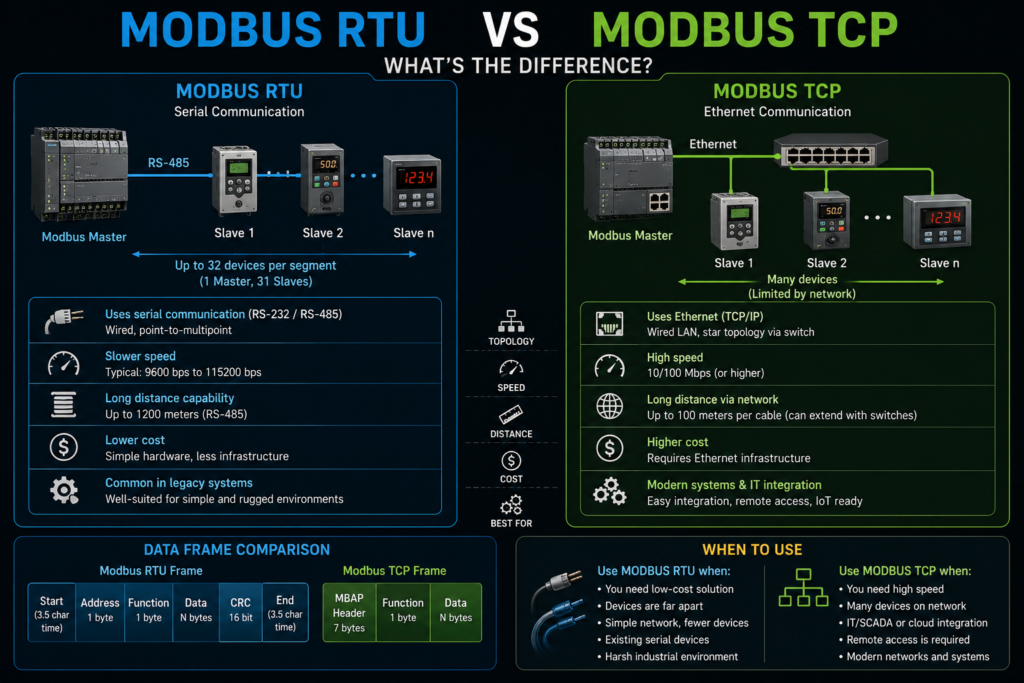
Same protocol. Same register map. Same function codes you already know. But one runs over a two-wire serial cable snaking through a panel, and the other runs over the same Ethernet network as your office printer. And somehow they’re both “Modbus.”
If you’re wiring up a sensor, a drive, or a power meter and the datasheet offers both, the natural question is: which one, and does it even matter? It does — but maybe not for the reasons you’d guess. Let me lay out what actually separates Modbus RTU from Modbus TCP, where each belongs, and how to choose.
Good news up front: if you understand one, you’re most of the way to understanding the other. They share the same DNA. The differences are almost entirely about how the message travels, not what the message says.
Start with what they share
Modbus is ancient by tech standards — it dates to 1979, born at Modicon for talking to PLCs — and that longevity is exactly why it’s everywhere. It’s dead simple, openly published, and royalty-free, so practically every industrial device speaks it.
At its heart, Modbus is a request/response protocol built on a client/server model (you’ll still hear the old “master/slave” terms constantly in the field). One device — the client — asks; the other — the server — answers. The client says “give me the value in holding register 40001” or “set coil 5 on,” and the server does it and replies. Servers never speak unless spoken to.
The content of those requests is identical across RTU and TCP. Same function codes (read holding registers, read input registers, write single coil, write multiple registers, and so on). Same data model of coils, discrete inputs, input registers, and holding registers. Same register addressing. So the core “language” you learn transfers completely between the two.
What differs is the envelope the message rides in. That’s the whole story. Everything below flows from RTU using a serial envelope and TCP using an Ethernet envelope.
Modbus RTU: the serial original
Modbus RTU is the classic. It runs over serial — almost always RS-485 (occasionally RS-232 for a single point-to-point link), a rugged two- or four-wire electrical standard built for industrial distances and noise.
The defining feature of RTU is that it’s a multidrop bus. You can wire many devices onto the same pair of wires — a single RS-485 line daisy-chained from device to device to device. Because they all share one set of conductors, every device needs a unique slave address (typically 1–247) so the client knows who it’s talking to and who should answer. The request carries the address; only the matching device responds; everyone else ignores it.
And because there’s only one shared wire, only one device can talk at a time. It’s strictly half-duplex — the client sends, then waits, then a server replies, then the line is free for the next transaction. No two devices talk over each other, ever, by design.
RTU wraps each message in a compact binary frame and protects it with a CRC (cyclic redundancy check) — a checksum the receiver recomputes to catch any bits that got corrupted by electrical noise on the way. Frame boundaries are marked by silent gaps on the line (a pause of at least 3.5 character-times), which is how a device knows one message has ended and the next begun.
Characteristics that matter in practice:
- Two wires, many devices. Cheap cabling, and one bus can serve dozens of nodes.
- Long distance. RS-485 comfortably runs up to around 1200 m (1000+ meters) at lower baud rates — far beyond what standard Ethernet does on a single segment.
- Deterministic and simple. One transaction at a time, no network stack, no switches. Easy to reason about.
- Slower. Bound by serial baud rates (9600, 19200, 38400, up to 115200 typically). Fine for a lot of process data, but it’s serial-speed.
- One conversation at a time. The half-duplex bus means transactions queue up; the client polls devices one after another.
- Addressing by slave ID, set with dip switches or in device config.
Modbus TCP: the same protocol over Ethernet
Modbus TCP takes that identical Modbus message and, instead of a serial frame, wraps it in a TCP/IP packet and sends it over standard Ethernet. Same function codes, same registers — riding your regular network infrastructure.
Because it lives on Ethernet, devices are identified by IP address rather than a serial slave ID. The transaction talks to a device at, say, 192.168.1.50 on the standard Modbus TCP port, 502. The switched, full-duplex nature of Ethernet changes the dynamics completely from the shared serial bus.
A few structural differences fall out of the switch to TCP:
The CRC is gone — and that’s fine. RTU needs its CRC because raw serial has no error checking of its own. TCP/IP already guarantees reliable, error-checked, in-order delivery at the transport layer, so Modbus TCP drops the CRC entirely; the network handles integrity. Instead, the message gets a small header (the MBAP header) that adds a transaction identifier, protocol ID, and length. The slave-address byte becomes a “unit identifier,” mostly used when a TCP device also bridges to serial devices behind it (a gateway).
Multiple simultaneous conversations. Full-duplex switched Ethernet means devices aren’t fighting over one shared wire. A client can hold connections to many servers at once, and a capable server can serve multiple clients concurrently. No half-duplex bottleneck.
Characteristics that matter in practice:
- Fast. Ethernet speeds (100 Mbit and up) dwarf serial baud rates. Big data, or lots of it, moves quickly.
- Uses existing network infrastructure. Standard switches, cables, routers — the same plant Ethernet you already have. Easy to integrate with SCADA, historians, and higher-level systems.
- Addressing by IP, which slots naturally into IT-style network management.
- Concurrent transactions, so you can poll many devices without the strict one-at-a-time queue.
- Distance per segment is shorter — standard copper Ethernet tops out around 100 m per run — but switches, fiber, and routing extend the reach and cross network boundaries in ways serial can’t.
- More infrastructure. You need switches and IP management; it’s not just two wires between devices.
The core differences, lined up
Stripping it to essentials:
Physical layer. RTU = serial, usually RS-485 two-wire multidrop. TCP = Ethernet, standard network cabling.
Addressing. RTU = slave ID (1–247). TCP = IP address (plus port 502, plus a unit ID for gateway cases).
Error checking. RTU = CRC in the message, because serial has none. TCP = handled by TCP/IP itself, so no CRC in the Modbus payload.
Duplex / concurrency. RTU = half-duplex, one transaction at a time on the shared bus. TCP = full-duplex, multiple simultaneous connections.
Speed. RTU = serial baud rates (slow-ish). TCP = Ethernet speeds (fast).
Distance. RTU = long on a single serial run (~1200 m). TCP = ~100 m per copper segment, but extensible via switches/fiber/routing.
Cost and infrastructure. RTU = cheap, minimal — two wires, no network gear. TCP = needs Ethernet infrastructure but reuses what’s often already there.
Same everything else. Function codes, register model, request/response behavior — identical.
So which do you use?
The honest answer is that it depends on your situation, but here are the patterns that usually decide it.
Lean toward Modbus RTU when:
- You’re connecting simple field devices — sensors, meters, drives — over modest distances, and cost matters. Two wires and no switches is hard to beat.
- The devices are spread out physically and you need the long serial reach.
- You’ve got a bunch of low-bandwidth devices and daisy-chaining them onto one bus is tidy and economical.
- The equipment simply is RS-485 (a lot of field instruments still are).
Lean toward Modbus TCP when:
- You need speed, or you’re moving a lot of data.
- You want to integrate with SCADA, MES, historians, or anything up the stack — TCP drops straight onto the network those systems already live on.
- You’re polling many devices and the concurrency of Ethernet helps.
- You already have Ethernet infrastructure in place and want everything on one network.
- You need to cross network segments or reach across a facility in ways serial can’t route.
And a very common real-world answer: use both, bridged. A Modbus gateway sits between the two worlds — TCP on the plant-network side, RTU on the serial side — letting a modern SCADA system on Ethernet talk to a string of legacy RS-485 devices as if they were on the network. This is where that “unit identifier” in the TCP header earns its keep: it tells the gateway which serial slave the TCP request is meant for. Mixed installations like this are everywhere, because plants accumulate equipment across decades.
One caution worth stating plainly
Neither Modbus flavor has meaningful built-in security — no authentication, no encryption. That was fine in 1979 on an isolated serial link. It is not fine when Modbus TCP puts industrial devices on a routable network. Putting Modbus TCP on a network reachable from the outside is a genuine risk, and it should live on a segmented, protected industrial network — behind firewalls, isolated from IT and the internet — not exposed. RTU’s serial isolation gave it a kind of accidental security by being physically hard to reach; TCP trades that away for connectivity, so the protection has to be designed in at the network level. Worth keeping front of mind on any TCP deployment.
The takeaway
Modbus RTU and Modbus TCP are the same protocol wearing different clothes. The messages — function codes, registers, request/response — are identical. What changes is the transport: RTU rides a cheap, long-reach, one-conversation-at-a-time serial bus addressed by slave ID; TCP rides fast, concurrent, IP-addressed Ethernet that plugs straight into your wider network.
Choose RTU for simple, distributed, cost-sensitive field devices. Choose TCP for speed, data volume, and integration with everything up the stack. And when you’ve got both — which you often will — a gateway bridges them. Learn the shared core once, and you can work fluently in either.
Just don’t forget to lock down the TCP side. That part isn’t 1979 anymore.