A motor starts normally, reaches operating speed and appears to run without trouble. Then, several minutes later, the overload relay trips and stops the machine.
After cooling or resetting, the motor starts again.
A few minutes pass.
Click. It trips once more.
This pattern usually points to a thermal overload condition rather than an immediate short circuit. The motor or overload relay is gradually heating because the current is too high, the phases are unbalanced, the motor cannot cool properly or the protection device is incorrectly configured.
An overload relay is designed to imitate the heating behaviour of a motor. It normally allows temporary starting current, but it trips when excessive current continues long enough to threaten the windings.
The delay is therefore an important clue.
A motor that trips instantly has a different likely fault from one that runs for ten minutes before stopping.
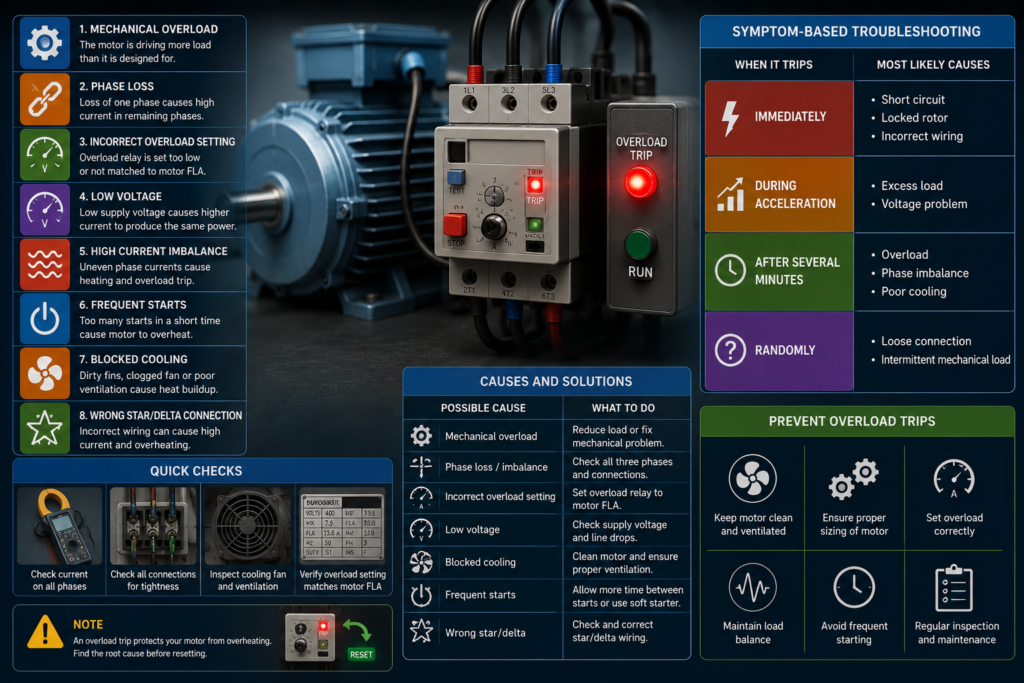
Quick Symptom-Based Troubleshooting Table
| When it trips | Most likely causes |
|---|---|
| Immediately | Short circuit, locked rotor, severe phase loss or incorrect wiring |
| During acceleration | Excess mechanical load, low voltage, long acceleration or voltage problem |
| After several minutes | Mechanical overload, phase imbalance, incorrect overload setting or poor cooling |
| Randomly | Loose connection, intermittent phase loss, changing mechanical load or damaged cable |
This table gives you a starting point, not a final diagnosis. Always check the actual motor current, voltage and mechanical condition before resetting the overload.
What Does a Motor Overload Relay Do?
A motor overload relay protects the motor against sustained excessive current.
It does not normally replace short-circuit protection. Fuses or a circuit breaker handle large fault currents, while the overload relay protects against slower heating caused by conditions such as:
- excessive mechanical load;
- phase loss;
- low voltage;
- frequent starts;
- incorrect settings;
- poor motor cooling.
When current passes through the overload relay, its thermal elements or electronic measuring circuit estimate how quickly the motor is heating.
A short current surge during startup is expected. The relay allows it for a limited time.
If elevated current continues, the calculated temperature rises until the relay trips.
That is why a delayed trip often means the motor has been carrying too much current for too long.
Why the Motor Can Look Normal Before It Trips
A motor does not need to stop rotating to be overloaded.
It may continue running while drawing 10%, 20% or even more current than its rated value. From across the room, everything can appear normal.
Inside the motor, however, the windings are producing excess heat.
Motor heating is strongly related to current. Copper losses rise approximately with the square of current:Pcopper=I2R
If current rises by 20%, winding losses do not rise by only 20%.
They increase by approximately:1.22=1.44
That is about 44% more copper loss.
The motor may therefore heat much faster even though the measured current does not appear dramatically above the nameplate value.
1. Mechanical Overload
Mechanical overload is one of the most common reasons a motor overload trips after several minutes.
The motor is being asked to produce more torque than it can supply continuously. More torque generally requires more current, and the overload relay eventually reacts to the resulting heat.
Possible mechanical causes include:
- overloaded conveyor;
- blocked pump;
- closed or restricted valve;
- jammed material;
- overtightened belt;
- damaged gearbox;
- seized or worn bearings;
- misaligned coupling;
- product buildup;
- incorrect machine adjustment.
Typical symptoms
- Motor starts but accelerates slowly.
- Current remains above the nameplate value.
- Motor or gearbox becomes unusually hot.
- The machine sounds strained.
- The overload trips faster when the process is fully loaded.
- The motor runs normally when disconnected from the driven equipment.
How to check it
Place the machine in a safe condition and inspect the load.
Check whether:
- the shaft rotates freely;
- bearings are smooth;
- belts are correctly tensioned;
- the gearbox has sufficient lubrication;
- the conveyor or pump is obstructed;
- the process load exceeds its normal level.
Measure motor current under real operating conditions. Checking an unloaded motor does not reveal what happens when the machine begins doing actual work.
2. Phase Loss
Phase loss occurs when one phase of a three-phase supply is lost.
The motor may fail to start, or it may continue running on the remaining two phases if it was already rotating. This condition is commonly called single phasing.
The remaining phases then carry increased current, causing rapid overheating.
Possible causes include:
- blown fuse;
- damaged contactor pole;
- loose terminal;
- broken conductor;
- faulty isolator;
- burned overload-relay contact;
- damaged cable;
- supply failure upstream.
Why it may trip after a delay
If the motor is already running when one phase disappears, it may continue turning. The current in the remaining phases rises, but the motor does not necessarily stop immediately.
The overload relay then heats and trips after a short delay.
Warning signs
- One phase current is near zero.
- The other phase currents are unusually high.
- Motor torque drops.
- The motor hums or vibrates.
- Starting becomes difficult.
- The contactor or terminal block shows discoloration.
- The trip occurs randomly as a loose connection opens and closes.
How to check it
Measure all three phase-to-phase voltages and all three motor currents.
Do not assume that correct voltage on the incoming side of a contactor proves that all three phases reach the motor. Check the complete power path where safe and permitted.
Inspect:
- fuses;
- contactor contacts;
- overload terminals;
- motor terminals;
- cable joints;
- isolators.
A contactor can pull in normally while one burned main contact fails to conduct.
3. Incorrect Overload Setting
The overload relay must be adjusted to suit the motor and its connection.
If the setting is too low, a healthy motor may trip during normal operation.
If the setting is too high, the motor may overheat without receiving proper protection.
The correct setting is usually based on the motor’s rated current shown on its nameplate, but the exact value can depend on:
- star or delta connection;
- overload-relay location;
- motor service factor;
- ambient temperature;
- starting method;
- manufacturer instructions;
- applicable electrical standards.
Common setting mistakes
- Relay set below motor nameplate current.
- Setting copied from the previous motor.
- Kilowatt rating used instead of rated current.
- Star-connected current confused with delta-connected current.
- Relay selected with the wrong current range.
- Electronic overload configured for the wrong trip class.
- Setting increased to stop nuisance trips without investigating the cause.
What to check
Compare:
- Motor nameplate current.
- Actual motor connection.
- Overload-relay setting.
- Measured operating current.
- Relay trip class and application.
Do not simply turn the overload dial higher.
The trip may be warning you that the motor is genuinely overloaded. Raising the setting could replace an annoying stop with a burned winding.
4. Low Supply Voltage
Low voltage can cause a motor to draw higher current when trying to produce the torque required by its load.
The relationship is not always as simple as “lower voltage always means higher current” under every operating condition, but for a heavily loaded induction motor, insufficient voltage often results in increased slip, reduced torque capability and excessive current.
Possible causes include:
- undersized supply cables;
- long cable runs;
- overloaded transformer;
- loose terminals;
- voltage drop across damaged contacts;
- weak generator supply;
- incorrect transformer tap;
- excessive plant load;
- undersized extension or temporary wiring.
Typical symptoms
- Motor accelerates slowly.
- Current rises as load is applied.
- Contactor chatters.
- Voltage drops significantly during startup.
- Several machines show problems at the same time.
- The fault is worse during peak production hours.
How to check it
Measure voltage:
- before starting;
- during acceleration;
- while the motor is fully loaded;
- at the motor terminals where safe;
- on all three phase combinations.
A voltage reading taken while the machine is stopped may appear perfect. The useful measurement is often the one captured while the motor is under load.
5. High Current Imbalance
The three phase currents should normally be reasonably balanced.
A significant difference between phase currents causes uneven heating in the motor windings. Even a relatively modest voltage imbalance can produce a much greater current imbalance.
Possible causes include:
- unequal phase voltages;
- loose terminal;
- damaged contactor contact;
- winding fault;
- poor cable connection;
- phase loss beginning intermittently;
- internal motor asymmetry;
- unbalanced supply.
Example
Suppose the measured currents are:
- L1: 8.2 A
- L2: 8.4 A
- L3: 11.1 A
The average current is:38.2+8.4+11.1=9.23 A
The largest deviation from the average is:11.1−9.23=1.87 A
The approximate current imbalance is:9.231.87×100≈20.3%
That is substantial and requires investigation.
Do not judge the motor only by the average current. One winding may be carrying far more current than the others.
What to inspect
- Phase-to-phase voltage balance.
- Contactor contacts.
- Fuse resistance and condition.
- Terminal tightness.
- Motor cable.
- Motor winding resistance.
- Insulation condition.
If the high-current phase changes when two supply phases are swapped, the problem may be upstream. If it remains associated with the same motor winding, the motor or its cable becomes more suspicious.
Testing should be performed only by qualified personnel using appropriate procedures.
6. Frequent Starts
Starting current can be several times higher than normal running current.
The overload relay allows this current for a limited time, but repeated starts do not give the motor enough time to cool.
Applications at risk include:
- compressors;
- pumps with unstable level control;
- conveyors repeatedly starting and stopping;
- machines with short production cycles;
- poorly tuned pressure systems;
- motors controlled by rapidly switching sensors.
Why the trip is delayed
Each start adds heat.
The motor may survive the first few cycles, but its temperature gradually rises. Eventually, another ordinary start pushes the thermal model beyond its trip threshold.
Check for
- excessive starts per hour;
- short cycling;
- unstable pressure or level switches;
- contactor chatter;
- repeated automatic reset commands;
- unnecessarily short stop periods;
- motor not reaching full speed before stopping again.
Compare the actual starting frequency with the motor and starter manufacturer’s permitted duty.
A motor rated for continuous operation is not necessarily rated for continuous restarting.
7. Blocked or Inadequate Cooling
A motor can trip on overload even when its current is close to normal if it cannot remove heat effectively.
Common cooling problems include:
- blocked ventilation openings;
- damaged cooling fan;
- missing fan blades;
- fan rotating in the wrong direction;
- dust-covered cooling fins;
- motor installed in a hot enclosure;
- high ambient temperature;
- motor running too slowly from a VFD;
- inadequate clearance around the motor.
VFD-driven motors need special attention
Many standard motors use a shaft-mounted fan.
At low speed, the fan also turns slowly. The motor may still produce substantial torque and current, but its cooling airflow is greatly reduced.
A motor running continuously at low speed may therefore overheat even if the VFD current display does not look extreme.
Possible solutions include:
- separately powered cooling fan;
- larger motor;
- reduced low-speed torque;
- inverter-duty motor;
- direct winding-temperature monitoring.
How to check it
Inspect the motor only after safe isolation.
Check:
- fan condition;
- airflow;
- cooling-fin cleanliness;
- ambient temperature;
- motor surface temperature;
- winding-temperature sensor status;
- operating speed and duty.
Do not cool a repeatedly overloaded motor with a larger fan and assume the problem is solved. Cooling may delay the trip while the mechanical overload remains.
8. Wrong Star/Delta Connection
Incorrect star or delta connection can cause poor torque, excessive current or motor damage.
The correct connection depends on both the supply voltage and the voltage markings on the motor nameplate.
Common examples
A motor marked:
230/400 V Δ/Y
is normally connected:
- delta at 230V;
- star at 400V.
A motor marked:
400/690 V Δ/Y
is normally connected:
- delta at 400V;
- star at 690V.
Therefore, on a 400V supply:
- a 230/400 V motor is normally connected in star;
- a 400/690 V motor is normally connected in delta.
Always confirm the actual nameplate and manufacturer documentation.
What happens with the wrong connection?
If a motor that should run in delta is left in star, each winding receives less voltage. The motor may develop insufficient torque, accelerate slowly and draw abnormal current when heavily loaded.
If a motor intended for star at the available supply voltage is connected in delta, each winding may receive excessive voltage. Current can rise dramatically, and the motor may overheat or trip very quickly.
Star-delta starters
In a star-delta starter, the motor begins in star to reduce starting current and later changes to delta for normal operation.
Problems can occur when:
- the transition timer is incorrect;
- the delta contactor does not close;
- the star contactor remains engaged;
- interlocking fails;
- phase wiring is incorrect;
- the motor is unsuitable for star-delta operation at the supply voltage.
If the motor remains in star, it may run with reduced torque and eventually overload under normal mechanical load.
If star and delta contactors close together, the result can be a severe short circuit rather than a delayed overload.
Why Trip Class Matters
Motor overload relays are available with different trip characteristics.
A trip class indicates approximately how long the overload allows a specified overcurrent before tripping.
Common classes include:
- Class 10;
- Class 20;
- Class 30.
A standard motor that accelerates quickly may use a faster class. A high-inertia load with a long normal starting time may require a slower characteristic, provided the motor can safely tolerate it.
Selecting a slower trip class merely to prevent trips can leave the motor insufficiently protected.
The correct class depends on:
- motor thermal capability;
- acceleration time;
- starting current;
- load inertia;
- starting frequency;
- manufacturer recommendations.
Why It Trips Faster After Being Reset
A motor that trips, resets and then trips again more quickly may still be hot.
Thermal overload devices and electronic thermal models do not necessarily return instantly to a cold state.
The motor windings may also retain considerable heat even if the frame feels only warm.
Repeated resetting can produce this pattern:
- First trip after 15 minutes.
- Second trip after 5 minutes.
- Third trip after 1 minute.
That does not necessarily mean the fault is worsening rapidly. The system may simply never have cooled.
Allow sufficient cooling time and investigate the cause before restarting.
Random Overload Trips
An overload that trips unpredictably is often harder to diagnose.
Possible causes include:
- loose power terminal;
- intermittent phase loss;
- damaged cable moving with the machine;
- variable mechanical load;
- product occasionally jamming;
- failing bearing;
- contactor contact intermittently opening;
- unstable supply voltage;
- changing ambient temperature;
- motor fan stopping occasionally.
Record what the machine was doing immediately before each trip.
Useful information includes:
- motor current;
- process load;
- speed;
- operating time;
- supply voltage;
- ambient temperature;
- number of starts;
- whether other equipment started nearby.
Random-looking faults often follow a pattern that has not yet been recorded.
A Practical Troubleshooting Procedure
Step 1: Record the trip conditions
Before resetting, note:
- how long the motor ran;
- whether it was starting or at full speed;
- process load;
- overload-relay indication;
- motor temperature;
- unusual sound or smell.
Step 2: Check the overload setting
Compare it with the motor nameplate and actual motor connection.
Step 3: Measure all three currents
Measure during:
- startup;
- normal running;
- maximum process load.
Compare each phase with the others and with the motor rating.
Step 4: Measure all three phase voltages
Check for low voltage and imbalance, especially under load.
Step 5: Inspect the mechanical load
Look for binding, jamming, worn bearings, belt problems and gearbox faults.
Step 6: Inspect the complete power circuit
Check:
- fuses;
- circuit breaker;
- contactor;
- overload relay;
- terminals;
- motor cable;
- motor terminal box.
Step 7: Verify star/delta wiring
Compare terminal links and starter wiring with the motor nameplate.
Step 8: Check cooling
Inspect the motor fan, ventilation openings, ambient temperature and low-speed operation.
Step 9: Review starting frequency
Count how often the motor starts and compare this with its allowed duty.
Step 10: Test under real production load
A motor that runs perfectly while uncoupled may still overload as soon as the machine begins processing material.
What Not to Do
Avoid these common responses:
- Do not repeatedly reset the overload.
- Do not increase the overload setting without measuring current.
- Do not install a larger fuse to stop trips.
- Do not assume the overload relay is defective.
- Do not measure only one phase.
- Do not ignore low voltage during startup.
- Do not replace the motor before checking the driven load.
- Do not change star/delta links without reading the nameplate.
- Do not bypass the overload relay.
An overload trip is usually inconvenient because it stopped the motor before the windings were damaged.
Removing that protection does not remove the overload.
It removes the warning.
When the Overload Relay May Be Faulty
Overload relays can fail or become inaccurate, although external problems are more common.
Suspect the relay when:
- measured current is balanced and safely below the correct setting;
- cooling and mechanical load are normal;
- the motor is correctly connected;
- the relay trips from a cold state much earlier than its characteristic suggests;
- one thermal element or current sensor behaves differently;
- terminals show heat damage;
- the relay cannot reset properly.
Before replacing it, confirm:
- correct current range;
- correct trip class;
- ambient compensation;
- wiring through all phases;
- reset mode;
- installation orientation where relevant.
A replacement relay should match the motor and starter application.
Why a Motor Overload Trips After a Few Minutes
A delayed motor overload trip normally means heat is accumulating gradually.
The most common causes are:
- excessive mechanical load;
- phase loss;
- incorrect overload setting;
- low supply voltage;
- current imbalance;
- frequent starting;
- blocked cooling;
- incorrect star/delta connection.
The time of the trip is one of the best diagnostic clues.
An immediate trip points toward a locked rotor, short circuit or serious wiring fault. A trip during acceleration suggests excessive starting demand or low voltage. A trip after several minutes usually points toward sustained overload, imbalance or insufficient cooling.
Do not begin by adjusting the overload relay.
Begin by measuring all three currents and voltages, checking the mechanical load and confirming the motor’s nameplate connection.
The overload relay is rarely tripping because it dislikes production.
It is usually tripping because something is making the motor hotter than it should be.