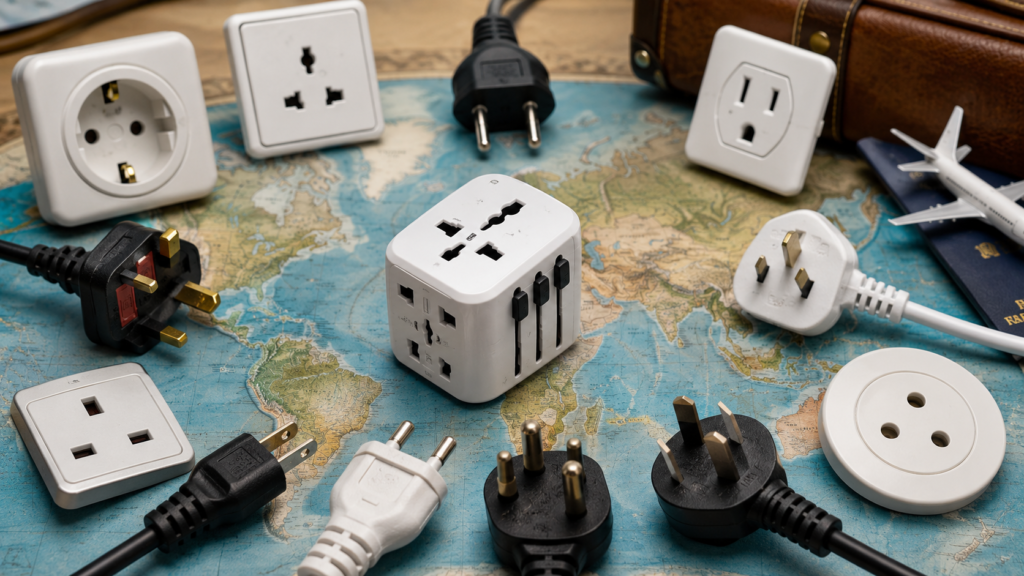
You land in another country, unpack your phone charger and immediately discover that the wall socket seems to have been designed by someone with a personal grudge against travellers.
Two flat pins. Two round pins. Three square pins. Angled pins. Ground contacts on the side. Recessed sockets. Shutters that refuse to open until both pins enter at exactly the same time.
Why?
Electricity works according to the same physical laws everywhere, so why do countries have different plugs?
Mostly because national electrical systems developed independently. Countries built their power networks at different times, chose different voltages and adopted their own ideas about grounding, polarity and shock protection. By the time international travel and global electronics became common, billions of incompatible sockets were already installed.
At that point, agreeing on one plug was the easy part.
Replacing every socket, appliance cord, extension lead, factory outlet and hotel connection was not.
Electrical Plugs Developed Before Global Standardization
Today, it feels natural to expect technology to follow international standards.
USB connectors work across borders. Wi-Fi devices communicate almost anywhere. A laptop can connect to the same websites whether it is in Lithuania, Japan or Brazil.
Early electrical systems developed very differently.
When public electricity networks began spreading through cities, there was no single worldwide organization deciding:
- What voltage should be used
- What frequency generators should produce
- What shape sockets should have
- Whether plugs should be polarized
- How protective earthing should work
- Whether live contacts needed shutters
- How much current a household outlet should carry
Electricity companies, inventors, appliance manufacturers and national regulators made their own choices.
Some systems began with sockets intended mainly for lamps. Others developed around industrial machinery. Certain countries adopted designs influenced by local manufacturers, while neighbouring countries sometimes chose completely different arrangements for technical, commercial or political reasons.
Once a plug system became common, it created momentum.
Homes were wired for it. Factories manufactured it. Appliances were sold with it. Electricians were trained around it. Regulations were written to support it.
Changing direction became increasingly difficult.
Early Electricity Networks Were Local
The first electricity networks were not enormous national grids.
They were often small systems supplying a limited district, industrial site or section of a city. One company might operate a generating station using one voltage, while another company nearby used something else.
Even within the same country, different towns could have different electrical arrangements.
Over time, governments and utilities standardized their domestic systems—but usually at the national or regional level, not globally.
By then, countries had already invested heavily in particular technologies.
Imagine trying to persuade an entire country to replace a plug design that already worked reasonably well.
The technical argument might be strong. The invoice would be stronger.
Voltage Differences Influenced Plug Design
One major difference between national electrical systems is voltage.
Most countries today use a nominal household supply somewhere around either:
- 100–127 volts
- 220–240 volts
Both ranges can power household equipment, but they have different design implications.
For the same amount of power, a lower-voltage appliance needs more current.
Using the basic power formula:
Power = Voltage × CurrentA 1,200-watt heater operating at 120 volts draws approximately:
1,200 W ÷ 120 V = 10 AThe same heater operating at 230 volts draws approximately:
1,200 W ÷ 230 V = 5.2 AHigher current requires suitable conductors, contacts, breakers and connectors.
Plug systems therefore evolved around the expected:
- Supply voltage
- Normal household current
- Appliance power
- Cable size
- Socket construction
- Protection method
This does not mean one plug shape can only ever operate at one voltage. In fact, similar-looking connectors are sometimes used on different systems.
It does mean that plug standards were designed as part of a broader electrical installation, not as decorative plastic pieces added at the end.
Why Some Countries Use About 120 Volts
Countries including the United States and Canada commonly supply household receptacles at approximately 120 volts.
These systems developed from early low-voltage distribution practices and became deeply established before higher-voltage domestic systems became common elsewhere.
A lower voltage can reduce current through the body under otherwise similar contact conditions, although it must never be considered harmless. A 120-volt supply can still cause severe injury or death.
The trade-off is higher current for a given appliance power.
Large appliances such as electric cookers, dryers and air-conditioning equipment may therefore use higher-voltage connections, often supplied from two line conductors.
Why Many Countries Use About 230 Volts
Much of Europe and many other regions use a nominal voltage around 230 volts.
Higher voltage allows the same amount of power to be delivered with less current, reducing conductor losses and allowing powerful household appliances to operate efficiently.
However, the higher line-to-earth voltage increases the importance of:
- Reliable insulation
- Protective earthing
- Correct clearances
- Circuit protection
- Enclosed contacts
- Safe socket construction
Again, neither voltage system is automatically “good” or “bad.”
Both can be operated safely when the complete installation is designed, protected and maintained correctly.
The plug is only one part of that system.
Frequency Is Another Difference
National AC systems also operate at different frequencies.
The most common values are:
- 50 Hz
- 60 Hz
Many modern electronic devices accept either frequency because their power supplies convert incoming AC into DC internally.
Older or simpler equipment may care much more.
Frequency can affect:
- AC motor speed
- Transformer performance
- Electric clocks
- Inductive loads
- Certain timers
- Audio equipment
- Heating and cooling systems
A plug adapter changes the physical connection.
It does not change voltage or frequency.
That small distinction has destroyed more than a few hair dryers.
Earthing Systems Shaped Plug Designs
Protective earthing is one of the biggest reasons plug designs differ.
A protective-earth connection provides a path for fault current when a line conductor touches accessible metalwork. The resulting current should cause a fuse, circuit breaker or other protective device to disconnect the supply.
Different countries developed different ways to include this connection in a plug.
Some plugs use:
- A round earth pin
- A rectangular earth pin
- Side grounding contacts
- A socket earth pin that enters the plug
- Recessed metal contacts
- A combination of pin and side-contact arrangements
The shape is not arbitrary.
It affects:
- Which contact connects first
- Which contact disconnects last
- How much current the connection can carry
- Whether the plug can be inserted in either direction
- Whether ungrounded appliances can use the same socket
- How deeply live contacts are recessed
In many grounded plug designs, the protective-earth connection is made before the line and neutral contacts.
When unplugging, earth remains connected until after the current-carrying contacts begin separating.
That sequencing gives exposed metal equipment an extra layer of protection during connection and disconnection.
Why Some Plugs Have Three Pins
A three-pin plug often contains:
- Line
- Neutral
- Protective earth
The third pin is not there to improve mechanical balance, although it often does that too.
It may also perform another task.
In some socket systems, the earth pin is longer than the current-carrying pins. It can open internal safety shutters before the line and neutral pins enter.
So even an appliance that does not need a protective-earth conductor may use a specially shaped insulated pin or plug body to operate the shutter mechanism.
One piece of plastic, several jobs. Efficient little thing.
Why Some Plugs Have Only Two Pins
Not every appliance requires protective earthing.
Double-insulated equipment is constructed so that accessible parts are separated from live components by reinforced or multiple layers of insulation.
Common examples can include certain:
- Phone chargers
- Televisions
- Hair dryers
- Power tools
- Lamps
- Small kitchen appliances
Because the enclosure is not relying on an earth conductor for protection, the plug may have only line and neutral contacts.
Two-pin plugs are also common in systems where ungrounded sockets historically remained widely installed.
Still, a two-pin plug does not mean every appliance can safely operate without earth.
Metal-bodied equipment designed for protective earthing should never have its earth connection removed merely to fit a different socket.
What Is a Polarized Plug?
A polarized plug is designed so it can be inserted in only one orientation.
One pin may be wider, differently shaped or positioned so that:
- Line connects to the intended line terminal
- Neutral connects to the intended neutral terminal
Why does that matter if alternating current constantly changes direction?
Because line and neutral do not have the same relationship to earth.
Neutral is normally referenced to earth at the supply source. Line remains at the full supply voltage relative to earth.
Inside an appliance, designers may expect:
- A switch to interrupt line rather than neutral
- A fuse to be connected in the line conductor
- The threaded shell of a lamp holder to be connected to neutral
- Certain filters and internal components to follow a defined polarity
If line and neutral are reversed, the appliance may still operate.
That does not mean it is equally safe.
A lamp can switch off while parts of its holder remain connected to line voltage. A fuse placed in neutral may open while energized internal components remain live.
Polarization helps prevent these situations—provided the socket itself is wired correctly.
Why Many European Plugs Are Not Polarized
Several European plug systems allow insertion in either direction.
This means the appliance cannot rely on knowing which pin will be line and which will be neutral.
Equipment designed for these systems must therefore remain safe in either orientation.
Possible design approaches include:
- Double-pole switching
- Double-pole disconnection
- Symmetrical internal construction
- Fusing or protection suitable for either orientation
- Reinforced insulation
- Avoiding accessible components tied closely to one conductor
This is not necessarily less safe.
It is simply a different design philosophy.
A polarized system controls orientation. A non-polarized system requires the appliance to tolerate both orientations safely.
Safety Shutters
Modern sockets in some countries include internal shutters covering the live contacts.
These shutters are intended to reduce the risk of children or other users inserting:
- Nails
- Keys
- Wire
- Screwdrivers
- Other conductive objects
A proper plug opens the shutters by applying force in the correct places.
Depending on the socket design, the shutters may open when:
- Both line and neutral pins enter together
- The earth pin enters first
- A specific pin shape operates an internal mechanism
This is one reason badly designed travel adapters can be dangerous.
A cheap adapter may:
- Open shutters incorrectly
- Expose partially inserted live pins
- Fit loosely
- Lack proper earth continuity
- Accept plugs it cannot safely support
- Allow one pin to become energized before the other is secure
The fact that an adapter physically fits does not prove it is electrically suitable.
A potato can probably be shaped to fit a socket too. That does not make it a standard.
Recessed Sockets and Sleeved Pins
Some plug systems reduce shock risk by recessing the socket contacts.
The current-carrying pins begin contacting live parts only after the plug has entered the recess.
Other systems place insulating sleeves around the base of the pins.
This helps prevent fingers from touching live metal while a plug is partially inserted.
Imagine a plug being pulled halfway out.
Without insulated sleeves or a recessed socket, a portion of the pins may remain energized while exposed.
Safety features evolved differently around the world, but many of them address the same basic danger: accidental contact during insertion and removal.
Why Plug Pins Have Different Shapes
Pin shape is influenced by several considerations:
- Mechanical strength
- Contact pressure
- Manufacturing methods
- Required current
- Socket depth
- Polarization
- Earth sequencing
- Existing national designs
Round pins can provide reliable contact using spring pressure around their surface.
Flat blades are easy to manufacture and can be arranged to create polarization.
Large rectangular pins can be mechanically robust and provide room for substantial contact areas.
No shape is automatically superior in every respect.
Each design is part of a complete standard that includes dimensions, tolerances, current ratings and safety tests.
Copying the rough shape without following the full standard is how poor-quality adapters end up overheating.
Why Some Plugs Contain Fuses
Certain plug systems place a replaceable fuse inside the plug itself.
This can protect the appliance flex when the building circuit is rated for more current than the appliance cable should safely carry.
For example, a ring or radial final circuit may be protected by a relatively high-rated circuit breaker, while a small lamp uses a thin flexible cord.
A correctly selected plug fuse provides more closely matched protection for that cord.
Other countries rely mainly on:
- Branch-circuit breakers
- Appliance protection
- Smaller circuit ratings
- Different wiring arrangements
- Non-replaceable internal fuses
Again, the plug cannot be judged separately from the electrical system around it.
A fused plug makes sense in the installation for which it was designed.
Move it into a completely different wiring philosophy and the advantages may change.
Why One Global Plug Was Never Adopted
The simple answer is timing.
By the time international standardization became realistic, national systems were already too deeply established.
A worldwide conversion would require replacing or adapting:
- Domestic wall sockets
- Commercial outlets
- Factory receptacles
- Appliance cords
- Extension leads
- Power strips
- Hotel wiring
- Medical equipment connections
- Laboratory equipment
- Building regulations
- Testing equipment
- Manufacturing tooling
- Electrician training
- Spare parts
That is not a weekend project.
It would cost enormous amounts of money, create safety risks during the transition and produce years—perhaps decades—of mixed old and new systems.
The Installed Base Is Enormous
Imagine a country with tens of millions of homes.
Each home may contain dozens of sockets, appliances and extension leads.
Even if the government selected a technically excellent new plug standard, people would need adapters during the conversion.
Then questions appear:
- Which sockets should be replaced first?
- Who pays?
- Can old plugs still be sold?
- How long should the transition last?
- What happens in rented homes?
- How are industrial sites handled?
- Should appliances contain two different cords?
- How are counterfeit adapters controlled?
The transition itself could be less safe than leaving the existing system in place.
Standards are sticky. Electrical standards are practically glued to the wall.
Countries Already Had Working Systems
Most established plug systems work adequately when used correctly.
They may differ in:
- Size
- Convenience
- Mechanical strength
- Earthing method
- Reversibility
- Current rating
- Shutter design
- Fuse arrangement
Engineers can debate which is best—and they do, enthusiastically—but replacing a functioning national system requires a much stronger justification than “another plug looks nicer.”
Governments usually prioritize:
- Improving existing safety rules
- Requiring shutters
- Adding residual-current protection
- Updating wiring standards
- Improving product certification
- Removing dangerous legacy sockets
These changes provide safety benefits without forcing an entire nation to replace every connector.
Political and Commercial Factors
Technical standards are never purely technical.
Manufacturers invest in:
- Production equipment
- Patents
- Supply chains
- Testing laboratories
- Certification systems
- Existing product lines
Countries also tend to protect established industries and avoid becoming dependent on another region’s system.
National pride occasionally joins the discussion too.
Nobody likes hearing that their familiar plug—used without trouble for fifty years—is apparently wrong because a committee somewhere else prefers a different shape.
Travel Was Once Less Important
When early plug systems were chosen, ordinary people did not travel internationally with bags full of electronic devices.
There were no:
- Smartphones
- Laptops
- USB chargers
- Digital cameras
- Portable gaming systems
- Electric toothbrush chargers
- International remote workers
Most electrical products stayed in the country where they were sold.
Compatibility across borders was therefore a minor concern.
Today, a traveller may carry six devices requiring power before breakfast. We are dealing with design decisions made for a world that did not anticipate this much luggage.
Modern Electronics Made Voltage Compatibility Easier
Many modern electronic power supplies accept a wide input range, often roughly covering both major voltage systems and both common frequencies.
A laptop charger may state something similar to:
Input: 100–240 V AC, 50/60 HzSuch a charger usually needs only a correctly rated plug adapter when travelling.
The adapter changes the mechanical connection. The charger handles the voltage range internally.
This is not true for every appliance.
Heating devices and simple motors are more likely to be voltage-specific.
Examples include:
- Hair dryers
- Curling irons
- Kettles
- Electric heaters
- Older electric shavers
- Certain fans
- Some kitchen appliances
Connecting a 120-volt appliance directly to 230 volts can cause severe overheating, immediate failure or fire.
Connecting a 230-volt heating appliance to 120 volts may simply make it perform very poorly.
Always read the rating label.
Tiny text. Large consequences.
Plug Adapters Versus Voltage Converters
These products are often confused.
Plug adapter
A plug adapter changes the physical pin arrangement.
It does not normally change:
- Voltage
- Frequency
- Available power
- Earthing arrangement
Voltage converter or transformer
A converter changes the voltage supplied to the appliance.
It must be rated for:
- Input voltage
- Output voltage
- Appliance power
- Duration of operation
- Appliance type
A small travel converter may be suitable for a phone charger but completely unsuitable for a 2,000-watt hair dryer.
Some electronic converters also behave poorly with motors, transformers or sensitive equipment.
The safest option is often to use equipment designed for the local supply rather than carrying a heavy converter around the world.
Earthing Can Be Lost Through Travel Adapters
A three-pin appliance plug may include a protective-earth connection.
Some cheap travel adapters accept the plug mechanically but provide no genuine earth path.
The appliance turns on, so the user assumes everything is fine.
During a fault, however, exposed metalwork may remain energized because the intended protective route is missing.
Before using an adapter with earthed equipment, confirm that it:
- Supports the source plug’s earth contact
- Connects that earth to the destination socket
- Is rated for the required voltage and current
- Fits securely
- Is certified to an appropriate standard
- Does not expose live pins during insertion
A metal-bodied laptop power supply, appliance or test instrument deserves more than the cheapest adapter from an airport basket.
Why Universal Sockets Can Be Problematic
So-called universal sockets are designed to accept many plug types.
Convenient? Certainly.
Potentially troublesome? Also yes.
Poorly designed universal sockets may have:
- Weak contact pressure
- Large openings
- Inadequate shutters
- Loose plug retention
- Poor earth connections
- Small internal contacts
- Unclear current ratings
- Easy access to energized metal
A socket that accepts everything must compromise somewhere.
Good-quality universal outlets can be engineered safely for controlled applications, but unverified products deserve caution.
“Fits every plug” is a marketing claim, not an electrical safety certificate.
Why USB Did Not Solve the Entire Problem
USB charging has reduced the importance of plug differences for small electronics.
Hotels, vehicles and furniture increasingly provide USB outlets, and newer USB power delivery systems can supply phones, tablets and even laptops.
Still, USB does not replace household AC power for:
- Ovens
- Kettles
- Washing machines
- Space heaters
- Air conditioners
- Workshop tools
- Large motors
Even USB chargers require some connection to the local electrical system.
A universal low-voltage charging standard helps at the device end. It does not remove the national wiring system inside the wall.
Could the World Still Adopt One Plug?
Technically, yes.
Practically, a rapid global conversion is extremely unlikely.
A more realistic path is gradual compatibility through:
- Wide-input electronic power supplies
- Replaceable appliance cords
- Standardized equipment connectors
- USB charging
- Safer travel adapters
- Regional harmonization
- Improved product labelling
Some countries have replaced older plug systems or introduced newer standards during major electrical reforms.
It can be done.
It is much easier when:
- The electrical network is still developing
- Few old sockets exist
- A major voltage conversion is already planned
- Strong regulation controls the transition
- The government can coordinate manufacturers and installers
For countries with mature infrastructure, the benefit rarely justifies the disruption.
Common Plug Myths
“Different plugs mean electricity works differently”
The basic physics is the same. The systems differ in voltage, frequency, grounding and safety design.
“A travel adapter makes every appliance compatible”
No. It changes the plug shape, not necessarily the voltage or frequency.
“Two-pin appliances are unsafe”
Not automatically. Properly designed double-insulated equipment may not require protective earth.
“Three-pin plugs are always grounded”
They should be according to their design, but a damaged cord, incorrect adapter or miswired socket can defeat the earth connection.
“Polarized plugs are always safer”
Polarization offers useful safety benefits, but non-polarized systems can also be designed safely by ensuring equipment remains protected in either orientation.
“A worldwide standard was ignored because countries were stubborn”
Stubbornness may have helped a little, but infrastructure cost, historical timing and safety during conversion were the larger obstacles.
The Practical Answer
So, why do countries have different plugs?
Because electrical systems developed locally before global standardization became a serious priority.
Countries adopted different voltages, frequencies, grounding arrangements and safety philosophies. Those choices influenced whether plugs needed earth pins, polarization, shutters, insulated sleeves, recessed sockets or built-in fuses.
By the time international compatibility mattered, enormous numbers of sockets and appliances were already in use.
One global plug could have simplified travel.
But converting every home, hotel, office and factory would cost a fortune and create a messy period where both systems had to coexist.
That is why the world still carries adapters.
Not because engineers could not design one universal plug—but because the best time to agree on it was well over a century ago.
And, as usual, nobody put the meeting in the calendar.