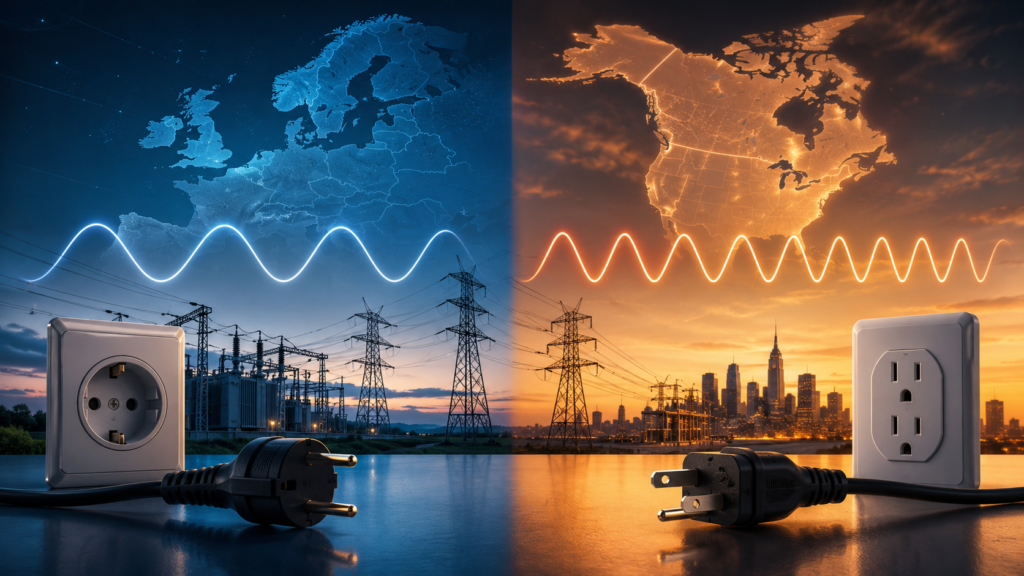
Plug a European motor directly into an American supply and it may run faster. Take certain American transformers to Europe and they may become unusually hot—or fail altogether.
The voltages are part of the story, naturally. But another number printed on the nameplate matters just as much:
50 Hz or 60 Hz.
Most European electricity networks operate at 50 hertz, while the United States, Canada and much of North America use 60 hertz. A hertz is one complete alternating-current cycle per second, so a 50 Hz waveform completes 50 cycles every second and a 60 Hz waveform completes 60.
So, why 50Hz in Europe and 60Hz in America?
Not because engineers proved that one frequency was perfect and the other was hopeless. Both emerged from the messy early years of electrification, when competing companies built isolated networks using their own generators, lamps, transformers and motors.
Once millions of machines were designed around a particular frequency, changing it became extraordinarily expensive.
That old decision still hums inside nearly every transformer and motor connected to the grid today.
What Does 50 Hz or 60 Hz Actually Mean?
Alternating-current voltage continuously changes magnitude and polarity.
At 50 Hz, the electrical waveform completes 50 full cycles every second:
50 cycles per secondAt 60 Hz, it completes:
60 cycles per secondOne cycle takes:
50 Hz: 1 ÷ 50 = 0.020 seconds, or 20 ms
60 Hz: 1 ÷ 60 = 0.0167 seconds, or 16.7 ms
The 60 Hz waveform therefore changes slightly faster.
For a basic heating element, this difference may barely matter. For generators, motors, transformers, clocks and equipment containing magnetic components, it can matter quite a lot.
Frequency affects:
- Generator rotational speed
- AC motor speed
- Transformer magnetic flux
- Motor torque
- Cooling-fan speed
- Electromagnetic vibration
- The timing of frequency-dependent clocks
- The design of inductors and filters
It is not merely another number beside the voltage rating.
Early Power Networks Used Many Different Frequencies
The first public electricity systems were not part of one enormous synchronized grid.
A generating station might supply a factory, a small district or a handful of nearby customers. Another company across town could use an entirely different voltage or frequency.
Early AC installations experimented with frequencies including:
- 25 Hz
- 40 Hz
- 50 Hz
- 60 Hz
- 66⅔ Hz
- 125 Hz
- 133⅓ Hz
Different frequencies suited different equipment.
Higher frequencies could improve the visible performance of early lighting by reducing noticeable flicker. Lower frequencies worked well for certain large motors and power-transmission applications. Unfortunately, a frequency that suited one load did not necessarily suit another.
There was no international committee waiting with one approved answer. Companies made commercial and engineering choices, then built equipment around them.
How 60 Hz Became Established in America
During the early development of AC power, Westinghouse engineers selected 60 Hz as a standard frequency for American systems.
Why 60?
It offered a workable compromise.
The frequency was high enough for acceptable lighting performance, yet low enough for the motors, transformers and generators available at the time. It also allowed practical generator speeds with common pole arrangements.
Once Westinghouse and other major manufacturers produced large amounts of 60 Hz equipment, utilities had a strong reason to follow the same standard.
Standardization meant:
- Generators could operate together
- Utilities could interconnect
- Motors could be sold across wider regions
- Transformers became easier to manufacture
- Replacement equipment became readily available
- Customers were not trapped inside one tiny supplier’s system
The American power system gradually consolidated around 60 Hz.
Some older 25 Hz systems survived for decades in factories, railways and heavy industry. Replacing every motor and generator at once would have been ruinously expensive, so conversion happened slowly.
Electrical infrastructure has a long memory.
How 50 Hz Became Established in Europe
At roughly the same stage of electrical development, the German manufacturer AEG selected 50 Hz for its systems.
That choice spread as European manufacturers supplied generators, transformers and motors across the continent. Countries expanding their networks often adopted equipment based on the established 50 Hz designs already available.
Europe was not immediately unified.
Individual cities and countries continued using a mixture of voltages and frequencies for some time. Gradually, however, the benefits of compatibility pushed most European systems toward 50 Hz.
Once neighbouring networks began connecting, keeping a common frequency became essential. Two ordinary AC grids cannot simply be joined while operating at unrelated frequencies. Their voltage waveforms must be synchronized.
An early manufacturer’s preference therefore grew into a regional standard—and eventually into a rather permanent fact of life.
Was 50 Hz Chosen Because It Is Better?
Not really.
You will occasionally hear tidy explanations such as:
- Europe chose 50 because it is mathematically convenient.
- America chose 60 because Nikola Tesla preferred it.
- One frequency was selected for lighting and the other for motors.
- One side simply wanted to be different.
There may be fragments of truth hiding inside some of these stories, but they oversimplify what happened.
Both frequencies offered practical engineering compromises. Commercial influence, existing equipment, regional manufacturing and the need to connect neighbouring systems mattered enormously.
Had history unfolded slightly differently, either region might have ended up using the other frequency.
Once a standard spreads far enough, technical superiority stops being the main issue.
Compatibility takes over.
Frequency and Generator Speed
An AC generator’s frequency is linked to its rotational speed and number of magnetic poles.
The relationship is:
Synchronous speed = (120 × frequency) ÷ number of polesOr:
n = 120f ÷ PWhere:
nis speed in revolutions per minutefis frequency in hertzPis the number of poles
For a two-pole generator:
50 Hz: (120 × 50) ÷ 2 = 3,000 rpm
60 Hz: (120 × 60) ÷ 2 = 3,600 rpm
For a four-pole generator:
50 Hz: (120 × 50) ÷ 4 = 1,500 rpm
60 Hz: (120 × 60) ÷ 4 = 1,800 rpm
This does not mean every grid generator rotates at 1,500 or 1,800 rpm.
Large hydroelectric generators may have many poles and rotate much more slowly, while steam-turbine generators commonly use high-speed two- or four-pole arrangements.
The pole count allows designers to produce the required frequency at a suitable mechanical speed.
For example, a 100 rpm hydro generator would need many more poles than a 3,000 rpm turbine generator to produce the same 50 Hz output.
The Entire Grid Must Remain Synchronized
Once generators are connected to an AC grid, they cannot each operate at whichever frequency happens to suit them.
They must remain synchronized with the network.
In a 60 Hz system, generation and demand are continually balanced to keep the grid operating close to 60 Hz. If electrical demand becomes greater than the mechanical input from generators and other sources, frequency tends to fall.
If generation exceeds demand, frequency tends to rise.
The same principle applies to Europe’s 50 Hz network.
Frequency is therefore not merely printed on consumer appliances. It reflects the operating speed and balance of an enormous interconnected machine.
Why Motors Run at Different Speeds
The rotating magnetic field inside an AC motor is directly linked to supply frequency.
Using the same synchronous-speed formula, a four-pole motor has a theoretical field speed of:
50 Hz: 1,500 rpm
60 Hz: 1,800 rpm
A two-pole motor has:
50 Hz: 3,000 rpm
60 Hz: 3,600 rpm
An induction motor normally runs slightly below synchronous speed because it needs slip to produce torque.
A four-pole induction motor might therefore have a nameplate speed roughly around:
- 1,450 rpm on 50 Hz
- 1,750 rpm on 60 Hz
The exact figure depends on motor design and load.
This frequency difference can be very noticeable in direct-on-line equipment.
What Happens to a 60 Hz Motor on 50 Hz?
A motor designed for 60 Hz will attempt to run more slowly on 50 Hz.
The synchronous speed falls by:
50 ÷ 60 = 0.833So it becomes approximately 83.3% of the original value—a reduction of about 16.7%.
A machine expected to run near 1,750 rpm may operate somewhere closer to 1,450 rpm, depending on its load and slip.
That can affect:
- Pump flow
- Fan airflow
- Conveyor speed
- Compressor performance
- Machine-cycle timing
- Cooling capacity
- Gearbox output speed
There is another concern: the voltage-to-frequency ratio.
Why the Voltage-to-Frequency Ratio Matters
A motor’s magnetic flux depends heavily on the relationship between voltage and frequency.
Engineers often refer to this as the V/f ratio.
Consider a motor rated:
460 V at 60 HzIts approximate ratio is:
460 ÷ 60 = 7.67 V/HzIf the same voltage is applied at 50 Hz:
460 ÷ 50 = 9.2 V/HzThe magnetic flux becomes too high.
This can push the motor’s iron core toward saturation, causing:
- Excessive magnetizing current
- Overheating
- Increased noise
- Poor efficiency
- Insulation damage
- Premature failure
Reducing the voltage in the same proportion as the frequency keeps the V/f ratio closer to its design value.
For a 60 Hz motor moved to 50 Hz:
Required voltage ≈ Rated voltage × 50 ÷ 60For a 460 V motor:
460 × 50 ÷ 60 ≈ 383 VStill, voltage correction alone does not guarantee that the motor can safely deliver its original mechanical output.
Its shaft speed, cooling, load torque and power rating must also be considered.
Read the manufacturer’s data. Do not redesign the motor with a calculator and confidence.
What Happens to a 50 Hz Motor on 60 Hz?
A 50 Hz motor connected to 60 Hz attempts to run approximately 20% faster:
60 ÷ 50 = 1.2A four-pole machine designed around 1,500 rpm synchronous speed now has an 1,800 rpm synchronous field.
That may create several issues:
- The driven machine runs too fast
- Bearings experience higher speed
- Fans and pumps demand different power
- Mechanical parts exceed their ratings
- Gearboxes receive higher input speed
- Centrifugal forces increase
- Motor torque may fall if voltage is not increased proportionally
If the voltage remains unchanged while frequency rises, the V/f ratio decreases. The motor’s magnetic flux and available torque may be reduced.
Some motors are specifically rated for both 50 and 60 Hz. Their nameplates provide separate voltage, current, speed and power information for each frequency.
Those are designed for the job.
A nameplate that says only 50 Hz is not secretly offering a second opinion.
Fans and Pumps Can Be Hit Particularly Hard
A small increase in speed may not sound alarming.
For centrifugal fans and pumps, however, power demand rises rapidly with speed.
The affinity laws state, approximately:
Flow ∝ speed
Pressure ∝ speed²
Power ∝ speed³
If speed increases by 20%:
Power change ≈ 1.2³ = 1.728In theory, the load may demand roughly 73% more power, assuming the system follows the affinity laws.
So a 50 Hz pump connected to 60 Hz may not merely pump 20% more. It could overload the motor dramatically.
This is why frequency conversions must consider the entire machine, not just whether the motor spins.
Sometimes the motor survives and the pump becomes the problem.
Teamwork, but not the useful kind.
Frequency Changes Transformer Design
Transformers also depend on alternating magnetic flux.
At a simplified level, core flux is related to:
Flux ∝ Voltage ÷ FrequencyLowering frequency while keeping voltage unchanged increases magnetic flux in the transformer core.
A transformer designed only for 60 Hz may therefore experience excessive flux when connected to 50 Hz at its full rated voltage.
Possible consequences include:
- Core saturation
- Excessive magnetizing current
- Loud humming
- Overheating
- Blown fuses or tripped breakers
- Winding damage
- Insulation deterioration
A 60 Hz transformer used on 50 Hz often requires its voltage to be reduced in the same ratio:
50 ÷ 60 = 0.833For example, a 480 V, 60 Hz transformer would need approximately:
480 × 50 ÷ 60 = 400 Vat 50 Hz to maintain a similar voltage-to-frequency relationship.
It would then deliver proportionally lower secondary voltage unless another winding arrangement were provided.
Can a 50 Hz Transformer Run on 60 Hz?
Often, a transformer designed for 50 Hz can operate at 60 Hz at the same voltage because the higher frequency produces less core flux rather than more.
But “often” is not the same as “always.”
Other factors can include:
- Winding losses
- Impedance
- Voltage regulation
- Noise
- Temperature rise
- Connected-load characteristics
- Manufacturer certification
The nameplate and manufacturer instructions remain the final authority.
Does an Ordinary Transformer Convert 50 Hz to 60 Hz?
No.
A conventional transformer changes voltage and current relationships through electromagnetic induction. It does not change the incoming frequency.
Feed a transformer with 50 Hz and its output remains 50 Hz.
Feed it with 60 Hz and the output remains 60 Hz.
Frequency conversion requires equipment such as:
- A static frequency converter
- A motor-generator set
- An AC-to-DC-to-AC converter
- A suitably rated variable-frequency drive
- Specialized power-electronic equipment
A travel plug adapter certainly will not do it.
Which Equipment Usually Does Not Care?
Some equipment is relatively insensitive to the difference between 50 and 60 Hz.
Resistive heaters
A basic resistive heater primarily responds to RMS voltage. If the voltage is correct, the small frequency difference may have little practical effect.
Examples include simple:
- Heating elements
- Incandescent lamps
- Toasters
- Older electric kettles
Control electronics or motors inside the same appliance may still have frequency restrictions.
Modern switch-mode power supplies
Many phone chargers, laptop adapters, televisions and computer power supplies first rectify AC into DC.
Their labels commonly state:
Input: 100–240 V AC, 50/60 HzThese units are designed to accept either standard frequency within the specified voltage range.
The important phrase is designed to.
A visually similar power supply marked only 60 Hz should not be assumed compatible.
Which Equipment May Care Very Much?
Frequency-sensitive equipment includes:
- Induction motors
- Synchronous motors
- Transformer-based power supplies
- AC solenoid coils
- Contactors
- Electromechanical timers
- Turntables
- Older clocks
- Certain fluorescent-light ballasts
- Pumps and fans
- Refrigeration compressors
- Microwave transformers
- Frequency-dependent filters
Some devices run but behave incorrectly.
That is almost more dangerous than an immediate failure because the user assumes everything is fine while the equipment quietly overheats.
What Happens to Electric Clocks?
Traditional synchronous electric clocks use grid frequency as their timing reference.
A clock designed for 60 Hz and operated directly at 50 Hz may run at:
50 ÷ 60 = 83.3%of its intended speed.
Over one real hour, it may indicate only about 50 minutes.
A 50 Hz clock connected to 60 Hz may run 20% fast.
Modern digital clocks may use crystal oscillators or internally generated timing instead, although some still derive timing from the mains waveform.
Utilities also control average grid frequency carefully so frequency-dependent clocks remain reasonably accurate over long periods.
What About Contactors and Solenoid Coils?
AC coils are influenced by both voltage and frequency.
A 60 Hz-only coil operated at 50 Hz can draw excessive current because its inductive reactance decreases as frequency falls.
That may lead to:
- Overheating
- Loud buzzing
- Failure to release correctly
- Burned windings
- Shortened service life
A 50 Hz coil on 60 Hz may draw less current and produce less magnetic force, depending on its construction and applied voltage.
Many modern industrial coils are marked 50/60 Hz, meaning the manufacturer has designed and rated them for either supply.
Again: check the markings.
A contactor that pulls in successfully for five seconds has not necessarily passed a long-term thermal test.
Why Does Equipment Sometimes Work Anyway?
Electrical equipment usually has some tolerance.
A motor may survive the wrong frequency when lightly loaded. A transformer may operate without immediate smoke. A clock may simply run at the wrong speed. Modern electronics may accept both frequencies without caring at all.
This creates a dangerous temptation:
“I plugged it in and it worked, so it must be compatible.”
Not necessarily.
Damage may develop through:
- Gradual overheating
- Reduced cooling
- Excessive core flux
- Bearing overspeed
- Lower motor torque
- Increased load power
- Insulation ageing
Successful startup proves only that the equipment started.
It says little about how it will feel after eight hours.
Why Has Nobody Converted the World to One Frequency?
In theory, a common global frequency would simplify equipment design and international trade.
In practice, converting an established national grid would be a monumental job.
It could require replacing or modifying:
- Utility generators
- Power-station turbines
- Transformers
- Industrial motors
- Pumps and compressors
- Railway power systems
- Household appliances
- Clocks and timers
- Protection equipment
- Factory production lines
- Grid-interconnection equipment
Every connected generator in an AC grid must remain synchronized.
A country cannot casually change one region to 60 Hz while leaving the next at 50 Hz and connect them with ordinary AC lines.
Separate-frequency systems can exchange energy using HVDC links or electronic frequency converters, but these add cost and complexity.
Once an electrical standard reaches national scale, keeping it is usually cheaper than proving the other standard is marginally better.
Is 60 Hz More Efficient Than 50 Hz?
There is no universal winner.
A higher frequency can allow somewhat smaller magnetic components because transformers and motors can use less core material for a given flux level.
But higher frequency can also increase certain losses, including:
- Eddy-current losses
- Skin effect
- Reactive effects
- Dielectric losses
- Transmission-line charging current
Between 50 and 60 Hz, the differences are manageable.
Both systems can deliver reliable and efficient electricity.
The overall grid design, voltage, conductor size, transformer efficiency and load characteristics matter far more than the ten-hertz difference alone.
Had one frequency offered an overwhelming advantage, the other probably would not have survived across half the planet.
Japan Uses Both 50 Hz and 60 Hz
Japan is a particularly famous example of historical decisions refusing to leave quietly.
Eastern Japan developed around 50 Hz equipment, while western Japan adopted 60 Hz systems.
The two regions remain linked through frequency-converter stations rather than being connected as one ordinary synchronized AC network.
It is a useful reminder that frequency standards did not always develop neatly along national borders.
Sometimes one country could not even agree with itself.
Always Read the Nameplate
Before using imported electrical equipment, check:
- Rated voltage
- Rated frequency
- Number of phases
- Rated current
- Motor speed
- Power rating
- Permitted voltage connections
- Whether it is marked 50/60 Hz
- Manufacturer instructions
A label showing:
230 V, 50 Hzdoes not automatically permit operation at 230 V, 60 Hz.
A label showing:
100–240 V, 50/60 Hzexplicitly provides much wider compatibility.
For a motor, check the full rating table. A dual-frequency motor may require one voltage at 50 Hz and another at 60 Hz.
Same motor. Different operating conditions.
The Practical Answer
So, why 50Hz in Europe and 60Hz in America?
Because early power systems developed independently.
Westinghouse engineers selected 60 Hz for American AC systems, while AEG chose 50 Hz in Germany. As each company’s generators, transformers and motors spread, regional networks standardized around the equipment already installed.
Neither frequency was an obvious universal winner. Both were practical compromises.
Today, the difference affects generator speed, motor speed and transformer design:
- A four-pole motor has a synchronous speed of 1,500 rpm at 50 Hz and 1,800 rpm at 60 Hz.
- A 60 Hz transformer used at 50 Hz and full voltage may saturate and overheat.
- A 50 Hz motor used at 60 Hz may run 20% faster.
- A 60 Hz motor used at 50 Hz may run slower and experience excessive magnetic flux if voltage is not reduced.
- Modern electronics marked 50/60 Hz often work on either system.
Changing the standard now would mean rebuilding or converting enormous sections of the electrical grid and replacing vast quantities of connected equipment.
The world could agree on one frequency tomorrow.
Unfortunately, tomorrow would be about 130 years too late.