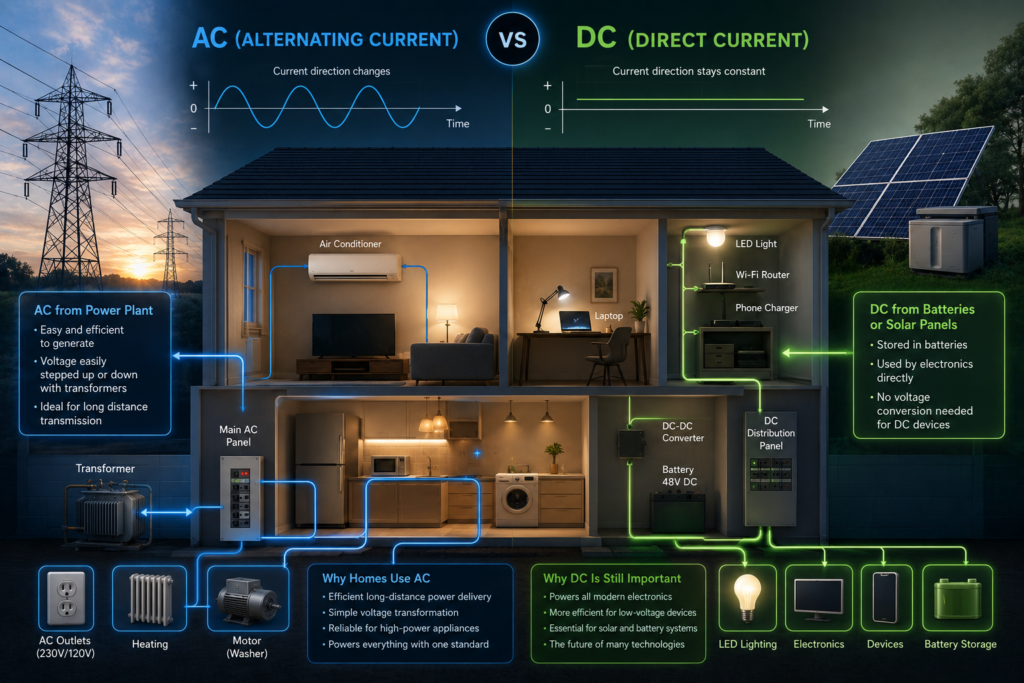
Most of the electronics inside a modern home actually run on direct current.
Your phone, laptop, television, router, LED lights and smart-home devices all rely on DC somewhere inside their circuits. Solar panels produce DC. Batteries store DC. Electric vehicles use large DC battery packs.
Yet the wall socket still supplies alternating current.
A little odd, isn’t it?
So, why do homes use AC instead of DC when so many modern devices convert that AC straight back into DC before doing anything useful?
The answer begins with transformers, early power-grid development and the difficulty of transmitting electricity efficiently over long distances. Alternating current became the practical foundation of national power systems more than a century ago, and once millions of generators, transformers, motors and buildings were designed around it, replacing the entire arrangement became enormously difficult.
AC won the grid.
DC quietly moved inside the appliances.
What Is the Difference Between AC and DC?
Direct current flows in one general direction.
A battery provides DC because one terminal maintains positive polarity while the other remains negative. Connect a lamp to the battery and current moves through the circuit in a consistent direction until the battery is discharged.
Alternating current behaves differently.
Its voltage and current repeatedly change direction. In a 50 Hz system, the waveform completes 50 full cycles every second. In a 60 Hz system, it completes 60.
The basic distinction looks like this:
DC: current flows in one direction

AC: current repeatedly reverses direction
Neither form is automatically better for every application.
DC works extremely well for:
- Batteries
- Electronic circuits
- Data equipment
- Solar panels
- LED lighting
- Electric vehicles
- Telecommunications
AC works extremely well for:
- Traditional power distribution
- Transformers
- Large motors
- Utility grids
- Household sockets
- Industrial power systems
The reason homes receive AC is not that DC is unusable.
It is because AC made the large-scale electricity network practical at the time that network was being built.
The Biggest Historical Advantage: Easy Voltage Transformation
Electricity can be transmitted more efficiently at high voltage.
For a given amount of power:
Power = Voltage × CurrentIf voltage is increased, the required current decreases.
Suppose a line must transmit 10,000 watts.
At 100 volts:
Current = 10,000 W ÷ 100 V
Current = 100 A
At 10,000 volts:
Current = 10,000 W ÷ 10,000 V
Current = 1 A
That lower current matters because cable heating losses are related to the square of the current:
Power loss = Current² × ResistanceIf current is reduced by a factor of 100, resistive losses fall dramatically.
High-voltage transmission therefore allows utilities to move large amounts of power over long distances using practical conductor sizes.
There is one complication.
Homes cannot safely use transmission voltages of tens or hundreds of thousands of volts. The voltage must be increased for transmission and then reduced again before reaching customers.
Alternating current made this relatively easy through the use of transformers.
Why Transformers Favoured AC
A traditional transformer uses a changing magnetic field to transfer energy between windings.
Alternating current naturally creates that changing magnetic field.
A transformer can:
- Increase voltage for transmission
- Reduce voltage for local distribution
- Provide electrical isolation
- Supply several secondary voltages
- Adapt industrial and domestic systems
A simplified power path looks like this:
Generator
↓
Step-up transformer
↓
High-voltage transmission line
↓
Substation transformer
↓
Local distribution line
↓
Distribution transformer
↓
Home
The frequency stays the same, but the voltage changes at several stages.
This could be done efficiently with passive equipment containing no electronic switching, computer control or rotating machinery.
That was a tremendous advantage in the late nineteenth and early twentieth centuries.
Early DC systems could not change voltage nearly as easily.
There were no compact modern power-electronic converters available. Raising or lowering DC voltage required inefficient motor-generator sets, batteries arranged in complicated combinations or other expensive equipment.
AC could move between voltage levels using a transformer made from copper windings and an iron core.
Simple. Rugged. Scalable.
That one advantage shaped the power grid we still use today.
Early DC Systems Worked—But Only Over Short Distances
Early public electricity systems often used low-voltage DC.
They could power incandescent lamps and small loads reasonably well within a limited area. The trouble began when customers lived farther from the generating station.
Low-voltage DC distribution required high current.
High current meant:
- Thick conductors
- Large voltage drop
- Heavy cable losses
- Limited service distance
- More generating stations
- Higher construction costs
To maintain acceptable voltage, a DC generating station had to remain relatively close to the buildings it supplied.
This was manageable in a small district.
It was far less practical for expanding cities, rural areas and eventually national networks.
AC systems could generate electricity, step the voltage up, transmit it over long distances and then step it down near customers.
That gave AC a much larger useful service area.
The War of the Currents
The historical competition between AC and DC is often called the War of the Currents.
Thomas Edison strongly promoted direct-current systems. His companies had already invested in DC generators, wiring and lighting infrastructure.
George Westinghouse developed and promoted alternating-current systems, with Nikola Tesla’s polyphase AC motor and power-system work helping demonstrate how useful AC could be for both transmission and machinery.
The disagreement was technical, commercial and occasionally rather ugly.
Supporters of DC argued that high-voltage AC was dangerous. That was not completely wrong—high voltage is indeed dangerous—but the criticism was also tied to business interests and competition.
AC supporters had the stronger distribution system.
Because its voltage could be transformed efficiently, AC could serve a much larger area from fewer generating stations.
That proved decisive.
The grid did not choose AC because alternating current was harmless or because DC was useless. AC won because it provided the more practical complete system for generation, transmission, voltage conversion and distribution using the technology available at the time.
Why Transmission Voltage Must Be High
Imagine trying to supply a distant town using low-voltage power.
The current would be enormous. Conductors would need to be thick, expensive and heavy. Even then, a large amount of energy would become heat before reaching the customers.
By raising the voltage, utilities reduce current and therefore reduce cable losses.
For example, suppose a transmission line has a resistance of 1 Ω.
If it carries 100 A:
Loss = 100² × 1
Loss = 10,000 W
If the voltage is raised so the same power requires only 10 A:
Loss = 10² × 1
Loss = 100 W
The current is ten times lower, while the resistive loss becomes one hundred times lower.
That is why electrical transmission lines operate at very high voltages.
Before the electricity reaches homes, transformers reduce the voltage to the local distribution level and then again to the voltage used by household appliances.
AC made this entire sequence practical long before modern electronics existed.
Why Homes Still Use AC Today
Technology has changed enormously since the first power grids were built.
Modern electronics can convert DC voltage efficiently. High-voltage DC transmission exists. Solar systems, battery storage and electric vehicles all use large amounts of direct current.
So why not replace household AC now?
Because the installed AC system is gigantic.
Changing homes to DC would affect:
- Power stations
- Substations
- Utility transformers
- Distribution lines
- Electrical panels
- Circuit breakers
- Wall sockets
- Appliance plugs
- Motors
- Heating systems
- Building regulations
- Electrical testing equipment
- Electrician training
- Existing appliances
AC is deeply embedded in the infrastructure.
Even when a different arrangement offers certain advantages, rebuilding a system that already serves billions of people is not a casual improvement.
It is more like replacing the road network while everyone is still driving on it.
Many Household Loads Work Well Directly on AC
Not every household appliance needs DC internally.
Several common loads can operate directly from AC, including:
- Resistive heaters
- Electric ovens
- Traditional kettles
- Incandescent lamps
- Certain pumps
- Refrigeration compressors
- Washing-machine motors
- Air-conditioning systems
- Induction motors
- Transformers
A heating element does not particularly care that current reverses direction. It produces heat during both halves of the AC cycle.
Traditional induction motors are also naturally suited to alternating current. A three-phase AC supply creates a rotating magnetic field, while single-phase appliances use additional motor-design features to achieve starting torque.
Many modern appliances now use electronic motor drives, but the incoming AC system still supplies them perfectly well.
Why Electronics Convert AC Back to DC
Electronic circuits require controlled, stable voltage.
Microprocessors, memory chips, sensors and communication circuits usually operate from low-voltage DC supplies such as:
- 1.2 V DC
- 3.3 V DC
- 5 V DC
- 12 V DC
- 24 V DC
The wall outlet may provide 120 V or 230 V AC, which is completely unsuitable for direct use by a processor.
The appliance therefore contains a power supply.
A modern switch-mode power supply generally performs several steps:
- Filters the incoming AC.
- Rectifies AC into DC.
- Smooths the rectified voltage.
- Switches it electronically at high frequency.
- Uses a small transformer or inductor to change the voltage.
- Rectifies and regulates the output.
- Supplies stable low-voltage DC to the electronics.
A laptop charger, for example, may accept:
100–240 V AC, 50/60 Hzand provide:
20 V DCThe laptop then converts that voltage into several lower DC rails for the processor, memory, display and battery-charging system.
Yes, the process looks slightly ridiculous from the outside.
The utility sends AC. The charger converts it to DC. Internal regulators convert that DC into several other DC voltages.
But each stage exists for a reason.
The AC grid handles large-scale distribution. The DC electronics handle precise local power.
Why Not Distribute Low-Voltage DC Throughout the House?
At first glance, a house-wide 12 V or 24 V DC system sounds sensible.
Many devices already use low-voltage DC, so why not remove all those individual adapters?
The problem is current.
Suppose a 2,000 W appliance operates at 230 V:
Current = 2,000 W ÷ 230 V
Current ≈ 8.7 A
At 24 V:
Current = 2,000 W ÷ 24 V
Current ≈ 83.3 A
At 12 V:
Current = 2,000 W ÷ 12 V
Current ≈ 166.7 A
Those currents require very thick conductors and substantial switching equipment.
Voltage drop also becomes a serious problem.
Low-voltage DC works beautifully for small devices and short cable runs. It becomes much less convenient for electric ovens, water heaters, air conditioners and other high-power loads.
A future DC home would therefore probably not use one low voltage for everything.
It might use several levels, perhaps:
- Low-voltage DC for electronics and lighting
- Higher-voltage DC for large loads
- AC for certain motors and legacy appliances
- Battery voltage for storage
- Separate charging buses for electric vehicles
At that point, the “simpler” system begins collecting quite a few cables and converters.
DC Switching Is More Difficult
Alternating current naturally crosses zero twice during every cycle.
In a 50 Hz system, current passes through zero 100 times per second. In a 60 Hz system, it does so 120 times per second.
That natural zero crossing helps extinguish electrical arcs when:
- A switch opens
- A circuit breaker trips
- A relay contact separates
- A fuse interrupts current
Direct current does not naturally cross zero.
Once a DC arc forms, it may continue for longer unless the switching device is specifically designed to stretch, cool or magnetically force the arc apart.
This is why an ordinary switch or breaker may have different AC and DC ratings.
A device rated for:
250 V ACmay be rated for a much lower DC voltage—or not rated for DC at all.
High-voltage DC distribution is certainly possible, but its switches, connectors and protective devices must be designed accordingly.
You cannot simply feed DC into an AC household installation and assume the breakers will sort it out.
They may not.
DC Does Have Advantages
Direct-current distribution is not a bad idea.
In some applications, it can reduce unnecessary power conversions.
Consider a home containing:
- Solar panels producing DC
- A battery storing DC
- An electric vehicle battery using DC
- LED lighting operating on DC
- Computers and routers using DC
- Phone chargers producing DC
A conventional system may repeatedly convert power:
Solar DC
↓
Inverter converts DC to AC
↓
Home AC wiring
↓
Power supply converts AC back to DC
↓
Electronic device
Each conversion introduces some loss.
A suitable DC distribution bus could potentially use a shorter path:
Solar DC
↓
DC converter
↓
DC distribution
↓
Electronic device
That can improve efficiency, especially in buildings with substantial solar generation and battery storage.
DC systems can also integrate naturally with:
- Data centres
- Telecommunications equipment
- Battery-backed lighting
- Electric-vehicle charging
- Off-grid homes
- Boats
- Recreational vehicles
- Microgrids
The question is not whether DC can work.
It can.
The harder question is whether the efficiency improvement justifies the additional wiring, protection, standards and compatibility problems in an ordinary home.
High-Voltage DC Transmission Already Exists
AC is not always the best choice for long-distance transmission.
Modern power electronics allow electricity to be converted between AC and high-voltage DC efficiently.
High-voltage direct current, commonly called HVDC, is useful for:
- Very long-distance transmission
- Long submarine cables
- Connecting asynchronous AC grids
- Moving large amounts of power between regions
- Offshore wind connections
- Controlling power flow precisely
HVDC can reduce certain losses and avoids some reactive-power and cable-capacitance problems associated with long AC links.
At each end, converter stations change AC into DC and then back into AC.
These stations are expensive and complex, but over long distances their benefits can outweigh the cost.
This produces an interesting modern arrangement:
Power station AC
↓
Converter station
↓
High-voltage DC transmission
↓
Converter station
↓
Regional AC grid
↓
Home
DC may handle part of the journey, while AC still handles local distribution.
The supposed battle between AC and DC is not really a battle anymore.
Engineers use whichever one suits each part of the system.
Could Future Homes Use More DC?
Very possibly.
Future homes may contain more local DC distribution because of:
- Rooftop solar
- Home batteries
- Electric vehicles
- LED lighting
- USB-C power delivery
- Smart-home electronics
- Heat-pump electronics
- Home energy-management systems
USB-C is already acting like a small DC power standard for many consumer devices. Phones, tablets, laptops, monitors and some tools can share compatible chargers and cables.
Power over Ethernet also distributes low-voltage DC alongside data for equipment such as:
- Security cameras
- Wireless access points
- Network phones
- Sensors
- Access-control devices
- Smart lighting
A home of the future might contain both AC and DC circuits.
For example:
- AC sockets for general appliances
- Dedicated DC outlets for electronics
- DC lighting circuits
- Direct solar-to-battery connections
- Vehicle-to-home energy systems
- Centralized DC power supplies
This hybrid approach is more realistic than eliminating AC entirely.
Why a Central DC Supply Could Help
Currently, a typical home may contain dozens of separate AC-to-DC adapters.
There is one for the router, another for the monitor, another for the LED strip, another for the smart speaker, another for the security camera—and, naturally, the connector you need is never the one in the drawer.
A centralized DC supply could potentially:
- Improve conversion efficiency
- Reduce duplicated adapters
- Simplify battery backup
- Integrate with solar
- Reduce electronic waste
- Provide common low-voltage circuits
However, a central system also creates new questions:
- Which DC voltage should be standard?
- How should polarity be protected?
- What connector should be used?
- How should faults be interrupted?
- How far can cables run before voltage drop becomes excessive?
- How should high-power devices be supplied?
- What happens when devices need different voltages?
- Who maintains the central converter?
Standardizing household DC is harder than it first appears.
Electronics do not all want the same voltage.
One device may need 5 V, another 12 V, another 20 V, and another 48 V.
Local conversion does not disappear. It merely moves.
Could Homes Use High-Voltage DC?
Higher-voltage DC would reduce current and cable losses.
For example, a 380 V DC bus could supply substantial power without requiring enormous conductors.
Some data centres and industrial systems already use higher-voltage DC distribution.
But bringing high-voltage DC into ordinary homes creates serious challenges:
- DC arcs are difficult to interrupt
- Existing sockets are unsuitable
- Existing appliances may be incompatible
- Polarity becomes important
- Specialized breakers are required
- Safe disconnection rules differ
- Regulations would need major changes
- Mixed AC and DC wiring could confuse users
A high-voltage DC outlet cannot safely be made to look like an ordinary AC socket.
Someone would eventually plug in the wrong appliance. Human beings are remarkably consistent in that regard.
Could Smart Appliances Accept Both AC and DC?
Yes, and some equipment already can.
Certain switch-mode power supplies can operate from either AC or a suitable DC input because their first stage rectifies incoming AC anyway.
After rectification, the internal circuit is already working with DC.
For example, an appliance designed for wide-range AC might internally see a high DC bus after the input rectifier.
With careful design, that appliance could potentially accept a suitable high-voltage DC supply.
But compatibility must be explicitly stated by the manufacturer.
Do not assume that every AC input can safely accept DC.
Input switches, fuses, filters, surge protectors, relays and protection circuits may behave differently.
Why Batteries Cannot Directly Power Everything
A home battery produces DC, but its voltage may vary with:
- State of charge
- Temperature
- Current
- Battery chemistry
- Cell arrangement
- Battery-management settings
Household appliances expect a defined supply.
An inverter converts the variable battery output into regulated AC matching the home’s normal electrical system.
That allows the battery to power existing:
- Lights
- Refrigerators
- Pumps
- Sockets
- Heating controls
- Electronic appliances
Without the inverter, every appliance would need to accept the battery’s changing DC voltage.
Using AC maintains compatibility with the building and its installed equipment.
Sometimes conversion efficiency is less important than avoiding the replacement of everything you own.
Is AC Safer Than DC?
Neither is inherently safe.
Shock risk depends on factors including:
- Voltage
- Current path
- Contact time
- Frequency
- Skin condition
- Source impedance
- Protective devices
- Grounding arrangement
AC and DC affect the body differently, and the relative danger depends on voltage and circumstances.
AC benefits from natural zero crossings, which help interrupt arcs and allow familiar protective devices to operate effectively.
DC avoids frequency-related effects but may sustain arcs more stubbornly.
A poorly designed installation is dangerous regardless of which waveform it uses.
Safety comes from insulation, earthing, bonding, protective disconnection, enclosure design and correct maintenance—not from three letters printed on a diagram.
Common AC and DC Myths
“Homes use AC because DC cannot travel long distances”
DC can travel long distances very effectively.
The historical problem was changing DC voltage efficiently. Modern HVDC systems solve that with power electronics.
“AC is always more efficient”
No. Efficiency depends on the application. HVDC can be more efficient for certain long-distance links, while local DC distribution may reduce conversion losses for electronic loads.
“All appliances internally use DC”
No. Heating elements, induction motors and several traditional appliances can operate directly from AC.
“Solar-powered homes should be entirely DC”
Not necessarily. A home still contains high-power and legacy AC loads. A hybrid system is often more practical.
“A transformer can change DC voltage”
A traditional transformer needs a changing magnetic field. Steady DC will not produce continuous transformer action and can overheat the winding.
Electronic DC-to-DC converters can change DC voltage, but they operate differently.
“Existing AC breakers work on DC”
Not automatically. DC interruption can be more difficult, and protective devices must carry a suitable DC rating.
The Practical Answer
So, why do homes use AC instead of DC?
Because alternating current allowed voltage to be changed easily using transformers.
Utilities could raise the voltage for efficient long-distance transmission, then reduce it near homes and businesses. Early DC systems could not perform this voltage conversion economically, which limited how far they could distribute power.
AC therefore became the foundation of national electricity grids.
Modern electronics convert AC back into DC because processors, batteries, LEDs and communication circuits require stable low-voltage DC supplies. The wall socket serves the whole building, while each device produces the exact DC voltage it needs.
Future homes may use more DC distribution, particularly for:
- Solar systems
- Battery storage
- LED lighting
- USB-powered electronics
- Electric vehicles
- Smart-home devices
But AC is unlikely to disappear soon.
It powers existing appliances, works with established infrastructure and remains easy to transform and distribute.
The future will probably not be AC or DC.
It will be AC where AC makes sense, DC where DC makes sense, and a slightly unreasonable number of converters sitting between them.