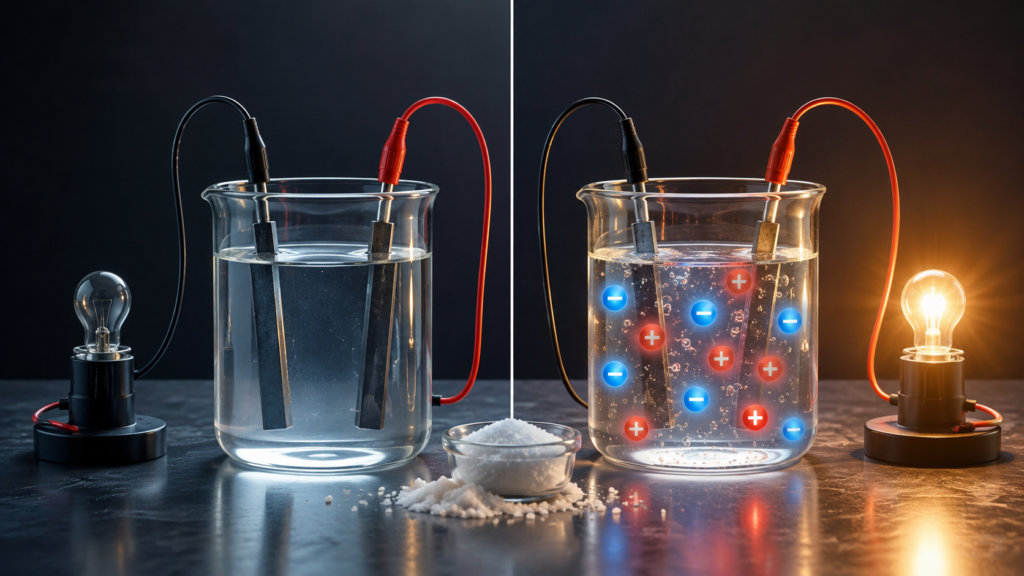
Drop two wires into a glass of distilled water and very little current flows.
Add a spoonful of salt, stir it, and the situation changes dramatically.
The water itself still looks exactly the same. No glowing particles. No tiny sparks swimming around. Yet electrically, it has become a much better conductor.
So, why does salt water conduct electricity?
Because dissolved salt releases electrically charged particles called ions. These ions can move through the liquid and carry charge from one electrode to the other.
Pure water contains very few free ions, so it offers a great deal of resistance to current. Ordinary tap water conducts better because it already contains dissolved minerals. Salt water contains far more mobile ions, which gives current an easier path.
And that innocent chemistry lesson has some rather serious consequences. Salt water can accelerate corrosion, damage electrical equipment and make shock hazards around pools, boats and wet work areas considerably worse.
Water Molecules Are Not Tiny Electrical Wires
A water molecule contains two hydrogen atoms and one oxygen atom:
H₂OThe molecule is polar, meaning its electrical charge is distributed unevenly. The oxygen side is slightly negative, while the hydrogen side is slightly positive.
That polarity makes water extremely good at dissolving many substances.
It does not, however, mean that a container of pure water behaves like a copper cable.
In a metal conductor, charge is mainly carried by mobile electrons. Inside a liquid solution, electrical current is carried mainly by moving ions.
That distinction matters.
Water molecules themselves are electrically neutral overall. They can rotate, vibrate and move around, but without a useful concentration of mobile charged particles, the liquid does not conduct much current.
What Are Ions?
An ion is an atom or group of atoms with a net electrical charge.
If an atom loses one or more electrons, it becomes positively charged. This is called a cation.
If it gains electrons, it becomes negatively charged. This is called an anion.
Table salt is sodium chloride:
NaClIn solid salt, positively charged sodium ions and negatively charged chloride ions are held together in a crystal structure.
When salt dissolves in water, water molecules surround the ions and pull them apart:
NaCl → Na⁺ + Cl⁻The sodium and chloride ions are then free to move through the solution. The U.S. Geological Survey explains that water’s polar molecules separate sodium and chloride ions when salt dissolves, producing a uniform solution containing mobile charged particles.
Now the water has charge carriers.
That is the key.
How Ions Carry Electrical Current
Imagine two electrodes placed in salt water and connected to a voltage source.
The electric field causes:
- Positive sodium ions to move toward the negative electrode
- Negative chloride ions to move toward the positive electrode
The ions do not need to travel from one end of the ocean to the other. Their collective movement through the liquid transfers electrical charge.
In a direct-current circuit, the ions drift mainly in their respective directions.
With alternating current, the electric field repeatedly reverses, so the ion motion also reverses. Charge still moves, and the liquid still conducts.
This is why an ionic solution can complete an electrical circuit even though there is no metal wire between the electrodes.
The liquid has become an electrolyte.
Why Pure Water Conducts Very Poorly
Truly pure water contains only a tiny concentration of ions.
A small number of water molecules naturally separate into hydrogen-related and hydroxide ions:
H₂O ⇌ H⁺ + OH⁻The chemistry is more accurately described using hydronium ions, but the simplified equation is enough to show the idea.
Because only a very small fraction of water molecules are ionized at any moment, pure water has very few mobile charge carriers. It is therefore a poor conductor rather than a perfect insulator.
Highly purified laboratory water can have a conductivity around only 0.055 microsiemens per centimetre at 25°C—a remarkably low value compared with ordinary natural water.
The important phrase is highly purified laboratory water.
The water in a sink, swimming pool, lake or bathtub is nothing like that.
Pure Water Does Not Stay Pure for Long
Even if water begins as distilled or deionized water, keeping it extremely pure is difficult.
It can collect ions from:
- Dust
- Airborne contamination
- Carbon dioxide
- Glass or plastic containers
- Metal pipes
- Human skin
- Cleaning residue
- Soil
- Nearby surfaces
Carbon dioxide from the air dissolves into water and contributes to its chemistry. Touching the water can introduce salts from sweat.
Put highly purified water into an ordinary container, leave it exposed and dip your fingers into it, and its electrical properties begin changing almost immediately.
This is why “water does not conduct electricity” is only technically useful when discussing water of unusual purity under controlled conditions.
In everyday life, water almost always contains something dissolved in it.
Why Tap Water Conducts Electricity
Tap water contains dissolved minerals and chemicals collected from its source and treatment process.
Depending on the area, these may include ions associated with:
- Calcium
- Magnesium
- Sodium
- Potassium
- Chloride
- Sulfate
- Bicarbonate
- Nitrate
- Iron
Calcium and magnesium are also responsible for much of what people call water hardness.
The U.S. Geological Survey notes that ordinary water—from a kitchen tap, swimming pool, groundwater source or rainfall—contains dissolved substances, minerals and chemicals. Conductivity depends strongly on the type and quantity of those dissolved materials.
This is why tap water conducts much better than freshly produced deionized water.
Two cities can have noticeably different water conductivity because their water passes through different soils and rocks, comes from different sources and receives different treatment.
Hard water generally contains more dissolved mineral ions than very soft water, although conductivity cannot be reduced to hardness alone. Other ions contribute too.
Why Salt Water Conducts Even Better
Adding salt deliberately increases the number of mobile ions in the liquid.
More charge carriers generally mean higher conductivity.
The U.S. Environmental Protection Agency explains that dissolved salts and other inorganic chemicals increase water conductivity, and that conductivity tends to rise with salinity.
A simplified comparison looks like this:
Pure water:
Very few ions → very low conductivity

Tap water:
Some dissolved ions → moderate conductivity

Salt water:
Many dissolved ions → much higher conductivity
The relationship is not perfectly linear across every concentration. At very high salt levels, interactions between ions become more complicated, and different ions move through water at different speeds.
Still, for an everyday experiment, adding salt to relatively clean water makes it conduct much more readily.
Does the Salt Itself Conduct Electricity?
Solid table salt normally does not conduct electricity well.
That may seem strange. It contains ions, after all.
The trouble is that those ions are locked into a rigid crystal lattice. They cannot move freely through the material.
Melt the salt or dissolve it in water, and the ions gain mobility.
Then electrical conduction becomes possible.
So the more complete rule is:
Ionic substances conduct when their charged particles are free to move.
A block of solid sodium chloride keeps its ions firmly seated.
Salt water lets them wander about.
Do Sugar and Salt Affect Water in the Same Way?
No.
Sugar dissolves in water, but ordinary sugar molecules remain electrically neutral. They spread throughout the liquid without separating into large numbers of positive and negative ions.
This means sugar water does not gain conductivity in the same dramatic way as salt water.
The EPA notes that many organic compounds, including sugar and alcohol, do not conduct current well in water compared with dissolved inorganic salts.
That gives us a useful distinction:
- Salt dissolves and forms ions
- Sugar dissolves mainly as neutral molecules
Both disappear visually into the water.
Only one provides a large collection of mobile charge carriers.
Chemistry likes hiding important differences behind identical-looking glasses of liquid.
Does More Salt Always Mean More Conductivity?
Generally, adding more dissolved salt increases conductivity because it adds more ions.
But only up to the point where the chemistry becomes more complicated.
At higher concentrations:
- Ions interact more strongly
- Their movement can become restricted
- The solution becomes more crowded
- Temperature has a greater influence
- Different salts behave differently
Sodium chloride is not the only salt capable of increasing conductivity.
Many dissolved ionic substances can do it, including compounds containing calcium, magnesium, potassium, nitrate and sulfate ions.
The final conductivity depends on:
- Ion concentration
- Type of ions
- Ion mobility
- Temperature
- Other dissolved materials
This is why conductivity meters can estimate the general level of dissolved ionic material but cannot identify every substance in the water by themselves.
A high reading says, “There are plenty of charge carriers here.”
It does not provide the full guest list.
Temperature Also Changes Conductivity
Warm salt water usually conducts better than cold salt water.
As temperature rises, ions move more easily through the solution. The liquid becomes less viscous, and ionic mobility increases.
This is why professional conductivity measurements are often corrected or referenced to a standard temperature, commonly 25°C. The EPA notes that water conductivity is related to ionic strength, ion mobility and temperature.
Without temperature compensation, the same water sample can produce different conductivity readings on a cold morning and a warm afternoon.
For electrical safety, however, do not focus too much on whether warm or cold water conducts slightly better.
Both can be dangerous when energized.
Salt Water and Corrosion
Salt water does more than conduct electricity through a cable fault.
It can also turn metal surfaces into small electrochemical cells.
Corrosion is an electrochemical process. Parts of a metal surface can behave like tiny anodes and cathodes, while the conductive liquid between them acts as an electrolyte.
The presence of ions allows electrical charge to move through the water while electrons move through the metal.
This supports the reactions that gradually remove metal from one area and deposit corrosion products elsewhere.
Salt water is particularly troublesome because:
- It has relatively high electrical conductivity
- Chloride ions can attack protective oxide films
- It can enter narrow gaps and connectors
- It remains behind as salty residue after water evaporates
- It can create galvanic cells between different metals
NASA describes galvanic corrosion as an electrochemical action involving dissimilar metals, an electrically conductive path and an electrolyte. In one documented case, salt water served as the electrolyte between an aluminium structure and a copper grounding system.
Why Different Metals Corrode in Salt Water
Connect two different metals electrically and expose them to salt water, and one may corrode faster than it would alone.
This is called galvanic corrosion.
For the reaction to occur, the arrangement generally needs:
- Two materials with different electrochemical potentials
- Electrical contact between them
- A conductive electrolyte connecting their surfaces
Salt water provides an excellent electrolyte.
One metal becomes more anodic and tends to corrode, while the other becomes more cathodic and is relatively protected.
Common combinations that require attention include:
- Aluminium and copper
- Steel and stainless steel
- Zinc-coated parts and more noble metals
- Dissimilar fasteners and structural materials
This is a major concern for:
- Boats
- Offshore platforms
- Marina equipment
- Coastal electrical installations
- Vehicles exposed to road salt
- Outdoor cabinets
- Solar mounting systems
- Industrial washdown areas
The speed of corrosion also depends on oxygen, temperature, pH, surface area, metal composition and protective coatings.
Salt is an enthusiastic accomplice, but not the only character in the story.
Salt Residue Can Keep Causing Trouble
Suppose salt water splashes onto an electrical connector and later appears to dry.
The visible water may be gone, yet salt remains on the surface.
That residue can:
- Absorb moisture from humid air
- Create leakage-current paths
- Attack metal contacts
- Cause intermittent faults
- Lower insulation resistance
- Encourage tracking across insulating surfaces
This is why seawater exposure is much more serious than simply allowing equipment to dry overnight.
The salt must be removed using an appropriate cleaning and restoration procedure, and damaged electrical equipment may require replacement.
Energizing contaminated equipment to “see whether it still works” can turn a cleaning job into a short circuit.
Why Water Makes Electrical Shock More Dangerous
An electrical shock occurs when the body becomes part of a circuit.
Water increases the danger in several ways.
First, ordinary water provides a larger conductive contact area. A person standing in water may be connected to grounded surfaces through both feet rather than one small point.
Second, wet skin has much lower electrical resistance than dry skin.
Third, salt and other dissolved ions in the water make it easier for current to travel through the liquid and across wet surfaces.
OSHA warns that wet environments greatly increase electrical risk because moisture lowers the resistance of human skin. It also notes that current can leak through wet connectors and through a person who provides a path to ground.
The result can be a dangerous current path involving:
Energized equipment
↓
Water
↓
Wet skin
↓
Body
↓
Grounded surface
The current does not need to travel through an entire swimming pool in a neat straight line.
Voltage differences can exist between nearby points in the water, and the body can bridge those points.
Is Fresh Water Safe Around Electricity?
No.
Fresh water may conduct less effectively than seawater, but ordinary freshwater still contains dissolved minerals and contamination.
Pool water contains chemicals.
Lake water contains minerals, soil, organic material and other dissolved substances.
Bathwater may contain soap, shampoo and salts from the human body.
Even rainwater quickly collects contamination from air, roofs, gutters and the ground.
The fact that salt water is more conductive does not make fresh water electrically safe.
“Less conductive” is not the same thing as “nonconductive.”
A weak conductor can still carry enough current to injure or kill someone, especially when voltage, contact area and exposure time are significant.
Why Salt Water Is Especially Dangerous on Boats
Boats combine several awkward ingredients:
- Water
- Metal
- Batteries
- Shore-power connections
- Generators
- Inverters
- Confined spaces
- Damp cables
- Corrosion
Freshwater marinas can be particularly dangerous for swimmers if faulty equipment leaks AC current into the water.
Salt water usually carries current more readily through the surrounding water, while a human body may represent a more competitive path in lower-conductivity freshwater. The exact current distribution depends on the voltage, geometry and conductivity of both the water and body.
Either environment can be deadly.
Swimming near docks, powered boats or marina wiring should never be treated casually when an electrical fault is suspected.
Why an RCD or GFCI Matters Near Water
Residual-current devices and ground-fault circuit interrupters are designed to detect current leaving the intended circuit path.
They compare the current travelling out through the line conductor with the current returning through neutral.
Under normal conditions:
Current out ≈ Current backIf some current leaks through water, a person or grounded metalwork, the values become unequal.
The protective device can then disconnect the supply quickly.
These devices substantially reduce risk, but they are not a licence to use damaged equipment in wet conditions.
Protection can fail because of:
- Incorrect wiring
- Damaged devices
- Missing grounding
- Improper extension leads
- Faults upstream of the protective device
- Lack of regular testing
- Equipment not connected through the protected circuit
OSHA recommends ground-fault protection in damp locations and warns against operating electrical equipment while standing in water.
Never Perform the Salt-Water Experiment With Mains Voltage
Classroom demonstrations sometimes use a battery, an LED and two electrodes to show how salt increases water conductivity.
That does not make it acceptable to repeat the demonstration with a wall socket.
Household mains voltage can deliver dangerous or fatal current through water, wet surfaces and the body.
Do not place mains-powered wires, probes or appliances into water to test conductivity.
Safe educational demonstrations should use:
- A suitably low-voltage, current-limited source
- Properly insulated connections
- Adult or qualified supervision
- Equipment intended for the experiment
Even low-voltage sources can create heat, gas or corrosion at the electrodes when significant current flows.
A glass of salty water is not an approved load bank.
What Should You Do If Electrical Equipment Gets Wet?
Do not touch the equipment while it remains connected to power.
Avoid standing in water or touching nearby metalwork.
Disconnect the supply from a safe, dry location only when this can be done without approaching the hazard. Otherwise, contact emergency services, the utility or a qualified electrician.
Equipment exposed to flooding, seawater or heavy contamination should be inspected before it is energized again.
Drying the outside does not prove that:
- Internal insulation is dry
- Salt residue is gone
- Protective devices still work
- Connectors are corrosion-free
- Motor windings are safe
- Circuit boards have not been damaged
Water can disappear.
The conductive mess it leaves behind may remain for months.
Common Water-Conductivity Myths
“Water conducts electricity because it contains oxygen”
No. Electrical conduction in ordinary water mainly comes from dissolved ions, not from the oxygen atom inside each water molecule.
“Pure water cannot conduct any electricity”
Not quite. Pure water has extremely low conductivity, but a tiny number of ions are naturally present.
“All clear water has the same conductivity”
No. Two visually identical samples can contain very different concentrations of dissolved ions.
“Adding sugar makes water conduct like salt water”
No. Sugar dissolves mainly as neutral molecules rather than separating into charged ions.
“Fresh water is safe because seawater conducts better”
No. Fresh water still contains ions, and wet skin greatly increases shock risk.
“Once salt water dries, the equipment is safe”
No. Salt residue can remain conductive in humidity and can continue attacking electrical contacts.
“Rubber shoes make electricity around water safe”
They may offer limited protection under specific conditions, but wet, dirty or damaged footwear cannot be relied upon as the sole safety measure.
Can Conductivity Tell Us How Salty Water Is?
Conductivity measurements are commonly used as an indicator of dissolved ionic material.
A meter applies an electrical signal between electrodes and measures how easily current travels through the sample.
Higher conductivity often suggests more dissolved salts or minerals.
This approach is used in:
- Water-treatment systems
- Aquariums
- Hydroponics
- Industrial processes
- Environmental monitoring
- Boiler-water testing
- Cooling systems
- Laboratory work
However, conductivity does not tell you exactly which ions are present.
A sodium chloride solution and a solution containing other ionic compounds can produce similar readings while having very different chemistry.
Conductivity is a useful clue—not a complete chemical analysis.
The Practical Answer
So, why does salt water conduct electricity?
Because salt dissolves into positively and negatively charged ions.
Those ions can move through water and carry electrical charge. Pure water contains very few ions, so it conducts extremely poorly. Tap water conducts better because it contains dissolved minerals, while salt water usually conducts much better because it contains a large concentration of mobile ions.
The same conductivity that makes a simple science experiment work can also create serious problems:
- Salt water supports leakage current.
- Wet skin lowers the body’s resistance.
- Salt residue damages insulation and contacts.
- Chloride ions accelerate certain forms of corrosion.
- Dissimilar metals can form galvanic cells.
- Electrical faults around pools, docks and wet equipment can become deadly.
Water does not need to look dirty to conduct electricity.
If ions are present—and outside a laboratory, they almost certainly are—the current has something to travel through.