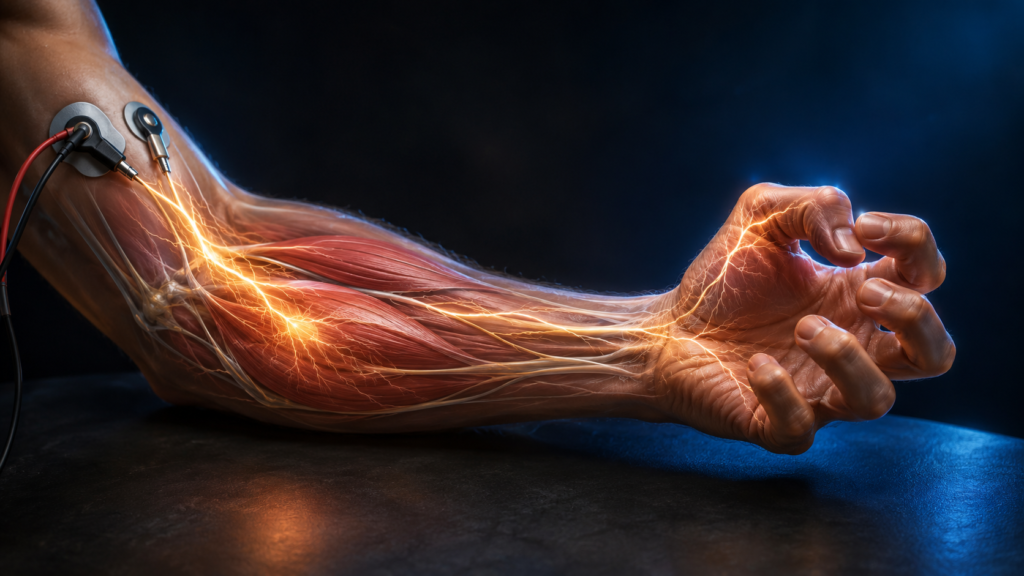
The hand does not politely decide to tighten around the wire.
It happens before conscious thought gets much of a vote.
An electric current passing through the body can interfere with the same electrical signalling system that nerves normally use to control muscles. The result may be a sudden jerk, a violent whole-body movement or a sustained contraction that prevents someone from releasing the energized object.
So, why does electric shock make muscles contract?
Because nerves and muscle cells respond to changes in electrical voltage across their membranes. An external current can disturb those voltages, trigger nerve impulses and force muscle fibres to contract without instructions from the brain.
With ordinary 50 or 60 Hz household AC, the stimulation repeats rapidly. The affected muscles may not have time to relax between signals, producing a sustained contraction known as tetany. That is one reason a person may be unable to let go.
It is also why household electricity must never be treated as harmless simply because the voltage is familiar.
Your Body Already Uses Electricity
The human nervous system does not contain tiny copper wires, of course, but it does communicate using electrical and chemical signals.
Nerve and muscle cells maintain a voltage difference across their outer membranes. They do this by controlling the movement of charged particles—mainly ions such as sodium, potassium and calcium.
When a nerve cell is stimulated strongly enough, ion channels open and the membrane voltage changes rapidly. This travelling voltage change is called an action potential.
In neurons, depolarization begins when sodium channels open and positively charged sodium ions move into the cell. Potassium movement then helps restore the original membrane voltage. The action potential travels along the nerve as a brief electrical signal.
That is how the brain sends commands to muscles.
No mains cable required.
How a Muscle Normally Receives the Order to Contract
Suppose you decide to pick up a cup.
The brain sends signals through the nervous system to the appropriate motor neurons. When an action potential reaches the end of a motor neuron, it triggers the release of a chemical messenger called acetylcholine.
Acetylcholine crosses the tiny gap between the nerve and muscle, then binds to receptors on the muscle fibre.
This changes the voltage across the muscle membrane and starts another action potential—this time inside the muscle itself.
The signal travels across the muscle fibre and into structures called T-tubules. That causes stored calcium ions to be released inside the muscle cell.
Calcium allows the proteins actin and myosin to interact. Myosin pulls on actin, the microscopic filaments slide past one another and the muscle develops force.
The sequence is roughly:
Motor-nerve signal
↓
Acetylcholine released
↓
Muscle membrane depolarizes
↓
Calcium released inside the muscle
↓
Actin and myosin interact
↓
Muscle contracts
This process is known as excitation-contraction coupling: an electrical event is converted into mechanical movement.
An External Current Can Hijack That System
During an electric shock, current from an outside source passes through tissue.
That current can alter the voltage across nerve and muscle-cell membranes. If the disturbance is strong enough, it can trigger action potentials in motor nerves or directly excite muscle fibres.
The muscle then receives what is effectively a false command to contract.
It does not matter that the person never intended to move. The external electrical source has interfered with the signalling system below the level of conscious control.
Research into neuromuscular electrical stimulation describes electrically produced contractions as the result of depolarizing motor-nerve axons and their branches.
That same basic principle is used deliberately in controlled medical and rehabilitation equipment.
The enormous difference is that approved stimulation devices use carefully limited pulses, defined electrode positions and controlled operating parameters.
Household mains electricity was designed to power kettles, heaters and motors.
It was not designed to negotiate politely with the nervous system.
Why the Movement Is Involuntary
Normal movement is coordinated.
The nervous system decides which muscles should contract, how strongly they should contract and when opposing muscles should relax.
An accidental electric current does not follow that plan.
It stimulates whichever excitable nerves and muscles lie along the current path. Several muscle groups may contract at once, including muscles that normally oppose one another.
The result may be:
- A sudden jerk
- A rigid grip
- An arm pulled inward
- A person thrown backwards
- Locked joints
- Loss of balance
- Painful whole-body contraction
- Inability to release the energized object
The exact response depends on the location of contact, current path, type of current, duration and which nerves are stimulated.
An electrical shock can therefore cause serious secondary injuries even before considering burns or effects on the heart. A violent contraction may cause a fall, collision, dislocation or muscle and tendon injury.
Why AC Can Prevent Someone From Letting Go
Household alternating current repeatedly changes direction.
In Europe, the supply normally alternates at 50 Hz. In North America, it is commonly 60 Hz.
At those frequencies, the body may receive repeated stimulation before an affected muscle has fully relaxed from the previous contraction.
Instead of one quick twitch, the contractions blend into a sustained tightening called tetany.
Medical guidance notes that low-frequency 50–60 Hz AC can produce prolonged muscle contraction and may prevent someone from removing a hand or another body part from the electrical source.
This is the well-known no-let-go or let-go problem.
A person may understand perfectly well that they need to release the wire. Mentally, the instruction is clear.
Physically, the hand may no longer obey.
Why the Hand May Grip More Tightly
The muscles that close the fingers and flex the arm can produce a powerful gripping response.
If someone contacts an energized conductor with the palm or wrapped fingers, electrical stimulation may contract those muscles and tighten the hand around the object.
That longer contact allows current to continue flowing, potentially worsening the injury.
In other situations, extensor muscles may dominate and throw the person away from the source instead. OSHA training material notes that electrical stimulation can either prevent release or, depending on which muscles are activated, throw a person away from the circuit.
Being thrown clear is not a reliable safety mechanism.
It may cause:
- A fall from a ladder
- Impact with machinery
- Head injury
- Contact with another conductor
- Loss of balance near moving equipment
The body’s response is unpredictable. Relying on a shock to “push you away” is a terrible protection strategy.
AC Does Not Simply Make the Muscles Vibrate
It is tempting to imagine that the muscle follows the positive and negative halves of the waveform like a loudspeaker cone.
The real physiology is more complicated.
Nerves respond when changes in the electrical field disturb their membrane voltage enough to generate impulses. Repeated stimulation can trigger repeated muscle activation, and those individual responses merge into a sustained contraction.
The muscle is not calmly reversing direction 50 times per second.
It is being driven into continued activation by a rapid sequence of nerve and muscle signals.
Short pulses can produce individual twitches.
Repeated pulses close together can produce a smoother and stronger contraction.
That is useful in a controlled clinical device. During an accidental shock, not so much.
What About Direct Current?
Direct current can also stimulate nerves and muscles.
A sudden DC connection or disconnection may produce a powerful single contraction. Depending on the contact position, it might throw someone away—or pull them into a dangerous movement.
Continuous low-frequency AC is particularly associated with sustained tetanic contraction and inability to release, but this does not make DC safe. Both AC and DC can cause burns, muscle injury, dangerous heart disturbances and death.
The body does not award safety points because a power source came from a battery.
Large batteries, photovoltaic systems, electric vehicles and industrial DC supplies can deliver enormous energy.
Current Path Matters
Electricity needs a complete circuit.
During a shock, the body may form part of that circuit between two conductors or between an energized conductor and earth.
Possible paths include:
Hand → Hand

Hand → Foot

Hand → Opposite Foot

Head → Foot

Finger → Hand

One point on the arm → Another nearby point
A short, localized path through one finger is not the same as a path crossing the chest.
Current passing through the torso may affect:
- The heart
- Breathing muscles
- Nerves
- Blood vessels
- Internal tissue
Current through a hand and forearm may produce an intense grip and local injury, while current passing from one hand to the other can cross the chest.
There is no way to judge the internal path accurately by looking only at the contact marks.
Electricity takes all available conductive routes, divided according to their impedance. Human tissue is not a neat, uniform resistor.
The Body Is Not Electrically Uniform
Different tissues conduct differently.
Blood and other fluid-rich tissues conduct relatively well. Fat, bone and dry outer skin generally offer more resistance.
Skin condition can change the overall situation dramatically.
Conductivity may increase when skin is:
- Wet
- Sweaty
- Cut
- Damaged
- Pressed firmly against metal
- In contact over a large surface area
Wet skin is one reason electrical equipment becomes especially dangerous in bathrooms, kitchens, construction sites, pools, basements and outdoor work areas.
Once current gets past the outer skin barrier, the body’s internal tissues provide conductive pathways.
A voltage that produced only a small current under dry, brief contact may produce a much more dangerous current when the skin is wet or damaged.
Why Household Voltage Can Be Fatal
Household voltage feels ordinary because we live around it every day.
That familiarity can be deceptive.
A 120 V or 230 V supply can drive dangerous current through the body, particularly when contact is firm, prolonged, wet or positioned across the chest.
The consequences may include:
- Sustained muscle contraction
- Inability to release
- Breathing interference
- Dangerous heart rhythm
- Cardiac arrest
- Internal and external burns
- Nerve damage
- Falls and impact injuries
OSHA and NIOSH safety material warns that electrical contact can cause shock, burns, involuntary muscle contraction, breathing arrest, heart disturbance and death.
The word low voltage is sometimes used in electrical standards to distinguish household and industrial distribution from high-voltage systems.
It does not mean low danger.
A domestic outlet has enough voltage and available current to kill.
Voltage Is Not the Whole Story
Voltage provides the electrical pressure that can drive current.
The biological damage is strongly related to the current that actually passes through the body, along with:
- Current path
- Contact duration
- Frequency
- Skin condition
- Contact pressure
- Contact area
- Source characteristics
- Individual circumstances
This is why simple claims such as “this voltage is safe” are misleading.
The same nominal voltage can produce very different outcomes in different contact conditions.
A dry fingertip touching briefly is one situation.
Two wet hands gripping conductive metal are another.
Neither should be tested voluntarily.
Why Longer Contact Is More Dangerous
Duration matters.
A brief involuntary touch may end when the person jerks away. A sustained contraction may prevent release, keeping the current flowing.
Longer exposure gives more time for:
- Tissue heating
- Burns
- Muscle injury
- Breathing disruption
- Heart-rhythm disturbance
- Nerve damage
This creates a nasty feedback loop:
Current causes contraction
↓
Contraction prevents release
↓
Contact lasts longer
↓
Injury becomes more severe
That is one reason the no-let-go effect is so dangerous. The muscle contraction is not merely a symptom of the shock—it can extend the shock.
How Electric Current Can Affect Breathing
Breathing depends on coordinated muscle activity.
The diaphragm and muscles around the rib cage must contract and relax in an organized rhythm.
Electrical current passing through the upper body may disrupt that control or force respiratory muscles into sustained contraction.
A person may be unable to breathe normally while still in contact with the source.
Even after the current stops, breathing problems, unconsciousness or other serious complications may remain. Electrical incidents should not be dismissed merely because the person is no longer touching the conductor.
OSHA safety guidance warns that prolonged current caused by inability to release can lead to respiratory paralysis.
The Heart Is Also an Electrically Controlled Muscle
The heart contracts because specialized cells generate and conduct carefully timed electrical impulses.
Those impulses coordinate the pumping action of the chambers.
An external current passing through the chest can disrupt this timing. Instead of a coordinated heartbeat, the electrical activity may become dangerously disorganized or stop functioning effectively.
This can happen without a dramatic external burn.
A small-looking contact mark does not prove the heart was unaffected.
That is one of the particularly unpleasant features of electrical injury: what happened internally may be far more serious than what is visible on the skin.
Why Medical Electrical Stimulation Is Different
Electrical stimulation is used intentionally in medicine and rehabilitation.
Examples include:
- TENS for pain management
- Neuromuscular electrical stimulation
- Functional electrical stimulation
- Cardiac pacing
- Defibrillation
These applications use controlled waveforms for a specific purpose.
Electrode position, pulse duration, current limitation and device isolation are carefully designed. Neuromuscular electrical stimulation intentionally depolarizes local motor nerves to produce a managed contraction.
This does not mean experimenting with electricity on the body is safe.
A certified medical device and an improvised circuit are separated by rather more than a plastic case and optimistic branding.
Never use mains electricity, homemade stimulators, batteries with improvised electrodes or unknown electronic equipment on the body.
Strong Contractions Can Cause Mechanical Injury
Electrical injury is not limited to burns.
A sudden, violent contraction can place enormous stress on:
- Muscles
- Tendons
- Joints
- Bones
- The spine
Reported electrical injuries include tendon rupture and other trauma caused by forceful involuntary contraction.
A person may also fall, strike nearby equipment or be pulled into moving machinery.
Even when the current path does not cause a fatal internal injury, the involuntary movement can create an entirely separate accident.
This is especially dangerous when working:
- At height
- Near rotating machinery
- Inside confined spaces
- Beside sharp metalwork
- On ladders
- Near water
- Around moving vehicles
Why Circuit Breakers Do Not Always Protect a Person
An ordinary circuit breaker mainly protects wiring against excessive current and overheating.
It may be rated for many amperes because household appliances legitimately draw substantial current.
A dangerous current through the human body can be far below the level needed to trip that breaker quickly.
The breaker may see the person as a small additional load rather than a short circuit.
Residual-current devices—called RCDs, GFCIs or similar names depending on the region—provide additional protection by checking whether current leaving through the line conductor returns through the intended neutral path.
If some current leaks through a person or earth, the device can disconnect the circuit.
However, such devices:
- Must be correctly installed
- Must be functional
- Must protect the affected circuit
- Do not eliminate every possible shock
- Do not make live work acceptable
Protective devices reduce risk.
They do not make touching an energized conductor a controlled experiment.
Why “It Only Tingled” Proves Very Little
A previous mild shock does not predict the outcome of the next one.
Contact conditions may change because of:
- Wetter skin
- Firmer grip
- Longer exposure
- A different hand
- Better contact with earth
- Damaged insulation
- A different current path
Someone may receive a brief tingling sensation from one contact and a life-threatening injury from the same supply under slightly different conditions.
The absence of immediate collapse also does not prove that no injury occurred.
Electrical incidents may involve burns, heart symptoms, nerve effects, falls or muscle damage that are not obvious in the first few moments.
What To Do During an Electrical-Shock Emergency
Do not grab a person who is still in contact with electricity.
Touching them may place you in the same circuit.
The first priority is to stop the electrical current safely. Switch off the supply at the mains, isolator or another appropriate disconnecting point when this can be done without approaching the hazard.
If the source cannot be safely isolated, stay clear and contact emergency services or the electricity utility as appropriate.
Once the supply is confirmed off:
- Call emergency services if the person is unresponsive, has breathing difficulty, has collapsed or appears seriously injured.
- Follow dispatcher instructions.
- Begin CPR only if needed and if you are trained or instructed.
- Do not move the person unnecessarily unless there is immediate danger.
- Arrange medical assessment after an electrical shock.
The NHS advises switching off the electrical supply before approaching, never touching the person until the current is isolated, and seeking medical help afterwards.
Never approach a downed or high-voltage power line. The ground and nearby objects may also be energized.
How To Prevent Electrical Shock
The most reliable approach is to prevent current from entering the body at all.
That means:
- Isolate circuits before work
- Lock out the supply where required
- Verify absence of voltage with suitable test equipment
- Prove the tester before and after testing
- Use equipment rated for the environment
- Keep plugs, tools and extension leads away from water
- Replace damaged cables and connectors
- Use RCD or GFCI protection where required
- Never remove protective-earth connections
- Avoid energized work unless it is strictly necessary and properly controlled
- Keep untrained people away from exposed electrical parts
Electrical safety is not about learning how much shock the body can tolerate.
It is about making sure the body never becomes part of the circuit.
Common Myths About Electric Shock and Muscles
“The muscles contract because electricity heats them”
Not primarily.
Heating can cause burns and tissue damage, but the immediate contraction happens because current stimulates electrically excitable nerves and muscle fibres.
“You can always let go if you stay calm”
No.
The inability to release may be involuntary. Conscious effort cannot necessarily overcome electrically stimulated muscle contraction.
“AC always throws people away”
No.
AC may produce sustained contraction that prevents release. In other circumstances, muscle activation may throw a person away. The response is not predictable.
“DC cannot lock the muscles”
DC can cause powerful involuntary contraction and serious injury. It must not be treated as safe.
“Rubber-soled shoes guarantee protection”
No.
Footwear may be wet, damaged, dirty or unsuitable for electrical isolation. Current may also find a path through another body contact.
“If there is no burn, the shock was harmless”
No.
An electric current can affect the heart, breathing, nerves and muscles without leaving a large visible burn.
“A circuit breaker will trip before someone is hurt”
Not necessarily.
An ordinary breaker protects the circuit wiring and may not respond rapidly to current passing through a person.
The Practical Answer
So, why does electric shock make muscles contract?
Because muscle control is already an electrical process.
Normally, motor nerves generate action potentials, release acetylcholine and trigger electrical activity inside muscle fibres. Calcium is released, actin and myosin interact, and the muscle contracts.
An external electric current can interfere with that system.
It may depolarize motor nerves and muscle cells, producing contractions that the brain did not request and cannot easily stop.
Household 50 or 60 Hz AC is particularly dangerous because its repeated stimulation can create sustained contraction. A person gripping an energized object may be physically unable to release it, extending the contact and increasing the risk of breathing failure, heart-rhythm disturbance, burns and other injuries.
The outcome depends on current path, contact duration, skin condition and many other variables.
There is no useful “survivable shock” target.
There is only a circuit that should have been isolated before anyone touched it.