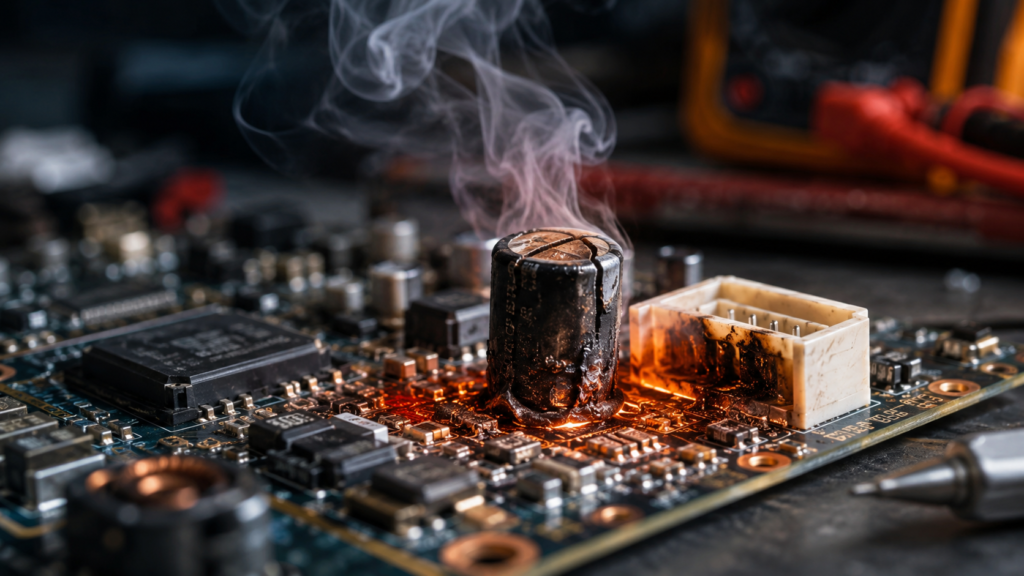
The screen still works. The fan is spinning. No smoke is visible.
But something smells wrong.
Perhaps it is a sharp chemical odour, hot plastic, dusty heat or that unmistakable “electrical” smell that makes you stop and look around the room. A minute later, the device switches off—or a small puff of smoke explains everything rather dramatically.
A burning smell from electronics should never be ignored.
Electrical parts do not normally produce a strong burnt or chemical smell during healthy operation. The odour often means that insulation, plastic, dust, a circuit board or an internal component has become hot enough to release vapours. In some cases, the device is already experiencing a short circuit, loose connection or component failure.
The fact that it still works is not reassuring.
Quite a few electrical failures continue operating right up until the moment they don’t.
Where Does the “Electrical Burning” Smell Come From?
Electricity itself has no smell.
You cannot smell voltage or current. What you notice is the effect that electrical energy is having on nearby materials.
Excessive current, poor contact resistance or a failed component can produce heat. As temperatures rise, materials inside the device begin to change chemically.
The smell may come from:
- Wire insulation
- Plastic connectors
- Circuit-board resin
- Dust on hot components
- Adhesives
- Varnish on transformer windings
- Electrolyte from a capacitor
- Overheated cable jackets
- A failing motor winding
- Plastic around a loose terminal
Sometimes the smell is noticeable before there is visible smoke because heated plastics and insulating compounds can release volatile decomposition products before they ignite openly.
It is an early warning.
Not a scented invitation to keep testing the device.
Why Electrical Components Become Hot
Every conductor and connection has some resistance.
When current passes through resistance, electrical energy becomes heat:
Power = Current² × ResistanceThis relationship explains why a seemingly small connection problem can become serious.
Suppose a damaged connector develops only 0.5 Ω of resistance while carrying 5 A:
P = 5² × 0.5
P = 12.5 W
That is 12.5 watts of heat concentrated inside a small terminal or plug contact.
At 10 A:
P = 10² × 0.5
P = 50 W
Fifty watts inside a plastic connector is no longer a minor inconvenience. The terminal may discolour, soften, carbonize or ignite.
Common causes of abnormal heating include:
- Loose terminals
- Corroded contacts
- Undersized cables
- Excessive load current
- Short circuits
- Blocked ventilation
- Failed cooling fans
- Incorrect supply voltage
- Reversed polarity
- Defective power components
- Poor-quality charging cables
- Age-related component failure
Texas Instruments lists overvoltage, overcurrent, incorrect wiring and overheating among common causes of destructive electrical overstress in electronic circuits.
Overheated Wire Insulation
Electrical wires are covered with insulating materials intended to keep conductors separated and prevent accidental contact.
Depending on the device, insulation may include:
- PVC
- Polyethylene
- Silicone rubber
- Enamelled winding varnish
- Heat-resistant polymer compounds
- Fibreglass sleeving
- Adhesive-backed insulating films
These materials are safe within their specified temperature ranges.
When insulation becomes too hot, it may soften, shrink, discolour or begin breaking down chemically. That process can create the familiar smell of hot plastic or overheated wiring.
Possible reasons include:
- Excessive current through the wire
- A short circuit
- A loose crimp or terminal
- Wire trapped against a hot component
- Damaged insulation creating leakage current
- A connector making poor contact
- Incorrect replacement wiring
- Overloaded extension leads or power strips
A warm plastic smell near an outlet, switch or appliance can indicate a developing fire hazard. The U.S. Consumer Product Safety Commission specifically identifies the smell of burning plastics, unusually warm outlets and flickering circuits as warning signs of potentially dangerous electrical connections.
Loose Connections Can Smell Before They Stop Working
A loose connection may still conduct electricity.
That is what makes it deceptive.
The device turns on, so everything appears normal. Yet the current is squeezing through a smaller or unstable contact area, increasing resistance and producing concentrated heat.
As the connection heats:
- Metal surfaces oxidize.
- Contact resistance increases.
- More heat is produced.
- Plastic around the terminal begins to soften.
- The connection becomes even less stable.
- Arcing may begin.
It is a nasty little feedback loop.
Signs of a poor electrical connection may include:
- A burnt smell
- Intermittent operation
- Flickering
- Crackling
- A connector that feels unusually hot
- Discoloured plastic
- Buzzing
- Visible melting
- Brown or black marks around terminals
Do not repeatedly wiggle the plug to make the device work. That may temporarily restore contact while worsening the damaged terminal.
What Does a Burning Circuit Board Smell Like?
Printed circuit boards are more than thin sheets of copper.
A typical board contains:
- Fibreglass reinforcement
- Polymer resin
- Copper tracks
- Solder mask
- Adhesives
- Component coatings
- Plastic connectors
- Soldered electronic parts
When a board overheats, several different materials may release vapours at the same time. The resulting smell can be sharp, chemical, acrid or similar to scorched plastic.
There is no universal “circuit-board smell.”
It depends on what is overheating.
A failed resistor may darken the board beneath it. A power transistor may become hot enough to damage its plastic package. A loose connector may carbonize one small area while the rest of the board looks perfectly clean.
UL evaluates plastic and printed-board materials partly according to their behaviour when exposed to heat and flame, because electronic substrates and enclosures must resist ignition and limit fire propagation under abnormal conditions.
Why Circuit Boards Sometimes Turn Brown or Black
A hot component can gradually cook the circuit board beneath it.
At first, the board may become slightly brown. Continued heating can darken the resin, damage the solder mask and weaken the material.
Eventually, carbonized board material may become partly conductive.
That can create new leakage-current paths between copper tracks, producing even more heating or arcing.
Look for:
- Brown areas around power resistors
- Black marks near connectors
- Cracked solder joints
- Melted plug housings
- Lifted copper tracks
- Burnt holes
- Soot
- Components leaning because their solder melted
- Brittle or crumbling board material
A darkened board does not automatically mean the entire device is beyond repair, but simply replacing the visibly burned component may not be enough. The underlying cause—overload, cooling failure, incorrect voltage or a downstream short circuit—must also be found.
Otherwise, the new component may enjoy a very short career.
Electrolytic Capacitors Can Leak or Vent
Aluminium electrolytic capacitors are found in power supplies, monitors, televisions, motor drives, amplifiers and many other electronic products.
They contain an electrolyte and use a very thin oxide layer as part of their internal dielectric system.
Over time, a capacitor may deteriorate because of:
- Excessive heat
- Age
- High ripple current
- Overvoltage
- Reverse polarity
- Manufacturing defects
- Long periods of unsuitable storage
- Nearby component failure
A failing electrolytic capacitor may:
- Bulge at the top
- Leak material around its seal
- Lose capacitance
- Develop high internal resistance
- Draw excessive leakage current
- Open its pressure-relief vent
- Short internally
Gas can form inside the capacitor as abnormal electrical or thermal conditions damage the electrolyte. Many capacitors include a scored pressure-relief vent intended to open before internal pressure ruptures the casing violently.
Nichicon warns that overvoltage, reverse voltage, excessive ripple and other abnormal conditions can generate gas, open the safety vent and release hot electrolyte vapour. Its emergency guidance says power should be switched off or the plug removed if venting or smoke is observed.
What Does a Failed Capacitor Smell Like?
A venting capacitor can produce a sharp chemical, solvent-like or otherwise unusual smell.
People sometimes describe capacitor failures as fishy, sour or sweet, but smell alone cannot reliably identify the failed part. Different electrolyte formulations and nearby heated materials produce different odours.
Do not lean over a device and sniff components to locate the source.
Capacitor vapour can be hot and irritating. Manufacturer guidance warns that gases released through a pressure vent may exceed 100°C and should be kept away from the face, eyes and skin.
Other possible signs of capacitor failure include:
- A bulging top
- A pushed-out rubber seal
- Crusty or wet residue
- Hissing
- Repeated clicking from a power supply
- Difficulty starting
- Screen flickering
- Unstable output voltage
- A device that repeatedly restarts
- A sudden pop
Not every failed capacitor visibly bulges. Some fail electrically while appearing perfectly normal.
Why Dust Can Produce a Burning Smell
Dust seems harmless because it sits quietly on shelves and television cabinets.
Inside electronics, it can become a problem.
Dust accumulates on:
- Cooling fans
- Heat sinks
- Air vents
- Power-supply components
- Motor windings
- High-voltage sections
- Warm resistors and transformers
A layer of dust acts as thermal insulation and restricts airflow. Components that once stayed within a safe temperature range may begin running much hotter.
Computer manufacturers warn that blocked vents and dust-covered fans reduce cooling, causing heat buildup and potentially damaging internal components.
Dust may also contain:
- Textile fibres
- Skin particles
- Cooking grease
- Pet hair
- Tobacco residue
- Metal particles
- Moisture
- Industrial contamination
When deposited on a hot component, these materials may create a dry, toasted smell similar to a dusty heater being switched on after months of storage.
Is a Dusty Smell Always Dangerous?
Not necessarily.
A heater, radiator fan or old amplifier may produce a brief dusty smell when first used after a long period. Settled dust warms up and releases an odour.
That smell should fade quickly.
It is more concerning when:
- The smell becomes stronger
- It continues for more than a short period
- The enclosure becomes unusually hot
- The cooling fan is not running
- The device shuts down
- Smoke appears
- Crackling or buzzing begins
- Performance changes
- A fuse or breaker operates
Do not assume every burning smell is “just dust.”
Without opening and testing the equipment safely, you may not know whether dust is warming normally or insulation is beginning to melt.
Dust Can Also Become Conductive
Ordinary dry household dust is generally not a strong conductor, but contamination can alter that.
Industrial dust may contain:
- Metal particles
- Carbon
- Moisture
- Salt
- Chemical residue
- Oil mist
Conductive contamination can create leakage-current paths across circuit boards and terminals. Moisture makes matters worse.
This can lead to:
- Tracking
- Corrosion
- Short circuits
- Unstable sensor readings
- Intermittent faults
- Arcing
- Ground leakage
Electronics used in workshops, factories, kitchens and coastal areas often face much harsher contamination than equipment sitting in a clean office.
The grey fluff inside a computer is annoying.
The metallic dust inside a control cabinet can be genuinely dangerous.
Heated Plastic Compounds Produce Different Smells
Electronics contain many kinds of plastic.
Each material contains its own base polymer, pigments, plasticizers, flame retardants, stabilizers and fillers.
That is why overheating devices do not all smell the same.
A warming cable jacket may smell different from:
- A melting connector
- A scorched relay
- A hot transformer bobbin
- A burned circuit-board resin
- A failing charger enclosure
- An overheated fan motor
Some plastics soften and deform before igniting. Others char. Flame-retardant materials may resist continued burning but still release smoke and unpleasant decomposition products when exposed to excessive heat.
A flame-retardant rating does not mean the material cannot melt, smoke or be damaged.
It means the material has met particular test requirements under defined conditions. UL’s plastic flammability classifications distinguish materials by how they behave after controlled flame exposure; they do not promise that an overheated product will remain odourless or undamaged.
New-Electronics Smell Versus Burning Smell
A newly manufactured device may have a mild smell during its first few hours of operation.
Possible sources include:
- Fresh plastic
- Adhesives
- Protective coatings
- Packaging residue
- Manufacturing compounds warming slightly
A faint new-product smell that decreases with use is different from an increasingly strong burnt, acrid or smoky odour.
Warning signs include:
- The smell suddenly appearing after months or years
- A smell concentrated near the power input
- Rapidly increasing heat
- Visible discolouration
- Smoke
- A popping sound
- Repeated shutdowns
- Melted plastic
- An outlet or plug becoming hot
When in doubt, switch it off.
Saving a charger is not worth gambling with a room.
Why Small Chargers Can Fail So Dramatically
Phone chargers and laptop power adapters appear modest, but they process substantial electrical power inside a compact enclosure.
A charger may contain:
- Rectifiers
- High-voltage capacitors
- Switching transistors
- A transformer
- Control electronics
- Insulation barriers
- Output filters
Poor cooling, defective components or inadequate insulation can create concentrated hot spots.
Low-quality or counterfeit chargers may have:
- Insufficient spacing between high- and low-voltage sections
- Undersized components
- Weak solder joints
- Inadequate thermal protection
- Poor flame resistance
- Missing safety components
A charger that smells burnt, crackles or becomes too hot to handle comfortably should be disconnected and replaced with an approved unit.
CPSC recalls have repeatedly involved adapters and consumer electronics that overheated, produced a burnt smell, smoked or caught fire.
Motors and Transformers Have Their Own Burning Smell
Motors and transformers contain windings made from insulated copper wire.
The copper is coated with a thin enamel insulation, while larger windings may also use:
- Varnish
- Paper insulation
- Fibreglass
- Tapes
- Resin
- Plastic bobbins
When a winding overheats, its insulation begins to deteriorate. The smell may be sharp, varnish-like or similar to burned paint.
Possible causes include:
- Mechanical overload
- Jammed bearings
- Blocked cooling
- Low voltage
- Incorrect frequency
- Shorted winding turns
- Excessive switching
- Failed motor-start capacitor
- Overloaded transformer
- Incorrect supply voltage
Once winding insulation has seriously overheated, allowing the motor or transformer to cool does not necessarily make it healthy again.
The insulation may have become brittle or partly carbonized.
A restart could produce a short circuit.
Why A Device May Smell Before the Fuse Blows
A fuse or circuit breaker does not react to smell.
It reacts to electrical current.
Some faults produce dangerous local heating without drawing enough total current to operate the main protective device quickly.
Examples include:
- A loose terminal
- A resistive connector
- A partly broken wire
- A failing component
- A small area of circuit-board tracking
- A motor winding beginning to short
- A charger component running beyond its thermal rating
The circuit may draw less than the fuse rating while one tiny connection becomes extremely hot.
This is why a device can smell burnt for several minutes—or much longer—without tripping the breaker.
The breaker primarily protects the building wiring against excessive current.
It cannot diagnose every hot spot inside every appliance.
Why Power Should Be Disconnected Immediately
A burning smell means that something may already be overheating.
Continuing to operate the device can allow:
- Insulation damage to spread
- A connector to melt
- A short circuit to develop
- An arc to form
- A capacitor to vent
- A battery to enter thermal runaway
- Nearby plastic to ignite
- Smoke to become fire
When it is safe to do so:
- Switch the device off.
- Disconnect it from the wall outlet.
- Disconnect chargers and external power supplies.
- Keep it away from combustible materials.
- Allow it to cool without covering it.
- Do not reconnect it merely to check whether the smell returns.
- Have it inspected by a qualified repair technician or replace it.
Nichicon’s capacitor safety guidance says to switch off the main power or unplug the equipment if a capacitor safety vent operates. Consumer safety recalls involving overheating electronics likewise instruct users to stop using and unplug affected products immediately.
What If The Plug or Outlet Smells Burnt?
Do not focus only on the appliance.
The problem may be in the socket, plug or building wiring.
Warning signs include:
- A hot faceplate
- Brown marks around the outlet
- A loose-fitting plug
- Buzzing inside the wall
- A burnt-plastic smell
- Flickering when the plug moves
- Melted or discoloured pins
- Sparking during normal use
Switch off the affected circuit at the distribution board when this can be done safely, and have the outlet inspected by a qualified electrician.
Do not keep using another socket on the same damaged extension lead or adapter.
And do not cover the smell with air freshener. The fault is not embarrassed.
What If Smoke Is Already Coming Out?
Smoke means the failure has progressed beyond an unexplained smell.
If the device is smoking:
- Do not touch it unnecessarily.
- Disconnect power only when this can be done safely.
- Do not reach through smoke to remove a plug.
- Move away if there is fire, heavy smoke or battery involvement.
- Alert others in the building.
- Call emergency services when required.
- Do not use water on energized electrical equipment.
- Follow the fire extinguisher’s rating and your training.
If a lithium-ion battery is involved, the device may reignite even after visible flames disappear. Keep clear and follow emergency-service instructions.
CPSC reports show that products first displaying electrical odours or overheating can progress to smoke and fire, sometimes causing injury or property damage.
Do Not Open Power Supplies Casually
Unplugging a device does not guarantee that every internal part is immediately safe.
Power supplies, televisions, microwave ovens, motor drives and amplifiers may contain capacitors that retain dangerous voltage after disconnection.
Other hazards include:
- Sharp metal edges
- Hot components
- Damaged batteries
- Toxic residue
- Fragile high-voltage parts
- Exposed mains wiring
Do not open equipment unless you understand its hazards and have the correct tools, documentation and training.
A burned smell does not grant honorary electrician status.
Can The Device Be Used Again After Cooling?
Cooling down only removes the immediate heat.
It does not repair:
- Damaged insulation
- Melted connectors
- Dried or leaked capacitor electrolyte
- Carbonized circuit-board material
- Cracked solder joints
- Failed fans
- Loose terminals
- Shorted windings
- Overstressed semiconductor components
A device may restart and appear normal while the original fault remains.
In fact, damaged insulation and connectors may become more likely to fail after repeated heating and cooling.
Before reuse, the cause should be identified.
For inexpensive chargers, power strips and adapters, replacement is often more sensible than repair. For expensive industrial or household equipment, professional inspection may determine whether safe repair is practical.
Common Burning-Smell Myths
“It is only dust”
Perhaps.
But overheated wiring, circuit boards and connectors can smell similar. Disconnect the device and investigate safely rather than guessing.
“The fuse has not blown, so it cannot be serious”
Incorrect.
A local high-resistance connection can become dangerously hot without drawing enough total current to blow a fuse.
“Electronics always smell a little hot”
Healthy electronics may have a faint warm-material smell, particularly when new. A sudden, strong or worsening burnt smell is not normal.
“If the smell disappears, the problem is gone”
Not necessarily.
The device may have cooled, the damaged component may have opened electrically, or the fault may occur only under heavy load.
“I can locate the fault by sniffing the circuit board”
Do not do this.
Hot vapour, capacitor electrolyte and smoke can irritate or burn the face, eyes and respiratory system.
“It worked again after I unplugged it”
A thermal protection circuit may have reset after cooling. That does not explain why it overheated.
“Flame-retardant plastic cannot burn”
Flame-retardant materials can still overheat, melt, char and release smoke. Their classification describes tested burning behaviour—not immunity from damage.
A Useful Troubleshooting Checklist
After disconnecting the equipment, consider:
- Was the device unusually hot?
- Were its cooling vents blocked?
- Was the fan running normally?
- Did the smell come from the device or the outlet?
- Is the plug discoloured?
- Was an extension lead overloaded?
- Did the fault appear under heavy load?
- Was the correct power adapter used?
- Is the equipment full of dust?
- Did a capacitor vent or leak?
- Is there visible board damage?
- Did the device make a popping, buzzing or crackling sound?
- Has it recently been exposed to moisture?
- Is the device subject to a safety recall?
Do not energize exposed equipment merely to improve the diagnosis unless you are trained to test live circuits and can control the risks.
The Practical Answer
So, what causes a burning smell from electronics?
Usually, heat is changing one or more materials inside the device.
Overheated insulation releases a hot-plastic odour. Circuit-board resin and component packages smell sharp or chemical as they scorch. Electrolytic capacitors can vent hot electrolyte vapour. Dust blocks cooling and may cook on heat sinks or windings. Connectors and plastic housings can soften around loose, resistive contacts.
The exact smell cannot reliably identify the fault.
The correct response is much simpler:
Switch the equipment off and disconnect the power immediately when this can be done safely.
Do not wait for smoke. Do not keep using it because the screen still lights up. And do not repeatedly reconnect it to confirm that, yes, the burning smell remains impressively authentic.
An unusual electrical smell is often the device’s last warning before a more serious failure.
Listen to it.