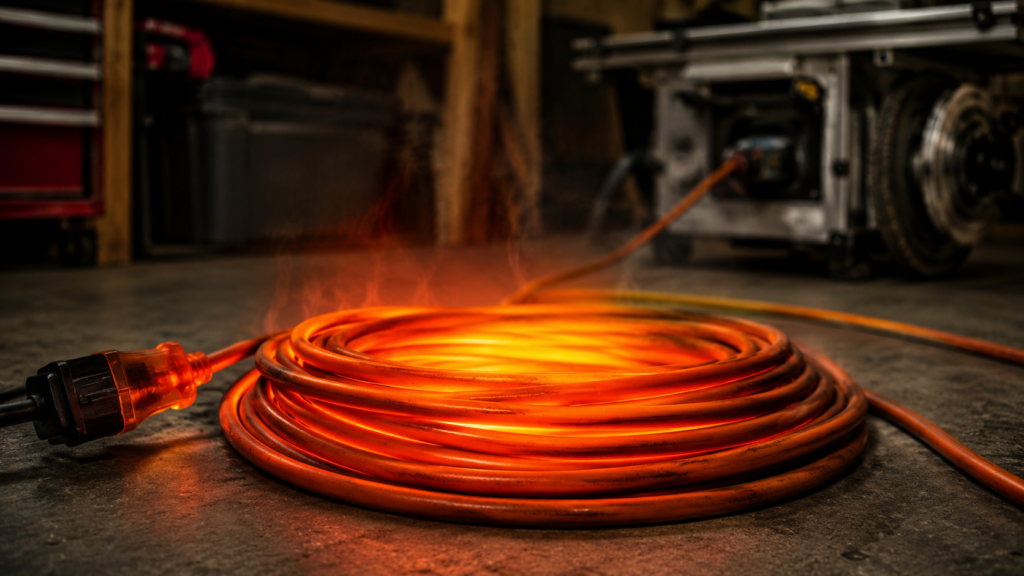
You need only five metres of cable, so the remaining twenty metres stay neatly wrapped around the reel.
Looks tidy. Sensible, even.
Then you connect a heater, lawnmower or pressure washer. After a while, the centre of the reel feels surprisingly warm. Perhaps the thermal cut-out trips. Perhaps there is a faint hot-plastic smell—which is the electrical equivalent of the cable clearing its throat before delivering some bad news.
So, why does an extension cord get hot when coiled?
Current flowing through the cable produces heat because the copper conductors have resistance. When the cable is stretched out, that heat can escape into the surrounding air. When many energized layers are wrapped tightly together, heat becomes trapped inside the reel.
The inner layers may become far hotter than the cable visible on the outside.
A coiled cable reel can therefore have a dramatically lower safe power rating than the same cable when it is fully unwound.
Every Cable Produces Some Heat
Copper is an excellent conductor, but it is not perfect.
Every metre of cable has a small amount of electrical resistance. When current flows through that resistance, some electrical energy is converted into heat.
The relationship is:
Power lost as heat = Current² × ResistanceOr:
P = I²RThe squared current is the important part.
If the current doubles, the heat produced by the same cable resistance increases four times.
For example:
5 A through a fixed resistance:

5² = 25
At 10 A:
10² = 100The current has doubled, but the heating effect has increased by a factor of four.
This is why a cable may remain cool while powering a lamp or laptop charger but become dangerously hot when connected to a powerful heater.
A Long Extension Cord Has More Resistance
The longer the cable, the greater its total conductor resistance.
Remember that current must travel through both the line conductor and the neutral conductor. A 25-metre extension lead therefore contains roughly 50 metres of current-carrying loop length.
As a simplified example, a 25-metre extension using 1.5 mm² copper conductors may have a line-and-neutral loop resistance somewhere around 0.6 Ω, depending on the exact cable and its temperature.
At 10 A:
P = 10² × 0.6

P = 60 W
That is approximately 60 watts of heat distributed along the cable.
When the lead is stretched out, 60 watts spread over 25 metres may be released into the air without creating an alarming temperature.
Wrap those same 25 metres tightly around a plastic drum and much of the heat is concentrated inside a small space.
Now the situation looks rather different.
Coiling Does Not Create the Heat—It Traps It
A common explanation says the cable becomes hot because the coil acts like a large electrical inductor.
That is not the main cause in an ordinary extension cord.
The line and neutral conductors run next to each other. Their currents travel in opposite directions at any given moment, so their magnetic fields largely oppose one another. The cable does not behave like a simple coil made from one isolated conductor.
The real problem is much less exotic:
- Current produces resistive heat along the conductors.
- The cable is wrapped in many close layers.
- Each warm layer heats the cable beside it.
- Air cannot circulate effectively between the layers.
- The centre of the reel becomes progressively hotter.
It is rather like sleeping under one blanket versus twenty blankets.
Your body produces the same heat either way. The difference is how easily that heat can escape.
Why the Centre of the Reel Gets So Hot
The outer cable layers can release some heat into the surrounding air.
The inner layers cannot.
They are surrounded by:
- More warm cable
- The reel drum
- Limited airflow
- Insulating plastic or rubber
- Heat produced by neighbouring conductors
As the cable temperature increases, the electrical resistance of copper also rises. Higher resistance produces additional heat at the same current.
That creates a feedback effect:
Current produces heat
↓
Heat raises conductor resistance
↓
Higher resistance produces more heat
↓
Cable temperature continues rising
Eventually, the cable may reach the operating point of its thermal protection.
Without effective protection—or if the reel is badly overloaded—the insulation can soften, deform or melt.
Cable-reel manufacturer Brennenstuhl warns that the centre of a loaded coiled reel can become extremely hot because the heat cannot dissipate properly. It recommends fully unwinding the cable to prevent insulation damage and fire.
Coiled and Uncoiled Power Ratings Are Different
Many cable reels display two maximum-load ratings:
- Maximum load while fully wound
- Maximum load while fully unwound
These ratings can be dramatically different.
For example, a reel may be capable of carrying close to its full socket rating when completely unwound, but only a small fraction of that load while the cable remains wrapped around the drum.
Electrical Safety First notes that the safe current rating of some cable reels may be only around 3 or 4 A while wound, even though a much higher rating applies when fully unwound. The exact figures depend on the reel, cable construction and manufacturer.
Never assume that a reel fitted with a 13 A or 16 A plug can carry that current while coiled.
The plug rating is not necessarily the coiled-cable rating.
How to Read a Cable-Reel Rating
Look for a label on the reel body, socket panel or nameplate.
It may show information similar to:
Fully wound: 1,000 W maximum
Fully unwound: 3,000 W maximum
Another reel may use current instead:
Wound: 4 A
Unwound: 13 A
To estimate appliance current:
Current = Power ÷ VoltageFor a 2,000 W heater on a 230 V supply:
2,000 W ÷ 230 V ≈ 8.7 AThat may be acceptable for a properly rated, fully unwound reel.
It could greatly exceed the same reel’s wound rating.
Where several devices are plugged into one reel, add their power or current together. Four sockets do not provide four separate cable capacities. Every connected appliance shares the same extension cable and plug.
Why High-Power Appliances Are Particularly Dangerous
High-power appliances draw substantial current for long periods.
Common examples include:
- Portable electric heaters
- Electric kettles
- Tumble dryers
- Washing machines
- Pressure washers
- Lawnmowers
- Air compressors
- Welders
- Large power tools
- Cooking appliances
- Portable air conditioners
A laptop charger drawing 60 W places very little load on a cable reel.
A 2,500 W heater is another story.
The heater may draw current continuously for hours, producing heat along the entire extension cable. If that cable remains tightly wound, the temperature inside the reel can continue climbing even though the visible outer section looks normal.
The London Fire Brigade advises fully unwinding drum extension leads because coiled reels can overheat and cause a fire. It also warns against overloading extensions with high-power appliances such as heaters, kettles and tumble dryers.
Space Heaters Deserve Special Caution
Portable heaters are responsible for a particularly demanding load because they often operate close to the maximum capacity of a household socket.
They also run for extended periods.
The U.S. Consumer Product Safety Commission recommends plugging portable electric space heaters directly into a wall outlet rather than using an extension cord or power strip, because overloaded connections can create a fire hazard.
That is sensible advice beyond the United States too.
A heater may appear to work perfectly through an extension lead while the plug, socket or cable is slowly overheating.
The fact that warm air is supposed to come from the heater does not mean it should also come from the cable reel.
Motors Can Draw Extra Current During Starting
Motor-driven equipment may briefly draw considerably more current while starting than it does during normal operation.
Examples include:
- Compressors
- Pumps
- Refrigerators
- Lawnmowers
- Workshop machinery
- Pressure washers
A correctly rated extension cable should accommodate the equipment’s operating requirements, including starting conditions.
An undersized or excessively long lead can create voltage drop. The motor may struggle to start, remain at high current for longer or repeatedly restart.
That can heat:
- The extension cable
- The plug
- The reel socket
- The motor windings
- Internal starting components
Using a thinner cable merely because the plug fits is not a bargain. It is a slower, warmer route to the same appliance.
Cable Thickness Matters
Extension cables are available with different conductor cross-sectional areas.
Common examples include:
- 0.75 mm²
- 1.0 mm²
- 1.5 mm²
- 2.5 mm²
A thicker conductor generally has lower resistance and can safely carry more current, assuming the cable, plug and connectors are all correctly designed.
Cable capacity also depends on:
- Cable length
- Insulation type
- Ambient temperature
- Installation method
- Number of loaded conductors
- Reel design
- Plug and socket ratings
- Whether the cable is wound or unwound
A thick-looking outer jacket does not prove that the copper inside is sufficiently large.
Poorly manufactured extension leads have been recalled because undersized conductors overheated under normal loads, creating shock and fire hazards.
Use a properly certified cable from a reputable manufacturer, and check its marked rating.
Why the Circuit Breaker May Not Trip
People often assume the house breaker will disconnect the circuit before the reel becomes dangerously hot.
Not necessarily.
The circuit breaker protects the fixed wiring against excessive current. A household circuit may legitimately allow 13 A, 16 A or more, depending on the installation.
The cable reel’s safe wound rating may be much lower.
For example:
House circuit protection: 16 A

Cable reel wound rating: 4 A

Connected load: 9 A
The reel is overloaded while wound, but the current remains below the building circuit breaker’s rating.
The breaker sees no reason to trip.
Meanwhile, the reel becomes hotter and hotter.
An RCD or GFCI does not solve this problem either. Those devices detect current leaking from its intended path. They are not designed to protect a normally conducting cable against every overload or trapped-heat condition.
What Does the Thermal Cut-Out Do?
Many cable reels contain a thermal cut-out positioned near the socket assembly or drum.
When the internal temperature becomes excessive, it disconnects the load.
After the reel cools, some models can be reset using a button. Others reset automatically or require a different procedure.
A thermal cut-out is useful backup protection.
It should not be treated as a normal operating switch.
Masterplug and Brennenstuhl both describe thermal protection as a safeguard against overheating when a reel is overloaded or not fully unwound.
If the thermal cut-out trips:
- Switch off the connected equipment.
- Unplug the reel from the wall.
- Disconnect all appliances.
- Fully unwind the cable.
- Allow the reel to cool in a safe location.
- Inspect it for damage before using it again.
- Follow the manufacturer’s reset instructions.
Repeatedly pressing the reset button without correcting the overload is not troubleshooting.
It is asking the thermal protection to keep winning the same argument.
Why Partial Unwinding May Not Be Enough
Pulling out only the length you need leaves most of the heat-producing cable on the reel.
Even if the appliance is several metres away, the remaining energized section still carries exactly the same current.
The unused cable is not electrically inactive.
It may be sitting on the drum doing no useful work, but it still has resistance and still produces heat.
For a high load, fully unwind the reel and lay the cable loosely where air can circulate.
Do not leave the spare cable:
- In a tight pile
- Under a rug
- Beneath furniture
- Inside a closed box
- Wrapped around a hook
- Covered by clothing or insulation
- Trapped in direct sunlight
Electrical Safety First recommends fully unwinding cable reels, using models with thermal cut-outs and checking regularly for burning smells or visible damage.
Does the Cable Need to Be Straight?
No.
The cable does not have to form a perfectly straight line across the garden like a surveyor’s marker.
It should simply be fully removed from the drum and arranged loosely so heat can escape.
Avoid tight coils and compact piles.
Also keep it away from:
- Vehicle tyres
- Sharp edges
- Doorways
- Hot surfaces
- Standing water
- Moving machinery
- Areas where people may trip
Do not create one safety improvement while introducing three new hazards.
Signs the Cable Has Become Too Hot
A dangerously hot cable reel may show several warning signs:
- The reel feels hot to the touch
- The cable feels unusually soft
- A hot-plastic smell appears
- The thermal cut-out repeatedly trips
- The plug or socket becomes discoloured
- The cable jacket looks glossy or melted
- The reel drum becomes distorted
- Connected equipment loses power intermittently
- Crackling or buzzing is heard
- The plug pins become unusually hot
- Brown or black marks appear around the sockets
Stop using the reel immediately when these signs appear.
Do not wait for visible smoke.
Signs of Damaged Cable Insulation
Inspect the full cable before use, particularly after an overheating event.
Look for:
- Cuts
- Cracks
- Splits
- Flattened sections
- Exposed inner insulation
- Visible copper
- Melted areas
- Hard or brittle sections
- Soft or sticky insulation
- Blisters
- Scorch marks
- Unusual discolouration
- Damage near the plug or reel entry point
Flex the cable gently while it is disconnected. Cracking or stiffness can indicate aged or heat-damaged insulation.
Do not repair a seriously damaged mains extension lead by wrapping ordinary tape around it.
Tape may hide the conductor while providing inadequate mechanical strength, insulation or moisture protection. Replace the lead or have an appropriate repair performed by a qualified person where the product is designed to be repaired.
A black band of tape is not a factory reset.
Check the Plug and Reel Sockets Too
The cable itself is not the only part that can overheat.
High resistance may develop at:
- Loose plug pins
- Worn reel sockets
- Internal screw terminals
- Damaged crimps
- Corroded contacts
- Poor-quality adapters
- Partially inserted plugs
A connector with poor contact can become hot even when the cable is correctly rated and fully unwound.
Warning signs include:
- A loose-fitting appliance plug
- Buzzing or crackling
- Localized melting
- Brown marks around one pin
- A burnt smell near the socket panel
- Heat concentrated at the wall plug
Stop using the reel if the plug or socket becomes hot. Replacing the cable alone will not repair a burned internal contact.
Is Slight Warmth Normal?
A loaded extension cord may become mildly warm, especially when carrying substantial current for a long time.
It should not become:
- Painfully hot
- Soft
- Smelly
- Discoloured
- Uncomfortable to hold
- Hotter with every passing minute
There is no reliable household rule such as “warm is fine up to this exact hand temperature.”
When the temperature seems abnormal, disconnect the equipment safely and investigate.
Your fingers are not calibrated test instruments, but they are fairly good at reporting that a plastic cable should not feel like a heated towel rail.
Automatic Retractable Reels Can Overheat Too
A wall-mounted or automatic retractable reel may look more sophisticated than a portable drum, but the same basic heating issue can apply.
If most of the cable remains inside the enclosure while carrying a heavy current, heat can accumulate around the stored cable.
Some retractable reels are designed with specific ventilation, thermal protection and load ratings for partially extended operation.
Others require the cable to be extended fully for higher loads.
Follow the product label and manufacturer’s instructions.
Do not assume the spring mechanism somehow removes electrical resistance.
It is clever, but not that clever.
Never Daisy-Chain Extension Leads
Connecting one extension lead into another increases total cable length and adds extra plug-and-socket connections.
That can create:
- Greater voltage drop
- More conductor resistance
- Additional heating
- More possible loose contacts
- Confusing load calculations
- Increased trip and damage hazards
Electrical Safety First advises using only one extension lead or reel per wall socket and avoiding the practice of connecting extensions together.
Where extension leads are needed regularly in one location, a better solution may be to have additional fixed sockets installed by a qualified electrician.
Safe Cable-Reel Checklist
Before connecting an appliance:
- Check the appliance power rating.
- Check the reel’s wound and unwound ratings.
- Add together the ratings of all connected appliances.
- Fully unwind the reel for substantial loads.
- Confirm the lead has suitable conductor size and length.
- Check that a thermal cut-out is fitted.
- Inspect the full cable for damage.
- Make sure plugs fit firmly.
- Keep the cable dry and properly positioned.
- Use equipment suitable for outdoor conditions where required.
- Use RCD protection for outdoor equipment where applicable.
- Never exceed the manufacturer’s marked rating.
- Do not cover, bundle or tightly loop the energized cable.
If you are unsure whether the reel is suitable, use a correctly rated alternative or connect the appliance directly to an appropriate wall socket.
Common Cable-Reel Myths
“Only the cable section being used carries current”
No.
The entire cable between the wall plug and connected appliance carries the same circuit current, including the portion remaining on the reel.
“The reel gets hot because it becomes an electromagnet”
Not mainly.
Normal resistive heating occurs in the conductors, while the coiled arrangement prevents that heat from escaping.
“A 13 A plug means the reel can always carry 13 A”
No.
The cable reel may have a much lower rating while wound.
“The circuit breaker will trip before anything overheats”
Not necessarily.
The reel can exceed its wound rating while remaining below the rating of the building circuit breaker.
“A thermal cut-out means I can leave the cable coiled”
No.
Thermal protection is a backup. It does not replace correct loading and full unwinding.
“If the outside of the reel feels cool, the inside must be cool”
No.
The centre can be significantly hotter because it is surrounded by layers of cable and has very little airflow.
“Once the reel cools, any damage is gone”
No.
Overheating may permanently weaken insulation, deform sockets or damage internal connections.
The Practical Answer
So, why does an extension cord get hot when coiled?
Because current flowing through the cable’s resistance produces heat.
When the cord is fully extended, that heat can escape along its length. When the cable is tightly wound, the layers insulate one another and trap heat inside the reel. The centre can become dangerously hot even when the outer cable does not look alarming.
High-power appliances make the problem much worse because cable heating rises with the square of current.
A coiled cable reel may therefore have only a fraction of its fully unwound power capacity.
Before using one:
Read the rating, add the connected loads and fully unwind the cable.
If the reel becomes hot, smells of burning plastic or repeatedly trips its thermal protection, disconnect it immediately and inspect it for damage.
A tidy coil is excellent for storage.
While powering a 2,000-watt appliance, though, tidy can get surprisingly expensive.