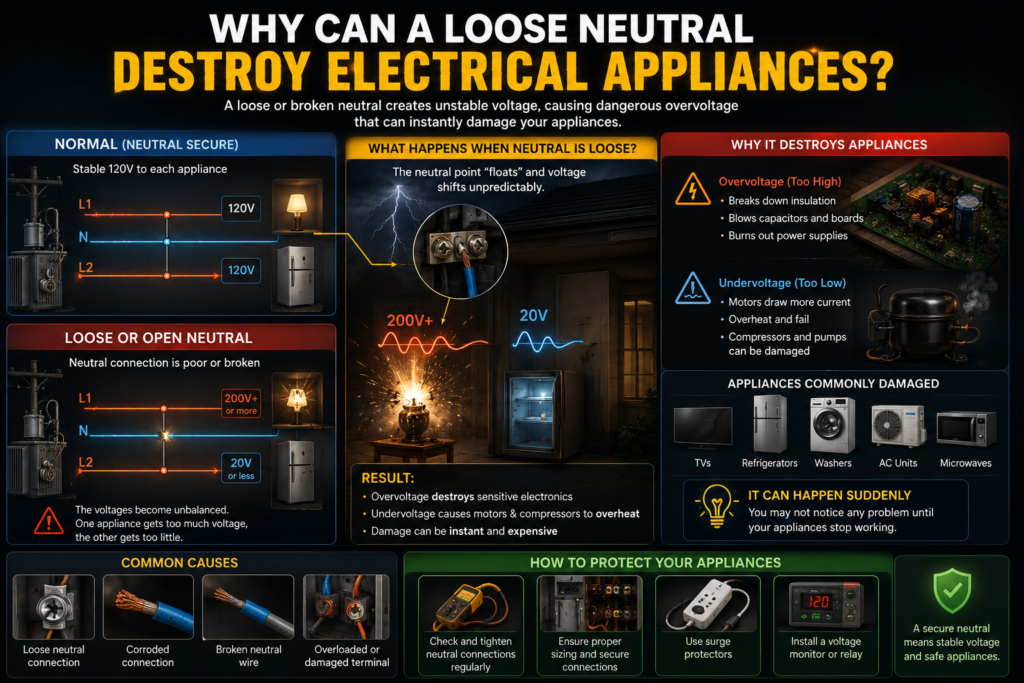
The kitchen lights become strangely bright when the kettle switches on.
Meanwhile, a lamp in the next room dims to a weak orange glow. The television restarts, the refrigerator sounds unhappy, and a phone charger that worked perfectly yesterday suddenly stops working altogether.
That is not a normal power fluctuation.
It may be one of the most serious loose neutral symptoms.
A damaged neutral connection can make the voltage across different circuits unstable. Some appliances may receive too little voltage, while others are exposed to far more than they were designed to handle.
The neutral conductor does not regulate voltage by itself, but it provides a stable return connection to the supply transformer’s neutral point. When that connection becomes loose, highly resistive or completely open, the neutral point can begin to “float.”
Then the connected loads effectively decide how the available voltage is divided.
Appliances are not especially good at negotiating.
What Does the Neutral Conductor Do?
In a normal single-phase circuit, current travels from the supply through the line conductor, passes through the appliance and returns through neutral.
The basic path is:
Line
↓
Appliance
↓
Neutral
↓
Supply transformer
Neutral is therefore a normal current-carrying conductor.
At the supply transformer, the neutral point is connected to the electrical system’s grounding arrangement. This keeps the line-to-neutral voltage relatively stable under normal operating conditions.
In a European low-voltage system, the nominal voltages are commonly around:
Phase to neutral: 230 V

Phase to phase: 400 V
The neutral allows ordinary 230 V appliances to operate between one phase and the transformer’s neutral point.
When that neutral connection is healthy, each circuit sees approximately the voltage it was designed to receive.
When the connection becomes loose, things get unpredictable rather quickly.
What Is a Loose Neutral?
A loose neutral is a neutral connection that is no longer mechanically or electrically reliable.
The conductor may still touch the terminal, but only through a small, damaged or intermittent contact area.
Possible causes include:
- A terminal that was never tightened correctly
- Thermal expansion and contraction
- Corrosion
- Vibration
- A damaged cable
- A burned connector
- Poor crimping
- An overloaded neutral
- A broken service conductor
- A faulty meter connection
- Damage to the utility network
- Rodents or mechanical impact
- Previous electrical work
A loose connection develops resistance.
When current flows through that resistance, it produces heat:
Power = Current² × ResistanceThe connection heats up, oxidizes and becomes less reliable. Its resistance may rise further, producing still more heat.
Eventually, the neutral may begin arcing or open completely.
A loose neutral can therefore create two separate dangers:
- Local overheating and fire risk at the bad connection
- Unstable or excessive voltage across connected appliances
Neither is particularly friendly.
A Loose Neutral Is Not Always the Same as an Open Neutral
The terms are often used interchangeably, but there is a useful distinction.
Loose neutral
The connection is still partly present, but it has excessive or changing resistance.
Voltage may fluctuate as loads switch on and off or as the damaged connection moves and heats.
Open neutral
The neutral connection is completely interrupted.
Depending on the circuit arrangement, appliances may stop working—or they may become connected in series across a higher phase-to-phase voltage.
A loose neutral can behave almost normally at light load and then become dangerous when a kettle, heater or motor starts.
That intermittent behaviour is one reason the fault can be difficult to locate.
Everything works while the electrician is driving over. Naturally.
What Is a Floating Neutral?
In a balanced three-phase system, the three phase currents can largely cancel one another.
If single-phase loads are connected unevenly across the phases, however, the loads are unbalanced and current must return through neutral.
When the neutral connection is lost, that return current can no longer follow its intended path.
The common load-neutral point then shifts electrically until the voltages across the connected loads reach a new balance. This shifting point is called a floating neutral.
The Institution of Engineering and Technology explains that when the neutral or PEN conductor in an unbalanced three-phase system becomes open circuit, the load star point can float and the line-to-neutral voltages shift according to the connected loads.
Instead of every appliance receiving a stable 230 V, one group might receive much less while another receives dangerously more.
The total voltage has not disappeared.
It has been divided differently.
Why One Circuit Can Receive Excessive Voltage
Consider two groups of appliances connected to different phases of a 400/230 V system.
Under normal conditions, each group is connected between its phase and neutral:
Phase L1 → Load A → Neutral

Phase L2 → Load B → Neutral
Each load receives approximately 230 V.
Now imagine that the neutral connection opens.
The two load groups may effectively become connected in series between L1 and L2:
L1 → Load A → Floating neutral point → Load B → L2The total voltage across both loads is now approximately:
400 VThat 400 V is divided according to the electrical impedance of the two load groups.
It will not necessarily divide evenly.
A Simplified Floating-Neutral Example
Suppose one load has an effective resistance of 100 Ω and another has 900 Ω.
Connected in series across 400 V:
Total resistance = 100 Ω + 900 Ω

Total resistance = 1,000 Ω
The current is:
Current = 400 V ÷ 1,000 Ω

Current = 0.4 A
The voltage across the 100 Ω load becomes:
V = 0.4 A × 100 Ω

V = 40 V
The voltage across the 900 Ω load becomes:
V = 0.4 A × 900 Ω

V = 360 V
One load receives only 40 V.
The other receives 360 V despite being designed for approximately 230 V.
Real household appliances are not simple fixed resistors. Their electronics, motors and heating elements change behaviour as voltage changes, so the actual voltage may jump around as equipment switches on, fails or disconnects.
Still, the simplified example shows why the fault is so destructive.
The lightly loaded phase often experiences the larger voltage rise, while the more heavily loaded phase experiences undervoltage.
How This Happens in North American Split-Phase Systems
A similar problem can occur in a 120/240 V split-phase supply.
The transformer secondary has a centre-tapped neutral:
Line 1 to neutral: approximately 120 V

Line 2 to neutral: approximately 120 V

Line 1 to Line 2: approximately 240 V
When the centre neutral opens, the 120 V loads on both sides may become series-connected across 240 V.
The voltage division then depends on the connected loads.
One side might fall to 80 V while the other rises to 160 V. Switch another appliance on and the voltages may change again.
The electrical system begins behaving like a badly designed seesaw.
What Happens in an Ordinary Single-Phase Circuit?
An important distinction: not every loose neutral immediately produces overvoltage.
In a simple circuit with one line, one neutral and one load, a completely open neutral normally breaks the circuit and stops current from flowing.
The appliance switches off.
A loose, high-resistance neutral may still cause:
- Voltage drop
- Flickering
- Intermittent operation
- Heating at the connection
- Arcing
- Low voltage at the appliance
The dramatic overvoltage problem occurs when several loads share a neutral reference, such as in:
- Three-phase, four-wire supplies
- North American split-phase systems
- Shared-neutral circuits
- Certain multiwire branch circuits
- Generator systems with an incorrect neutral arrangement
- Building or utility service-neutral faults
So a damaged neutral in one lamp circuit and a broken service neutral are not necessarily the same fault.
Both require attention, but the service-neutral fault can affect an entire property.
Loose Neutral Symptoms
The symptoms depend on where the bad connection is located and which loads are operating.
Some warning signs are subtle.
Others are about as subtle as a toaster bursting into flames.
Common loose neutral symptoms include:
- Lights that flicker for no obvious reason
- Lights becoming unusually bright
- Some lights becoming dim while others brighten
- Brightness changing when an appliance starts
- Appliances restarting randomly
- Televisions or computers switching off
- LED lamps failing repeatedly
- Motors changing speed
- Buzzing from appliances
- Intermittent power in several rooms
- Some sockets working while others behave strangely
- Voltage readings that change with load
- A hot or discoloured neutral terminal
- Burning smells from a distribution board or meter
- Crackling or arcing sounds
- Shocks or tingles from appliances, taps or metalwork
- Several appliances failing within a short period
An official utility neutral-integrity programme warns that a compromised neutral connection can lead to electric shocks, equipment damage and fire hazards.
Why Lights Flicker
A loose neutral introduces changing resistance into the circuit.
When a high-power appliance starts, neutral current increases. The resulting voltage drop across the poor connection becomes larger.
That can cause the voltage supplied to lighting circuits to fall or rise.
The lights may:
- Dim briefly
- Flicker continuously
- Pulse when a motor runs
- Change brightness when a heater starts
- Become brighter in one part of the house and dimmer elsewhere
One lamp dimming when a large motor starts can sometimes be caused by ordinary voltage drop.
Several circuits moving in opposite directions—some becoming brighter while others become dimmer—is far more suspicious.
Utility guidance treats dull or flickering lights, partial supply and inconsistent voltage as conditions that should not be ignored. Energex advises people experiencing inconsistent power not to touch the switchboard or metal objects in the home.
Why Unusually Bright Lights Are a Serious Warning
A lamp designed for 230 V may become noticeably brighter when exposed to excessive voltage.
This is not bonus lighting.
It means the lamp and other equipment on that phase may be receiving overvoltage.
Incandescent lamps may:
- Glow extremely brightly
- Become much hotter
- Burn out quickly
LED lamps may:
- Flicker
- Flash
- Fail suddenly
- Develop a burning smell
- Damage their electronic drivers
If lights become unusually bright, especially while other lights become dim, stop treating the situation as a defective bulb.
The wiring or supply may be unstable.
Why the Voltage Changes When Appliances Switch On
With a floating neutral, each connected appliance affects the voltage received by the others.
Switching on a kettle changes the load balance.
So does starting a refrigerator, heater, hair dryer or washing machine.
The voltage across another circuit may rise immediately.
Then the kettle switches off and the voltage changes again.
This is why loose-neutral symptoms may appear only when particular appliances are operating.
For example:
Kettle off:
Bedroom voltage appears normal

Kettle on:
Kitchen lights dim
Bedroom lights become very bright
Television restarts
The kettle is not necessarily defective.
It has merely changed the balance enough to reveal the neutral fault.
How Excessive Voltage Damages Appliances
Electronic appliances are designed to operate within a specified voltage range.
When the voltage rises too far, internal components experience greater electrical stress.
Possible failures include:
- Power-supply capacitors breaking down
- Surge-protection components overheating
- Rectifier diodes failing
- Switching transistors shorting
- LED drivers burning out
- Transformer insulation being overstressed
- Motor windings overheating
- Control boards failing
- Appliance fuses blowing
Official network guidance notes that excessively high supply voltage can damage appliances, while low voltage can cause flickering lights and poor power quality.
Modern electronics may contain surge-protection components, but those parts are not designed to absorb continuous overvoltage indefinitely.
A surge protector can help with a short transient.
It cannot turn 360 V into a healthy 230 V supply for half an hour.
Why Low Voltage Can Also Damage Equipment
The circuits receiving undervoltage are not automatically safe.
Some electronic devices simply switch off.
Others repeatedly attempt to restart, creating stress on their power supplies.
Motors may be particularly vulnerable.
A motor experiencing low voltage may:
- Struggle to start
- Draw excessive current
- Produce reduced torque
- Remain stalled
- Overheat
- Trip its protection
- Damage its windings
Compressors in refrigerators, freezers, air conditioners and heat pumps may repeatedly attempt to start under poor voltage conditions.
So a loose neutral can damage appliances on both sides of the imbalance:
- Overvoltage destroys insulation and electronics
- Undervoltage causes unstable operation and motor overheating
Nobody wins.
Why Some Appliances Survive While Others Fail
The voltage is not necessarily identical on every circuit.
Different appliances also respond differently.
A simple heater may tolerate a brief voltage disturbance better than a sensitive electronic control board.
Some power supplies have a wide input range. Others are designed closely around one nominal voltage.
The survival of one appliance does not prove that the supply was safe.
During the same fault:
- One lamp may burn out.
- A television may survive.
- A refrigerator compressor may overheat.
- A phone charger may fail silently.
- A heater may become excessively hot.
- Another appliance may simply switch off.
Damage can also be delayed. Components weakened by overvoltage may fail days or weeks later.
Three-Phase Neutral Faults
Three-phase systems are common in:
- Apartment buildings
- Commercial properties
- Workshops
- Farms
- Industrial sites
- Larger homes
- Public distribution networks
A balanced three-phase load, such as a correctly operating three-phase motor, does not normally require neutral current.
Single-phase loads are different.
Lighting, sockets, office equipment and household appliances are distributed across L1, L2 and L3. Utilities and electricians try to balance them, but exact balance is impossible because people constantly switch appliances on and off.
Under normal conditions, the neutral carries the remaining imbalance current.
When that neutral opens, the phase-to-neutral voltages shift.
The IET confirms that the floating star point moves until the voltages and connected loads reach a new electrical balance.
The phase-to-phase voltage may remain close to 400 V while individual phase-to-neutral voltages become wildly incorrect.
That detail can confuse troubleshooting.
An electrician measures 400 V between phases and thinks the supply looks fine.
Meanwhile, one phase-to-neutral circuit is being cooked.
The Fault May Be Inside the Property
A loose neutral can occur at:
- A wall socket
- A junction box
- A lighting connection
- The distribution board
- A main switch
- A neutral bar
- The electricity meter
- A service connection
- A generator changeover switch
- A UPS output
- A terminal inside an appliance
A fault affecting one circuit may be inside the building.
A fault affecting many unrelated circuits may be closer to the main board, meter or incoming supply.
Only proper testing can determine the location.
Do not start tightening random terminals.
A neutral conductor may be carrying current, and parts of the system can remain energized even when equipment appears not to be working.
The Fault May Be on the Utility Network
The problem can also occur outside the property.
Possible network causes include:
- A broken overhead neutral
- A damaged underground cable
- A loose service connection
- Storm damage
- Corrosion
- Vehicle impact
- Excavation damage
- A failed joint
- Metering equipment failure
If several neighbours experience flickering lights or damaged appliances at the same time, a network fault becomes more likely.
However, do not wait for a neighbourhood survey before reporting dangerous symptoms.
If your lights are alternating between cave and operating theatre, something is already wrong.
Broken PEN Conductors Are Even More Dangerous
In some electrical systems, one conductor performs both neutral and protective-earth functions for part of the network.
This is called a PEN conductor.
If it becomes loose or open, the installation may lose both:
- Its stable neutral reference
- Its protective connection to the supply earth
Exposed metalwork can then rise to a dangerous voltage relative to true earth.
Return current may seek alternative paths through:
- Water pipes
- Gas pipes
- Cable screens
- Structural metalwork
- Telecommunications cables
- A person touching metal and earth simultaneously
The IET warns that a broken PEN conductor can cause the neutral point to float and can create hazardous diverted neutral currents through bonded metal services.
A tingle from a tap, appliance enclosure, sink or shower fitting is therefore an urgent warning.
Do not test it a second time to make sure.
Why Circuit Breakers May Not Trip
A loose neutral does not necessarily produce a short circuit.
The currents may remain below the ratings of the circuit breakers, even while the voltages across individual loads become dangerously high or low.
The breaker sees ordinary-looking current.
It does not directly know that one circuit is receiving 300 V.
An RCD may not trip either if the outgoing and returning currents remain balanced and no meaningful current leaks to earth.
Protective devices are essential, but an ordinary breaker or RCD cannot correct a floating-neutral voltage imbalance.
Special overvoltage, undervoltage or phase-monitoring relays may provide additional protection in some installations.
Can a Surge Protector Save the Appliances?
Not reliably.
A surge-protection device is mainly intended to limit short-duration transient overvoltages caused by events such as lightning or switching.
A loose neutral can create sustained abnormal voltage lasting seconds, minutes or longer.
A plug-in surge protector may:
- Disconnect internally
- Damage its protective components
- Overheat
- Fail to protect the connected appliance
Whole-building voltage-monitoring protection can disconnect the supply when voltage moves outside a permitted range, but it must be correctly selected and installed.
It is additional protection.
It does not repair the neutral.
Warning Signs Requiring Immediate Attention
Contact an emergency electrician or the electricity network operator when you notice:
- Lights suddenly becoming extremely bright
- Some rooms brightening while others dim
- Several unrelated appliances restarting
- Power changing when large loads switch on
- Repeated failure of LED lamps or chargers
- A burning smell near the meter or switchboard
- Buzzing, crackling or arcing
- A hot or discoloured neutral connection
- Partial power across the property
- Multiple appliances failing together
- Tingling from taps, showers or metal appliances
- Similar symptoms at neighbouring properties
- Visible damage to the incoming service cable
These symptoms can indicate more than an inconvenient voltage problem.
They may involve fire and electric-shock hazards.
What Should You Do?
Do not open the distribution board or attempt to tighten the neutral yourself.
A neutral is a live circuit conductor and may carry substantial current. During a supply fault, its voltage relative to earth may also be dangerous.
When abnormal voltage is suspected:
- Stop using high-power appliances.
- Keep people away from the switchboard, meter and exposed metalwork.
- Do not touch taps or appliances that have produced a shock or tingle.
- Disconnect sensitive appliances only when this can be done safely.
- Contact an emergency electrician or electricity network operator.
- Mention flickering, unusually bright lights and suspected neutral failure clearly.
- Warn neighbours if the problem appears to affect several properties.
- Do not restore power until the installation has been declared safe.
Utility safety guidance advises people who feel shocks or tingles from appliances, taps or metalwork to stay clear and report the condition immediately.
If the switchboard is hot, buzzing, smoking or producing a burning smell, do not approach it unnecessarily.
Call emergency services if there is fire or immediate danger.
Should You Switch Off the Main Power?
Only when it can be done safely.
If the main switch is readily accessible, dry, cool and showing no signs of damage, disconnecting the supply may reduce appliance damage.
However, do not touch the switchboard when:
- It is hot
- It is buzzing or crackling
- Smoke is present
- Water is nearby
- You have received a shock or tingle
- Metalwork may be energized
- The supply cable appears damaged
- You are uncertain about the risk
Energex specifically advises people experiencing partial or inconsistent supply not to touch the switchboard or metal objects.
Personal safety comes before saving the television.
How an Electrician Diagnoses a Loose Neutral
A qualified electrician may check:
- Line-to-neutral voltage on every phase
- Phase-to-phase voltage
- Neutral-to-earth voltage
- Voltage while large loads operate
- Neutral continuity
- Terminal temperature
- Signs of arcing or overheating
- The main neutral bar
- Meter and service connections
- Shared-neutral arrangements
- Generator and inverter changeover systems
- Appliance damage
The electrician may deliberately switch test loads while monitoring voltage changes.
A utility technician may need to inspect:
- The service neutral
- Metering connections
- Street distribution equipment
- Overhead conductors
- Underground joints
- Transformer connections
The fault location must be identified before damaged appliances are replaced.
Otherwise, the new television may last approximately as long as the receipt remains warm.
Common Loose-Neutral Myths
“Neutral is at zero volts, so it cannot be dangerous”
Wrong.
Neutral carries load current and can develop voltage. During an open-neutral or PEN fault, it may rise to a dangerous potential relative to earth.
“A loose neutral only makes lights flicker”
No.
It can cause overvoltage, undervoltage, appliance damage, overheating, arcing, electric shock and fire.
“If the breaker has not tripped, the supply must be safe”
No.
The current may remain below the breaker rating while the voltage across individual loads becomes dangerously abnormal.
“A surge protector will handle it”
Not necessarily.
A loose neutral can create sustained overvoltage rather than a brief surge.
“Only old houses get loose neutrals”
No.
Loose connections can occur in new and old installations because of poor termination, damaged equipment, vibration, corrosion or network faults.
“Turning off one appliance fixes the voltage”
It may temporarily change the voltage balance.
It does not repair the fault.
“The appliance that caused the lights to change must be defective”
Not always.
Switching on a healthy high-power appliance may simply reveal an existing loose neutral by changing the load balance.
The Practical Answer
So, why can a loose neutral destroy electrical appliances?
Because the neutral keeps single-phase loads referenced to a stable point on the supply transformer.
When that connection becomes loose or open in a split-phase or three-phase system, the common neutral point can float. Connected loads may then form an unbalanced series circuit across the full line-to-line voltage.
One circuit receives too little voltage.
Another receives far too much.
The most important loose neutral symptoms include:
- Flickering lights
- Some lights becoming unusually bright
- Other lights becoming dim
- Appliances restarting
- Voltage changing when loads switch on
- Burning smells
- Tingling from metalwork
- Several appliances failing together
These signs require urgent professional attention.
Do not keep operating appliances to see whether the voltage settles down. Do not open the switchboard and tighten terminals unless you are qualified and the installation has been safely isolated.
A loose neutral rarely improves through patience.
It usually gets hotter, more unstable and more expensive.