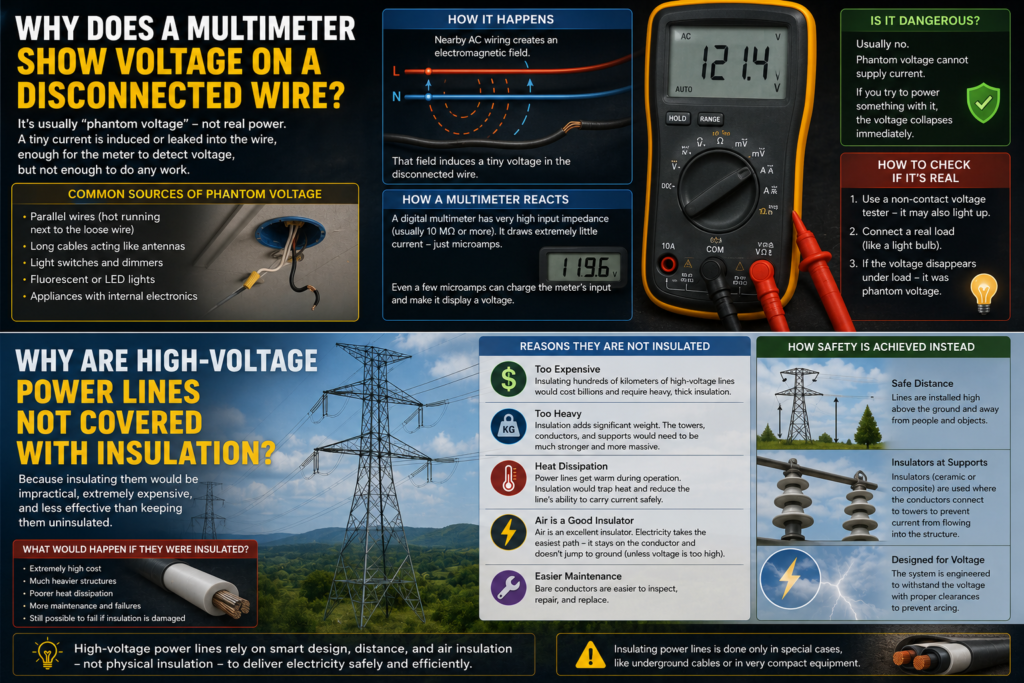
A cable inside your home has plastic insulation around it.
An extension lead has insulation. So does a phone charger, an appliance cord and nearly every wire inside an electrical cabinet.
Then you look up at a high-voltage transmission tower and see enormous metal conductors hanging completely bare.
No rubber. No plastic jacket. Nothing separating the aluminium from the open air.
That seems backwards. Surely the most dangerous wires should have the thickest insulation?
So, why are power lines not insulated?
High-voltage overhead lines use the surrounding air as their main insulation. The conductors are placed far enough apart—and far enough from towers, trees, buildings and the ground—that electricity normally cannot cross the air gap.
Adding solid insulation capable of withstanding transmission-level voltage would make the conductors much heavier, larger, more expensive and harder to cool. The towers would need to support the extra weight, while every joint, termination and repair would become more complicated.
The wires may be bare.
The electrical system around them is not unprotected.
Its insulation is simply measured in metres of air rather than millimetres of plastic.
Air Is an Electrical Insulator
Under ordinary conditions, dry air does not conduct electricity well.
The molecules in air are mostly electrically neutral, so there are relatively few free charge carriers available to sustain current. This allows a voltage difference to exist between two separated conductors without current flowing directly through the space between them.
That is the basic principle behind an overhead line:
Phase conductor
↓
Large air gap
↓
Another conductor, tower or ground
The U.S. Department of Energy describes the surrounding air and the distance between an overhead conductor and the ground as part of the line’s insulation system. National Grid documentation similarly explains that tower-mounted transmission conductors are bare and rely on the surrounding air for insulation.
Air is convenient because it is:
- Already present
- Lightweight
- Free
- Self-restoring after many minor electrical disturbances
- Able to carry heat away from the conductor
- Effective when adequate distances are maintained
No factory needs to wrap kilometres of atmosphere around the wire.
Nature has handled that part.
Air Can Break Down
Air is an insulator only up to a point.
When the electric field becomes strong enough, air molecules become ionized. The air then changes from a poor conductor into a conductive path capable of supporting an electrical arc.
This event is known as:
- Electrical breakdown
- Flashover
- Arcing
A person, crane, tree branch or vehicle does not necessarily need to touch a high-voltage conductor for current to cross the gap. Coming too close can be enough.
National Grid warns that bare overhead conductors can flash over when an object approaches too closely, creating a risk of fatal shock and severe burns. OSHA therefore requires overhead lines to be presumed energized and uninsulated unless the utility or a qualified engineer confirms otherwise.
The air is doing the insulating—but only while everyone respects its personal space.
Why Higher Voltage Requires Greater Spacing
As voltage increases, the electrical stress across an air gap becomes greater.
A small gap that is perfectly adequate for a low-voltage circuit may be completely unsuitable for a transmission line operating at tens or hundreds of kilovolts.
High-voltage lines therefore require carefully calculated distances between:
- Different phase conductors
- Conductors and tower steelwork
- Conductors and the ground
- Conductors and roads
- Conductors and buildings
- Conductors and trees
- Conductors and maintenance personnel
These distances are called electrical clearances.
They are chosen to account for more than the normal operating voltage. Engineers must also consider temporary overvoltages caused by lightning, switching operations and faults.
There must still be adequate separation when conductors:
- Swing in strong wind
- Sag during hot weather
- Accumulate ice
- Move under fault forces
- Vibrate
- Expand with temperature
The wire you see on a calm, cool morning is not always in the same position on a hot, windy afternoon.
Why Conductors Sag
Current flowing through a conductor produces heat because the metal has resistance.
As the conductor warms, it expands and becomes slightly longer. The additional length causes it to hang lower between towers.
This downward curve is called sag.
National Grid notes that greater electrical loading increases conductor temperature, which causes expansion and greater sag. Clearance requirements therefore account for the lowest position the conductor is expected to reach at its maximum design temperature.
That is why towers are so tall.
The conductors must remain safely above the ground even when they are carrying heavy current on a hot day with very little cooling wind.
Why Not Simply Add Plastic Insulation?
Insulating a domestic cable is relatively straightforward.
The voltage is modest, the cable is fairly small and the insulation thickness is manageable.
A high-voltage transmission conductor is a different creature entirely.
Solid insulation for high voltage must withstand:
- Continuous electrical stress
- Lightning impulses
- Switching surges
- Ultraviolet radiation
- Rain
- Ice
- Pollution
- Temperature cycling
- Mechanical movement
- Decades of outdoor exposure
A thin plastic coating would not be enough.
Proper high-voltage cable insulation requires a carefully engineered system with controlled material thickness, electric-field management, shielding and specialized terminations.
At transmission voltages, this would transform a relatively simple overhead conductor into a much larger and heavier cable.
Insulation Would Add Enormous Weight
A bare overhead conductor is already heavy.
Transmission conductors may contain aluminium strands, an aluminium alloy or a reinforced core designed to provide mechanical strength over long spans.
Now imagine surrounding every metre with a thick insulation system.
The extra material would increase:
- Cable diameter
- Weight per metre
- Wind loading
- Ice loading
- Mechanical tension
- Tower loading
- Required crossarm strength
- Installation difficulty
A transmission route may contain hundreds of kilometres of conductor. Even a moderate increase in weight per metre becomes substantial across that distance.
Towers, foundations, insulator strings and fittings would all need to be designed for the heavier cable.
The wire would no longer be the only thing gaining weight.
The invoice would become considerably heavier too.
Insulation Would Increase Construction Cost
Solid insulation suitable for high voltage is not ordinary household cable plastic.
The material must be manufactured with strict control over:
- Thickness
- Purity
- Voids
- Contamination
- Surface condition
- Electrical properties
- Weather resistance
Every connection would also need specialized treatment.
Bare overhead conductors can be joined using purpose-built compression connectors and mechanical fittings. A fully insulated high-voltage cable requires the electrical shielding and insulation system to remain continuous through every joint and termination.
That means:
- More expensive materials
- Specialized installation tools
- Longer installation times
- Highly trained jointers
- More complicated testing
- Greater repair costs
- More difficult fault location
Air does not need to be purchased by the kilometre, installed around the conductor or carefully restored after a repair.
It merely needs enough space.
Bare Conductors Lose Heat More Easily
Overhead conductors heat up as they carry current.
The amount of current a line can safely carry is partly limited by the maximum conductor temperature and the resulting sag.
A bare conductor can release heat directly into the surrounding environment through:
- Convection
- Wind cooling
- Thermal radiation
- Rain cooling
The Department of Energy describes how wind speed, wind direction, ambient temperature, sunlight and rain affect the temperature and current-carrying capacity of bare overhead conductors. In favourable wind conditions, greater cooling can allow a line to carry more power without exceeding its thermal limit.
A solid insulation layer would create additional thermal resistance between the metal and the air.
Heat would need to travel through the insulation before it could escape.
Depending on the cable design, this could mean:
- Higher conductor temperature
- Lower current capacity
- Greater sag
- Faster insulation ageing
- A need for larger conductors
- Reduced transmission efficiency
Leaving the conductor bare provides excellent access to cooling air.
On a windy day, the atmosphere is not only the insulation.
It is also the fan.
Why Underground Cables Are Insulated
Underground conductors cannot rely on open-air spacing.
The phases must be placed relatively close together inside trenches, ducts or tunnels. They may be surrounded by soil, concrete, water and grounded materials.
A bare underground conductor would immediately create a fault.
Underground high-voltage cables therefore need a complete insulation system, often including:
- The central conductor
- A conductor screen
- Thick solid insulation
- An insulation screen
- A metallic sheath
- Water-blocking layers
- Mechanical protection
- An outer jacket
These cables work extremely well, but they are more complex than bare overhead conductors.
Their heat must also pass through insulation, protective layers and surrounding soil before reaching the environment.
Overhead and underground lines solve the same electrical problem in very different ways:
Overhead line:
Bare conductor + air spacing

Underground cable:
Conductor + solid insulation + shielding
Neither approach is universally better.
Each fits a different environment.
Why the Tower Does Not Become Energized
The conductor cannot simply rest against the metal tower.
If it did, current would flow into the tower structure and create a major fault.
Instead, the conductor is supported by insulators.
National Grid documentation explains that glass or porcelain insulator strings maintain electrical separation between bare transmission conductors and the steel tower.
Modern overhead systems may use insulators made from:
- Porcelain
- Toughened glass
- Composite polymer materials
The insulator provides both:
- Mechanical support for the conductor
- Electrical separation from the grounded tower
That is an impressive workload for something that mostly appears to be hanging quietly from a crossarm.
Why Insulator Strings Are So Long
The required insulator length generally increases with voltage.
A higher-voltage line needs a longer electrical path between the energized conductor and tower steelwork.
The insulator must withstand voltage:
- Directly through its solid material
- Across the surrounding air
- Along its outer surface
That last route matters because insulator surfaces may become contaminated by:
- Dust
- Salt
- Industrial pollution
- Bird droppings
- Moisture
- Ice
Wet contamination can form a partially conductive film along the surface.
To make surface flashover less likely, insulators are shaped with multiple sheds or discs. These create a longer route along the surface, known as the creepage distance.
Electricity may be tempted to take a shortcut.
The insulator responds by turning the shortcut into a very long walk.
Why Some Lines Use Several Insulator Discs
On traditional glass or porcelain strings, each disc handles part of the total voltage.
Higher-voltage lines generally require more units in the string, although the exact number depends on:
- System voltage
- Insulator design
- Pollution level
- Local weather
- Altitude
- Lightning requirements
- Utility standards
The discs also make maintenance practical.
Individual damaged units may be identified and replaced, while the modular string can be adapted to different voltage levels and mechanical loads.
Composite insulators perform a similar job using a long fiberglass core with polymer sheds instead of a chain of separate glass or porcelain discs.
Different appearance.
Same essential mission: keep the conductor attached to the tower without electrically connecting it to the tower.
Why Phase Conductors Are Kept Far Apart
The three phase conductors operate at different instantaneous voltages.
If they move too close together, an arc can jump from one phase to another.
A phase-to-phase arc can release enormous energy and create:
- A short circuit
- Intense heat
- Molten metal
- Pressure
- Equipment damage
- A power outage
- Fire
Utilities therefore arrange conductors horizontally, vertically or in a triangular formation while maintaining sufficient separation.
The spacing must remain safe while the wires move in wind.
This is why large transmission towers look almost excessively wide.
The empty-looking space between the conductors is doing useful electrical work.
It is insulation you can see through.
Why Birds Can Sit on Bare Power Lines
A bird sitting on one conductor usually has both feet at nearly the same electrical potential.
Very little voltage exists across its body, so little current flows through it.
The bird becomes endangered if it simultaneously touches:
- Another phase
- A grounded tower
- An earth wire
- Another object at a different voltage
The same principle does not make a power line safe for humans.
A person approaching from a tower, ladder, tree, crane or ground creates a possible connection between the energized conductor and a different electrical potential.
Also, a bird is small enough to remain on one isolated conductor.
Most cranes are somewhat less graceful.
Why Rain Does Not Normally Short the Lines
Rainwater falling through air does not usually form one continuous, low-resistance path from the conductor to earth.
Individual droplets are separated from one another, and the system is designed to operate under expected weather conditions.
Insulators also have shapes that help manage water and surface contamination.
However, heavy pollution combined with moisture can increase leakage across insulator surfaces. Utilities account for this through:
- Greater creepage distance
- Suitable insulator materials
- Washing programmes
- Special coatings
- Pollution-resistant designs
Ice, salt spray and industrial contamination are genuine engineering concerns.
The line survives them not because rainwater is harmless, but because the insulation system has been designed with real weather in mind.
Are Lower-Voltage Overhead Lines Also Bare?
Many distribution lines are bare too.
Traditional medium-voltage and low-voltage overhead systems often use separate uncovered conductors supported on insulators.
However, covered or bundled systems are becoming common in certain locations.
The UK government notes that traditional low-voltage overhead networks have often used two to four bare conductors, while ageing systems may be replaced with aerial bundled cable.
The choice depends on factors such as:
- Voltage
- Tree exposure
- Population density
- Wildlife
- Wildfire risk
- Available space
- Reliability requirements
- Construction cost
Transmission lines and local distribution lines may both be overhead, but they do not necessarily use the same conductor design.
What Is a Covered Conductor?
A covered conductor has a polymer layer around the metal.
It looks insulated, and the covering can reduce faults caused by brief contact with:
- Tree branches
- Wildlife
- Debris
- Other covered conductors
Covered conductors are used selectively on distribution networks, especially in areas with heavy vegetation or wildfire risk. EPRI describes modern versions using materials such as polyethylene, cross-linked polyethylene and ethylene-propylene rubber.
But there is an important catch.
A covered conductor is not always the same thing as a fully insulated cable.
Covered Does Not Necessarily Mean Touch-Safe
Some overhead conductor coverings are intended primarily to reduce flashover during temporary contact.
They may not be rated to withstand the full line-to-ground voltage continuously under every condition.
EPRI warns that covered conductors are not a reliable safety barrier for workers or the public and must still be treated as bare energized conductors.
This distinction is easy to miss.
A black plastic-looking layer can create a dangerous sense of security.
It may be:
- Weather covering
- Tree-wire covering
- Partial insulation
- Full insulation
- Aerial bundled cable
Those systems have different ratings and purposes.
You cannot identify touch safety from the ground by judging how plastic the wire looks.
What Is Aerial Bundled Cable?
Aerial bundled cable, commonly called ABC, combines several insulated or covered conductors into one compact bundle.
It is often used on low-voltage distribution systems.
Potential advantages include:
- Reduced faults from conductor contact
- Less vulnerability to tree branches
- More compact construction
- Improved appearance
- Reduced risk of illegal connections in some areas
- Easier routing through narrow corridors
Because the conductors are bundled, the insulation system allows them to remain much closer together than traditional open-wire lines.
However, ABC is heavier and has different thermal and mechanical behaviour from bare conductors.
It is useful for local distribution.
It does not mean that wrapping a 400 kV transmission line in ordinary cable insulation has suddenly become practical.
Spacer Cable Systems
Another approach uses covered phase conductors held apart by insulating spacers and supported by a messenger wire.
EPRI describes spacer cable as a compact configuration that allows tighter construction where space is limited.
This type of system can be valuable in:
- Wooded corridors
- Urban areas
- Narrow rights-of-way
- Wildfire-prone regions
- Places with frequent animal contact
Again, the goal is often improved reliability rather than making the conductor safe to touch.
A covered energized line remains an energized line.
Why Covered Conductors Are Not Used Everywhere
If covering can reduce branch and animal faults, why not install it on every overhead line?
Because it introduces trade-offs.
Covered conductors may have:
- Higher material cost
- Greater weight
- More complex fittings
- More difficult inspections
- Specialized joining requirements
- Different heat-dissipation behaviour
- Polymer ageing from sunlight and heat
- Hidden damage beneath the covering
- More concentrated arc damage
EPRI notes that an arc can move along a bare conductor, spreading its heat, while covering may trap the arc at one location and cause concentrated burning or conductor failure. It also warns that a fallen covered wire may display fewer visible signs that it remains energized.
Bare conductors have disadvantages.
Covered conductors have different disadvantages.
Electrical engineering rarely offers a free lunch, and when it does, someone has usually forgotten to include the maintenance budget.
Why Fully Insulated Transmission Lines Are Uncommon
Full insulation becomes particularly difficult at very high voltage.
The insulation thickness is only part of the issue. Engineers must also control the electric field around:
- Cable ends
- Joints
- Suspension points
- Dead-end fittings
- Branch connections
- Test points
Sharp changes in geometry can concentrate electrical stress.
A small void, contamination particle or manufacturing defect inside solid insulation can develop into partial discharge and gradual insulation failure.
Air-insulated lines avoid many of these continuous solid-insulation problems by keeping the phases physically separated.
There is simply less material available to age.
Bare Conductors Are Easier to Inspect
Damage to a bare conductor may be visible during inspections using:
- Binoculars
- Drones
- Helicopters
- Cameras
- Infrared equipment
- Corona-detection equipment
Inspectors can look for:
- Broken strands
- Corrosion
- Hot connectors
- Mechanical wear
- Arc damage
- Sag problems
- Loose fittings
A thick covering can hide certain types of conductor damage until the outer layer is removed or specialized testing is performed.
Bare does not mean maintenance-free.
It does mean the conductor is not hidden inside a jacket for its entire service life.
Why Bare Conductors Often Use Aluminium
Many overhead lines use aluminium-based conductors because aluminium offers a useful combination of:
- Good electrical conductivity
- Low weight
- Availability
- Corrosion performance
- Cost
Some designs include a steel or composite core for mechanical strength.
Copper conducts electricity better for the same cross-sectional area, but it is heavier and usually more expensive.
Weight matters enormously when a conductor must span hundreds of metres between towers.
Adding insulation would work against one of aluminium’s major advantages: keeping the overhead system relatively light.
Why Undergrounding Is Not the Simple Alternative
People sometimes ask why utilities do not place all high-voltage lines underground instead.
Underground cables can reduce visual impact and exposure to wind, trees and certain external hazards.
They also introduce major challenges:
- Much higher installation cost
- Complex cable joints
- Difficult fault location
- Longer repair times
- Thermal limits imposed by soil
- Expensive transition stations
- Large construction disturbance
- Specialized reactive-power management for long AC cables
Overhead lines use distance and air.
Underground lines replace that open space with carefully manufactured insulation and shielding.
Both are valid technologies, but they have very different economics and maintenance requirements.
What Happens If Someone Touches a Bare Line?
Contact with an energized overhead conductor can allow current to pass through:
- The person
- A ladder
- A crane
- A tree
- A vehicle
- Scaffolding
- Another conductive object
The current then seeks a path toward another phase or earth.
The result may involve:
- Fatal electric shock
- Severe burns
- Electrical arcing
- Fire
- Ground-potential rise
- Step and touch voltage
- Energized machinery
High voltage may arc across an air gap before direct contact occurs.
OSHA requires power lines to be treated as energized and uninsulated unless the utility has confirmed otherwise, and its safety rules specify minimum approach distances that increase with voltage.
Never judge distance by eye while operating lifting equipment near overhead lines.
Perspective is unreliable.
High voltage is rather less forgiving.
A Fallen Line May Still Be Energized
A conductor lying on the ground may not spark, jump or make noise.
It can still be energized.
The ground around the contact point may also be at different voltages, creating dangerous step potential.
Do not approach a fallen line.
Do not attempt to move it with:
- Wood
- Rope
- A tool
- A vehicle
- Rubber gloves intended for household work
Keep others away and contact emergency services or the utility.
OSHA requires overhead lines to be presumed energized until the owner confirms that they have been de-energized and visibly grounded.
Silence is not isolation.
Common Power-Line Insulation Myths
“Bare power lines are unsafe by design”
No.
They are designed around air clearances, tower geometry, insulators and controlled access. They are dangerous to approach, but the lack of a plastic jacket is intentional.
“Air cannot insulate high voltage”
It can, provided the gap is sufficiently large and environmental conditions are considered.
“A plastic coating would make transmission lines completely safe”
Not necessarily.
Full-voltage insulation would need to be thick, carefully engineered and properly terminated. Ordinary covering may not be touch-safe.
“Covered overhead wires are safe to touch”
No.
Covered conductors may still need to be treated as bare energized lines.
“The wire must touch something before it shocks it”
No.
High voltage can flash over through air when an object comes too close.
“Rain automatically shorts overhead lines”
No.
Lines and insulators are designed for outdoor operation, although contamination and wet conditions influence insulation performance.
“Insulators cover the wire”
They do not.
They electrically separate the conductor from the supporting tower or pole.
“Bare lines cannot be used near trees”
They can, but vegetation must be managed. Covered conductors may be selected where tree-contact risk is particularly high.
The Practical Answer
So, why are power lines not insulated?
Because high-voltage overhead lines use air as their primary insulation.
The conductors are positioned far enough apart from one another, the towers and the ground that current cannot normally cross the air gap. Long glass, porcelain or composite insulators support the conductors while keeping them electrically separated from the grounded structures.
Adding solid insulation would create several problems:
- Much greater cable weight
- Higher material and installation costs
- Larger mechanical loads on towers
- More complicated joints and terminations
- Reduced heat dissipation
- More difficult inspection and repair
- Long-term ageing of the insulation itself
Bare conductors can release heat directly into the air, while wind provides valuable cooling.
Covered conductors and aerial bundled cables are used on some distribution networks, particularly where trees, wildlife, limited space or wildfire risk create problems. But a covered conductor is not always fully insulated and must not be assumed safe to touch.
The empty space around a transmission line is not wasted space.
It is part of the electrical equipment.
Air provides the insulation, the towers provide the height, the insulators separate the conductors from steelwork, and the clearances keep people and objects outside the danger zone.
The wire looks unprotected only because the most important part of its insulation is invisible.