Open a modern plug or electrical panel in much of Europe and one conductor should be immediately recognizable.
Brown may be live. Blue may be neutral.
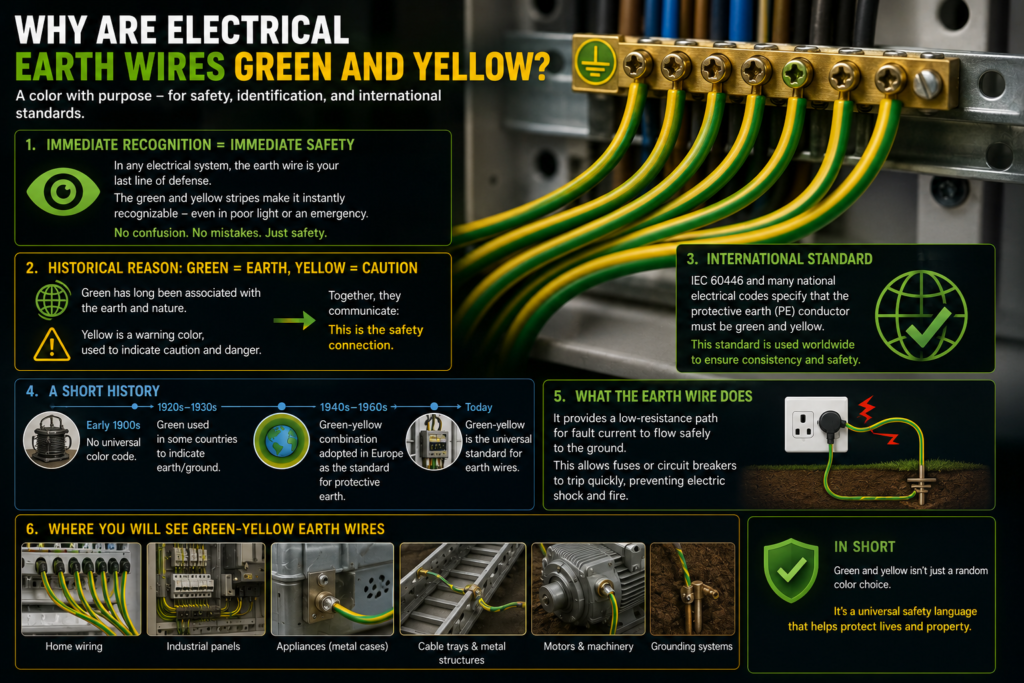
But the striped green-and-yellow wire has a special job: protective earth.
So, why is earth wire green and yellow rather than one ordinary colour?
The combination was standardized to make protective conductors easy to identify and difficult to confuse with normal current-carrying wires. Green and yellow used together create a distinctive pattern that can be recognized from different viewing angles, even when only a short section of the conductor is visible.
More importantly, the colour combination is reserved.
Under international IEC identification rules, green-and-yellow is the recognized colour combination for a protective conductor. It should not be casually reused for a live conductor, neutral, switched line or control signal. IEC 60445 provides common identification rules intended to remove ambiguity and support safe operation across cables, equipment and installations.
It is not decoration.
It is a warning, an instruction and a small piece of international safety language wrapped around a copper wire.
What Does the Earth Wire Actually Do?
The earth wire—more precisely called a protective conductor or protective earth conductor—connects exposed conductive parts of equipment to the installation’s protective grounding and bonding system.
These parts may include:
- Metal appliance enclosures
- Electrical-panel doors
- Motor frames
- Cable trays
- Metal junction boxes
- Machine structures
- Socket earth contacts
- Metal light fittings
During normal operation, the protective conductor should not carry the appliance’s ordinary load current.
Its main purpose appears during a fault.
Suppose the insulation inside a washing machine fails and the live conductor touches its metal enclosure.
Without a reliable protective conductor, the enclosure could remain energized. A person touching it while also connected to earth might provide the fault-current path.
With effective protective earthing, current has a deliberately installed route:
Live conductor
↓
Fault to metal enclosure
↓
Green-and-yellow protective conductor
↓
Grounding and bonding system
↓
Supply source
The resulting fault current should cause a fuse, circuit breaker or other protective device to disconnect the supply.
OSHA describes the equipment-grounding conductor as a fault-current return path that helps protective devices operate when insulation failure energizes metal equipment. It also distinguishes this conductor from neutral, which is an energized circuit conductor during normal operation.
The green-and-yellow wire is therefore not there to make the appliance work.
It is there to help prevent the appliance from killing someone when something goes wrong.
Why Is the Earth Wire Green and Yellow Instead of One Colour?
A single colour can be mistaken for another conductor, especially when wiring is:
- Dirty
- Faded
- Poorly lit
- Partly hidden
- Viewed through an enclosure
- Exposed only near a terminal
Using two colours creates a more distinctive visual pattern.
The green-and-yellow combination is applied so both colours remain visible around the conductor rather than one colour disappearing completely on the hidden side. The IET’s history of conductor identification explains that the manufacturing objective is to keep both colours visible when the wire is viewed from any angle.
That makes the conductor easier to recognize when only a few centimetres can be seen inside a plug, motor terminal box or crowded control cabinet.
It also gives the protective conductor an identity that ordinary single-colour wires do not share.
You may forget whether a particular project uses black, brown or grey for a phase conductor.
Green-and-yellow should require much less debate.
International Standardization Prevents Dangerous Guessing
Electrical equipment crosses borders.
A machine may be designed in Germany, assembled in Poland, installed in Lithuania and repaired years later using components supplied from Italy.
Without common identification rules, every technician would need to learn the original manufacturer’s private colour scheme before safely touching anything.
International standardization reduces that problem.
IEC 60445 establishes general rules for identifying electrical conductors and terminals using colours or alphanumeric markings. Its purpose is to avoid ambiguity and support safe operation, and the 2021 edition strengthened colour provisions for designated conductors from recommendations into requirements.
For many IEC-based installations, the familiar arrangement is:
Protective earth: Green and yellow

Neutral: Blue

Line conductors: Brown, black, grey or other permitted colours
The exact line colours depend on whether the circuit is single-phase, three-phase, fixed wiring, machinery wiring or another application.
The essential point is that the protective conductor receives a unique reserved identity.
A technician should not have to wonder whether the green-and-yellow conductor is earth today but a switched lighting wire on alternate Tuesdays.
Green-and-Yellow Is Reserved for Protection
The green-and-yellow combination is not merely the preferred earth colour.
It is reserved for protective purposes in systems following the relevant IEC rules.
IEC material identifies green-and-yellow as the recognized combination for protective conductors, and machinery guidance based on IEC 60204 likewise states that it should not be used for wiring other than protective or protective-bonding conductors.
That means it should not be repurposed as:
- A live conductor
- A switched live
- A neutral conductor
- A control signal
- A sensor wire
- A communications conductor
- A spare core carrying voltage
- A low-voltage DC conductor
Not even when someone has run out of brown wire at 4:55 on a Friday.
The whole value of a safety colour depends on everyone respecting it.
Once one electrician uses green-and-yellow for a live conductor, every future technician approaching that installation is placed at risk.
Why Coloured Tape Is Not a Good Excuse
People occasionally repurpose a green-and-yellow core and wrap brown, black or red tape around its ends.
The argument is usually that the tape identifies its new function.
The problem is that the conductor remains green-and-yellow throughout most of its length.
If it becomes exposed somewhere else—inside a junction box, cable tray, damaged sheath or future modification—it may still be mistaken for a protective conductor.
Someone may:
- Connect it to earth
- Touch it expecting it to be safe
- Remove it from a circuit believing it carries no operating current
- Bond metalwork to it
- Use it as a testing reference
For a conductor whose insulation is green-and-yellow throughout, a few centimetres of tape do not erase the safety meaning built into the rest of the cable.
Local wiring rules determine the exact permitted identification methods, but using a dedicated protective-conductor colour for another purpose defeats the reason the colour was reserved.
Saving one cable core is rarely worth creating a trap that may remain hidden for thirty years.
Earth and Neutral Are Not the Same Thing
Earth and neutral may be connected at a designated point in the electrical system.
That does not make them interchangeable.
They perform different functions.
Neutral conductor
Neutral normally carries current during ordinary operation.
In a simple single-phase circuit:
Line → Appliance → Neutral → SupplyThe appliance depends on neutral to complete the circuit.
Neutral may be close to earth potential under healthy conditions, but it can still carry substantial current and develop voltage because of conductor resistance, loose connections or faults.
Protective-earth conductor
Protective earth should not normally carry the appliance’s load current.
It connects exposed metal parts to the protective system so fault current can return to the source and operate protective devices.
OSHA summarizes the distinction clearly: neutral is an energized grounded circuit conductor, while the equipment-grounding conductor normally carries current only when leakage or a fault occurs.
Same installation.
Very different responsibilities.
Why Neutral Is Blue
In modern harmonized European wiring, blue is used to identify neutral where a neutral conductor is present.
This gives electricians a clear visual distinction:
Blue:
Normal current-return conductor

Green and yellow:
Protective conductor
The separation is vital because connecting neutral and earth incorrectly downstream can place normal load current onto:
- Protective conductors
- Metal enclosures
- Cable armour
- Pipework
- Bonding conductors
- Communication screens
It may also interfere with RCD operation and create dangerous voltage differences.
Neutral and earth may meet at a specific supply or service point according to the earthing arrangement.
That does not give installers permission to join them wherever convenient.
Why the Protective Conductor Must Be Easy to Recognize
During maintenance, an electrician may need to identify the protective conductor quickly while inspecting:
- A plug
- A distribution board
- A motor
- A machine panel
- An extension lead
- A socket
- A metal enclosure
- A junction box
The conductor may be surrounded by dozens or hundreds of other wires.
In an industrial control cabinet, most conductors may carry printed wire numbers, but the green-and-yellow protective connections still stand out immediately.
This helps during:
- Installation
- Inspection
- Continuity testing
- Fault finding
- Equipment replacement
- Emergency repairs
- Safety verification
Colour does not replace proper testing or documentation.
It provides a rapid first layer of identification.
A correctly coloured wire says, “This is intended to be part of the protective system.”
The electrician must still prove that it actually is.
Colour Is Identification, Not Proof
Never assume a conductor is safely earthed solely because its insulation is green and yellow.
It could be:
- Disconnected
- Broken
- Loosely terminated
- Corroded
- Connected to the wrong terminal
- Illegally repurposed
- Missing continuity
- Part of a defective extension lead
A green-and-yellow wire that stops halfway through a cable provides little protection.
Protective continuity must be tested using suitable procedures and equipment.
Similarly, never assume a blue conductor is a healthy neutral or a brown conductor is the only live wire present.
Old wiring, incorrect alterations, multiple supplies and poor workmanship can all make colours misleading.
Colour tells you what a conductor is supposed to be.
Testing tells you what electrical condition actually exists.
What Were the Older Wiring Colours?
Older wiring colours vary by country and period.
There was no single historical worldwide scheme, which is precisely why harmonization became valuable.
In older UK appliance flexes, a common arrangement was:
Live: Red

Neutral: Black

Earth: Green
Modern appliance flexes use:
Live: Brown

Neutral: Blue

Earth: Green and yellow
Electrical Safety First confirms this old-versus-modern comparison for plug wiring: red changed to brown for live, black changed to blue for neutral, and plain green changed to green-and-yellow for earth.
Older fixed wiring can be more complicated because cable type, installation date and circuit arrangement affect the colours present.
Other countries historically used different combinations again.
That is why old wiring should not be identified from internet colour charts alone.
Why Was Plain Green Replaced?
Plain green was historically used for earth in some systems.
The green-and-yellow combination provided a more distinctive international identifier and avoided relying on one ordinary colour that might be used differently elsewhere.
The bicolour system also reduces the likelihood that the conductor will be confused with another single-colour wire.
Once harmonized standards reserved the combination, manufacturers could produce cables, plugs and equipment for wider markets using the same protective-conductor identity.
That made maintenance safer and international trade easier.
A machine delivered from another IEC-based country would arrive with a protective conductor that local technicians already recognized.
No translation required.
Mixed Old and New Colours
Electrical installations are rarely rewired completely every time standards change.
As a result, one property may contain both old and newer conductor colours.
For example, an older circuit might use:
- Red line conductors
- Black neutral conductors
- Green or bare protective conductors with sleeving
A later extension might use:
- Brown line conductors
- Blue neutral conductors
- Green-and-yellow protective conductors
This creates opportunities for confusion.
Black, for example, was historically used as neutral in older UK single-phase wiring, while black can appear as a line conductor in newer harmonized multiphase arrangements.
The same colour does not always carry the same meaning across every installation and era.
Where mixed colours are present, appropriate warning labels, documentation and professional inspection become especially important.
An installation is not a history exam.
Guessing should not be part of the test.
Bare Protective Conductors
Not every protective conductor is fully insulated.
Some cables contain a bare copper circuit protective conductor. Green-and-yellow sleeving is placed over the exposed conductor at terminations to identify its function and prevent accidental contact with live terminals.
Metal cable armour, conduit or other approved conductive wiring systems may also form part of a protective path when properly designed and connected.
In North American systems, equipment-grounding conductors may be bare, green or green with yellow stripes, while neutral conductors are generally identified separately as white or grey. OSHA guidance emphasizes that grounded neutral and equipment-grounding conductors must be distinguishable from one another.
This is an important reminder:
Green-and-yellow is internationally familiar, but conductor-colour requirements are not identical in every country.
Always follow the rules applying to the installation’s location.
Is Green-and-Yellow Used Everywhere?
No.
It is widely used under IEC and harmonized European systems, and the combination is recognized in many other regions.
However, national codes differ.
Depending on the country and application, a protective conductor may be identified by:
- Green and yellow
- Green
- Bare copper
- A specific marking method
- A grounding symbol
- Numbered or labelled terminals
North American practice commonly uses green, green with yellow stripes or bare conductors for equipment grounding, while white or grey identifies the grounded neutral conductor.
So a traveller should not assume that every electrical installation on Earth follows the same colour chart.
International harmonization has reduced differences.
It has not erased them completely.
Protective Bonding Conductors Also Use Green and Yellow
The colour is not limited to the earth core inside a flexible appliance cable.
Green-and-yellow is also commonly used for protective bonding connections that join conductive parts to the equipotential protective system.
Examples include:
- Cabinet-door bonding straps
- Motor-frame connections
- Cable-tray bonds
- Earth-bar connections
- Machine-frame bonding
- Protective links around hinges or flexible joints
These conductors help keep accessible metal parts at approximately the same potential and provide a reliable fault path.
They should not be mistaken for functional wiring.
A green-and-yellow strap across an electrical-panel door is not there to help the door open more smoothly.
It is there because hinges are not always accepted as a dependable protective electrical connection.
What Happens If the Earth Wire Is Missing?
Many double-insulated appliances do not require a protective-earth conductor because their construction provides additional insulation between live parts and the user.
An appliance designed to rely on protective earthing is different.
If its earth conductor is missing or broken, the appliance may continue operating normally.
That is what makes the fault dangerous.
The line and neutral conductors still power the appliance. The missing protective conductor becomes noticeable only when another fault energizes exposed metalwork.
At that moment, the current may travel through:
- A person
- Pipework
- Another connected cable
- A wet surface
- An unintended metal structure
A missing earth connection does not always stop equipment.
It quietly removes part of the protection while leaving everything else looking ordinary.
Why an RCD Does Not Make Earth Optional
An RCD detects an imbalance between current leaving through line and returning through neutral.
It can disconnect the circuit when some current escapes through earth or a person.
That provides valuable additional protection.
It does not mean the protective conductor can be omitted from equipment designed to use one.
A proper earth connection can provide a low-impedance fault path and help the fault become detectable and disconnected promptly. It also bonds exposed metalwork into the protective system before anyone touches it.
RCD protection and protective earthing perform related but different roles.
One does not casually replace the other.
Electrical safety works best in layers.
Removing one because another exists is like removing the brakes because the car has airbags.
What If Green-and-Yellow Carries Current?
During a fault, protective current may flow through the green-and-yellow conductor.
Small leakage currents may also appear through filters and certain equipment under normal conditions, depending on the design.
But it should not be used as a routine operating return path.
If substantial normal current is found on protective wiring, possible causes include:
- An improper neutral-to-earth connection
- A broken neutral or PEN conductor
- Incorrect equipment wiring
- Leakage or insulation failure
- Parallel current paths
- Misused protective conductors
This can create voltage on metalwork and introduce shock or fire hazards.
The conductor may be called earth.
That does not mean electricity enters it and magically disappears into the soil.
Fault current still needs a route back to the electrical source.
Never Cut Off the Earth Pin
A grounded appliance plug may not fit an older two-pin outlet or unsuitable adapter.
Removing the earth pin may make it fit physically.
It also removes the intended protective connection.
The appliance may continue working because line and neutral remain connected. Again, normal operation does not prove safety.
If an internal fault energizes the enclosure, the protective device may not receive the fault-current path the appliance was designed to provide.
Use a properly grounded outlet and suitable approved adapter where needed.
The third pin is not an optional obstacle added by the plug designer to annoy people behind furniture.
Common Earth-Wire Colour Myths
“Green-and-yellow means the wire is always safe to touch”
No.
The colour identifies its intended function. The conductor may be faulty, disconnected or incorrectly energized.
“Earth and neutral are basically the same wire”
No.
Neutral normally carries operating current. Protective earth is intended mainly for fault protection and bonding.
“You can use green-and-yellow as live if you mark the ends”
That defeats the reserved safety identification and can create a serious hazard for anyone working on the installation later.
“Old green earth wiring is automatically unsafe”
Not solely because of its colour.
Its age, condition, installation method and compliance need proper assessment. Colour alone does not reveal insulation condition or protective continuity.
“Every country uses green-and-yellow”
Many IEC-based systems do, but national rules vary. Some systems permit green or bare grounding conductors.
“An appliance works, so its earth must be connected”
No.
Line and neutral can operate the appliance while the protective conductor is completely broken.
“An RCD means an earth wire is unnecessary”
No.
RCDs and protective conductors provide different layers of protection.
Warning Signs of a Protective-Earth Problem
Arrange professional inspection when you notice:
- A missing earth pin
- Green-and-yellow wire used as live or neutral
- Loose earth connections
- Cut bonding straps
- Damaged plug cables
- Tingling from metal appliances
- Repeated RCD operation
- Burned earth terminals
- Corroded bonding connections
- Unconnected metal enclosures
- Old wiring with unclear identification
- Mixed wiring colours and no documentation
Do not attempt to verify earthing by deliberately creating a short circuit.
Protective-conductor testing requires suitable instruments and safe procedures.
A screwdriver and optimism are not an earth-loop tester.
Why the Colour Must Remain Exclusive
Safety markings only work when their meaning remains consistent.
A red traffic light is useful because drivers generally agree that it means stop. If one town decided that red occasionally meant accelerate, the entire system would become rather exciting.
Green-and-yellow works in much the same way.
Electricians recognize it as protective wiring because standards, manufacturers and installers preserve that meaning.
Using it for another conductor damages more than one circuit.
It damages trust in the identification system itself.
A technician may spend only a fraction of a second recognizing a conductor before deciding how to test, disconnect or reconnect it.
That fraction of a second should not contain a surprise.
The Practical Answer
So, why is earth wire green and yellow?
Because protective conductors need a unique, highly recognizable identity.
The two-colour pattern is distinctive, visible from different angles and standardized across many IEC-based electrical systems. International standards reserve green-and-yellow for protective conductors so it cannot be confused with neutral, line or control wiring.
The difference is fundamental:
- Neutral normally carries operating current.
- Protective earth provides a fault-current path and bonds exposed metalwork.
Older wiring may use different colours. In older UK appliance flexes, earth was commonly plain green, neutral black and live red. Modern harmonized flexes use green-and-yellow, blue and brown respectively. Other countries and periods used their own systems, so old wiring must be inspected rather than identified by guesswork.
Most importantly, green-and-yellow must not be repurposed for another circuit function.
Its value comes from consistency.
When someone opens an electrical enclosure and sees that striped conductor, there should be no puzzle to solve:
That wire belongs to the protective system.
And in electrical safety, fewer puzzles are generally a very good thing.