A multimeter is one of the most important tools an electrician or maintenance technician carries. When voltage readings determine whether a circuit is healthy, faulty or safe to approach, reliability matters much more than finding the cheapest meter available.
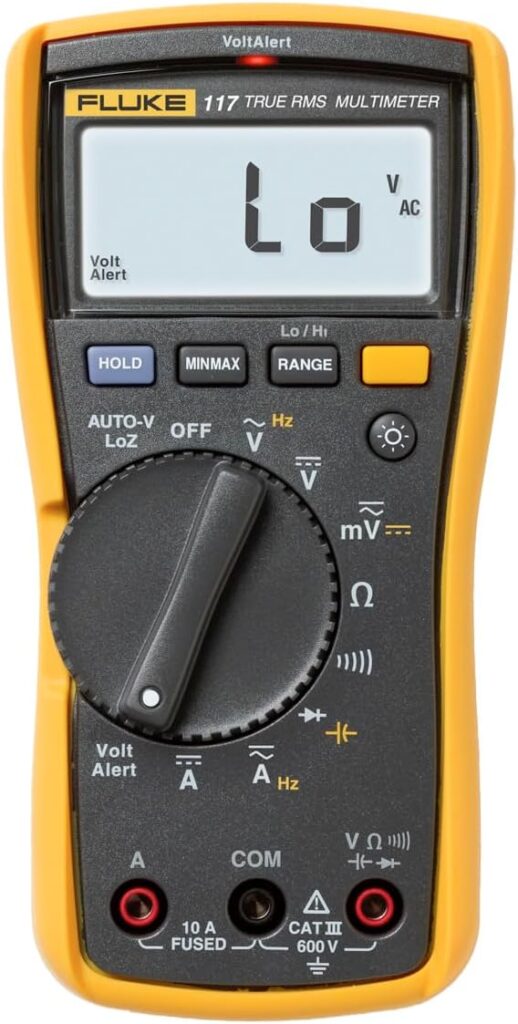
The Fluke 117 Electrician’s Multimeter is designed specifically for electrical troubleshooting in commercial buildings, schools, hospitals and similar environments. In my opinion, it is the best all-round multimeter currently on the market for electricians and technicians who want a compact, dependable professional instrument.
It is widely respected because it combines accurate True-RMS measurements, low-impedance voltage testing, non-contact voltage detection and a straightforward interface without filling the meter with unnecessary complexity.
Affiliate disclosure: This article contains affiliate links. I may earn a commission when you purchase through one of these links, at no additional cost to you. As an Amazon Associate, I earn from qualifying purchases.
The Fluke 117 covers the measurements needed for most everyday electrical troubleshooting, including:
AC and DC voltage
AC and DC current
Resistance
Continuity
Frequency
Capacitance
Minimum, maximum and average readings
It has a 6,000-count digital display, a fast analogue-style bar graph and a bright backlight for poorly lit panels and electrical rooms. Fluke rates it as a CAT III 600V instrument, making it suitable for many commercial and industrial distribution-level measurements within its specified limits.
True-RMS Measurement
One of the most important features is True-RMS AC measurement.
Modern electrical systems contain VFDs, switching power supplies, LED drivers and electronic controls that can produce distorted waveforms. A basic averaging meter may provide misleading readings when the waveform is not a clean sine wave.
The Fluke 117’s True-RMS capability provides more dependable AC measurements on these non-linear loads, which is especially useful for electricians and automation technicians working with modern equipment.
AutoVolt and LoZ Mode
The AutoVolt function automatically determines whether the measured voltage is AC or DC. This saves time when troubleshooting unfamiliar equipment or control circuits.
Even more useful is the low-impedance, or LoZ, mode.
Long disconnected cables can pick up capacitively coupled voltage from nearby energized conductors. A high-impedance meter may display this as a believable voltage even though the conductor cannot supply meaningful current.
LoZ places a greater load on the circuit and helps suppress these so-called ghost or phantom-voltage readings. This makes the Fluke 117 particularly helpful when troubleshooting building wiring, long cable runs and control systems.
Built-In Non-Contact Voltage Detection
The Fluke 117 includes VoltAlert non-contact voltage detection.
This allows you to perform a quick preliminary check for AC voltage without immediately connecting the test leads. It can be useful when scanning cables, outlets and electrical equipment before beginning a more detailed test.
Non-contact detection should never be the only method used to prove that a circuit is de-energized. Safe isolation requires the correct contact tester, procedure and verification against a known source.
Think of VoltAlert as a useful first check—not a replacement for proper electrical testing.
Designed for Professional Daily Use
The meter is compact enough to carry in a normal service bag and can be used with Fluke’s optional ToolPak magnetic hanger for hands-free operation. This is useful when you need to watch a reading while adjusting a component or testing inside a control cabinet.
Fluke specifies a typical battery life of approximately 400 hours without the backlight, powered by a standard 9V alkaline battery.
The controls are also relatively simple. You do not need to navigate complicated menus before checking voltage, resistance or continuity. That makes it practical for frequent use while still providing professional-level functions.
What Are the Limitations?
The Fluke 117 is excellent, but it is not the correct meter for every application.
It does not include:
A temperature-measurement input
A built-in current clamp
The advanced industrial functions of the Fluke 87V
A carrying case in every package
Measurement capability above its stated ratings
Technicians who regularly measure motor current may prefer pairing it with a clamp meter. Those performing advanced VFD diagnostics, high-energy industrial work or temperature measurements may need a different Fluke model.
It is also considerably more expensive than a basic homeowner multimeter.
You are paying for measurement quality, safety design, durability and Fluke’s professional reputation rather than simply buying the largest list of functions.
Final Verdict
I recommend the Fluke 117 Electrician’s Multimeter for electricians, automation technicians, maintenance engineers and serious technical users.
In my opinion, it is the best general-purpose professional multimeter currently available for everyday electrical troubleshooting. It is loved and trusted by electricians and technicians because it is accurate, compact, uncomplicated and designed around the measurements they actually perform.
True-RMS measurement makes it suitable for modern electrical loads. LoZ helps eliminate confusing ghost-voltage readings. VoltAlert provides a convenient initial voltage check, while the CAT III 600V rating suits many commercial electrical applications.
Cheaper meters can display voltage.
The Fluke 117 is the kind of instrument professionals buy when they want confidence in the number appearing on the screen.