Affiliate disclosure: This article contains an affiliate link. If you purchase the course through the link, I may earn a small commission at no additional cost to you.
A multimeter does not fix electrical faults. It tells you where to start looking—which is often half the battle.
Used correctly, it can reveal a broken fuse, damaged switch, open motor winding or missing supply voltage within minutes. Used incorrectly? You may blow the meter’s internal fuse, get a misleading reading or create a dangerous short circuit.
The Udemy course Master Electrical Testing Step-by-Step teaches beginners how to use a digital multimeter and test common electrical components. I believe it is a very good compact course for students, hobbyists and new maintenance technicians who want practical guidance without sitting through hours of unnecessary theory.
[Master Electrical Testing Step-by-Step]
What Does the Course Cover?
Created by Mohammed Hafidi, the course contains two sections, 17 lectures and approximately 51 minutes of video. At the time of checking, Udemy displayed Bestseller and Highest Rated badges, a 4.5 rating and 157 enrolled students. The course was last updated in October 2025.
The lessons cover:
- Digital multimeter controls and input ports
- Electrical safety and personal protective equipment
- Continuity testing
- Resistance measurement
- AC and DC voltage testing
- Current measurement
- Common multimeter mistakes
- Testing switches, fuses and breakers
- Checking contactors and relays
- Testing transformers
- Basic three-phase motor testing
It moves quickly. There is no long introduction to electrical history or a lecture explaining where electrons came from. The course gets into the meter settings and testing methods almost immediately.
Learning the Main Multimeter Functions
The first section explains how to select the correct function, connect the test leads and interpret the displayed value.
Students learn the difference between resistance and continuity. Both are normally checked with the circuit de-energised, but they answer slightly different questions: continuity confirms that a conductive path exists, while resistance gives an actual measured value.
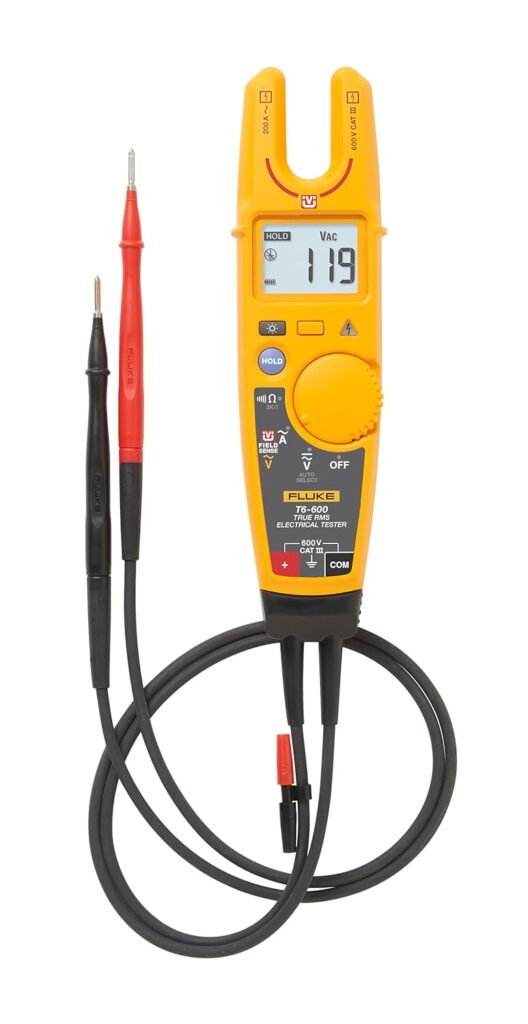
Voltage and current testing are also covered. The course explains that voltage is measured across two points, while current usually requires the meter to be placed in series with the circuit. A clamp meter is mentioned as a faster option for current measurements.
That distinction is important. Placing standard multimeter leads directly across a supply while the meter is set to current is a memorable mistake—for all the wrong reasons.
Testing Real Electrical Components
The second section focuses on component testing.
Students see step-by-step methods for checking:
- Normally open and normally closed push buttons
- Fuses and circuit breakers
- Motor-protection circuit breakers
- Contactor coils and contacts
- Electromechanical relays
- Transformer windings and output voltage
- Three-phase motor winding balance
The contactor lesson, for example, includes visual inspection, coil-resistance measurement and continuity checks on the main and auxiliary contacts. The motor lesson covers winding checks and comparison between phases after proper isolation and lockout.
These are useful entry-level troubleshooting procedures for anyone working around control panels or industrial machinery.
Who Is This Course For?
The course should suit:
- Complete electrical beginners
- Electrical and engineering students
- Junior maintenance technicians
- Hobbyists learning multimeter use
- Workers preparing for electrical-repair roles
No previous electrical experience is required, although basic safety awareness is recommended. Students need a digital multimeter and access to simple components or circuits for hands-on practice.
Are There Any Downsides?
At only 51 minutes, this is a quick introduction rather than complete troubleshooting training.
It does not go deeply into insulation-resistance testers, clamp-meter diagnostics, diode testing, capacitance, frequency measurement, control voltages or systematic fault-finding on complex machinery.
The listing also states that the course contains the use of artificial intelligence. Learners who strongly prefer entirely traditional instructor-created materials should consider that before enrolling.
Final Verdict
Master Electrical Testing Step-by-Step is a very good short course for learning the essential functions of a digital multimeter.
Its greatest strength is practicality. The course shows how to test recognisable components rather than discussing measurement theory in isolation.
It will not make a complete beginner an experienced electrician in less than an hour. Obviously. But it can provide a useful foundation and help prevent several common multimeter mistakes.
Check the current course price and availability here: