A selector switch is a manually operated control device used to choose between two or more operating conditions.
Unlike a momentary push button, a maintained selector switch normally stays in the selected position after the operator releases it. Turning the handle mechanically changes the state of the contact blocks mounted behind the switch.
Selector switches are commonly used for:
- Manual/Automatic mode selection
- Forward/Reverse control
- Local/Remote selection
- Hand/Off/Auto control
- Low/High speed selection
- Machine setup modes
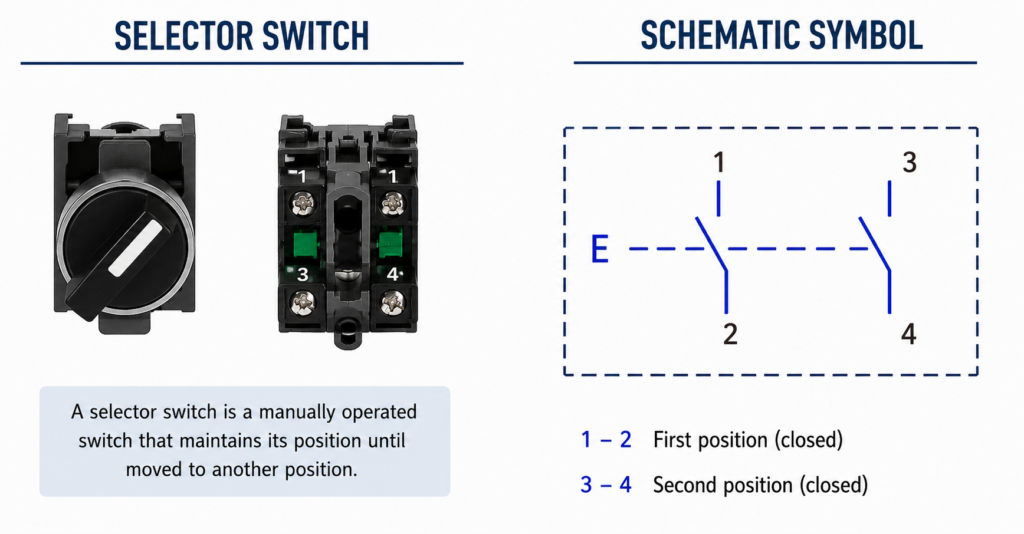
Two-Position Selector Switch
A two-position selector switch provides two operating choices, such as:
- Manual and Automatic
- Forward and Reverse
- Local and Remote
- ON and OFF
In one position, one contact may close while another opens. Rotating the switch changes the contact states and sends the selected command to the PLC, relay or contactor circuit.
For example, in a Manual/Automatic circuit:
- Position 1 activates the Manual input.
- Position 2 activates the Automatic input.
The PLC then uses these signals to determine how the machine should operate.
Three-Position Selector Switch
A three-position switch adds a centre position.
A common arrangement is:
Hand – Off – Auto
In the centre OFF position, both control contacts may remain open. Turning the switch left activates one contact, while turning it right activates another.
Some selector switches are spring-return types. For example, a Forward–Off–Reverse control may return automatically to the centre when released. Always check whether the device is maintained or momentary.
Contact Blocks and Terminal Numbers
Selector switches can operate normally open and normally closed contact blocks.
Common terminal numbering may include:
- 1–2
- 3–4
- 13–14 for a normally open contact
- 21–22 for a normally closed contact
Terminal numbering varies between manufacturers, so always check the markings and wiring diagram.
In schematic drawings, mechanically linked contacts are shown together to indicate that they change state when the selector handle is rotated.
Final Thoughts
Selector switches provide a simple way to choose machine modes or operating directions.
Their main advantage over push buttons is that maintained versions remain in position, giving the control system a continuous selection signal.
Before wiring one, confirm the number of positions, contact arrangement, terminal numbers and whether the handle is maintained or spring-return.