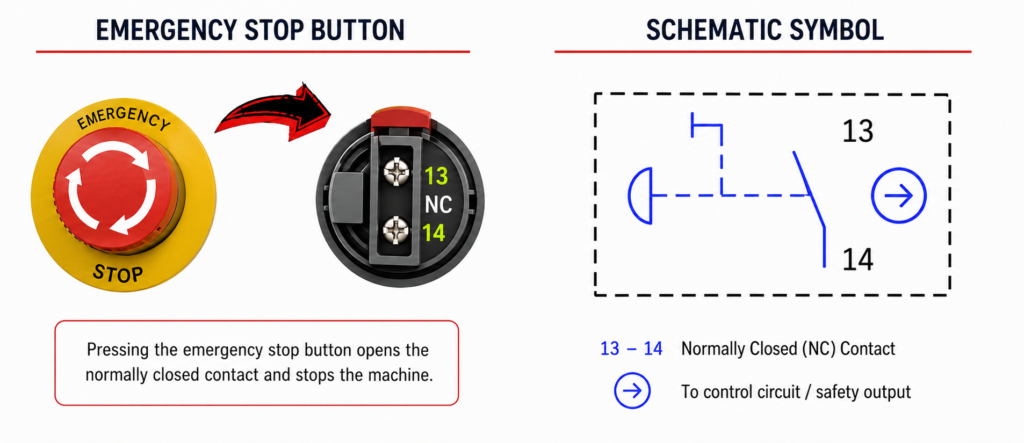
An emergency stop button, commonly called an E-stop, allows an operator to stop hazardous machine operation as quickly as possible during an emergency.
It is usually large, red and mushroom-shaped, with a yellow background. E-stop buttons should be installed where operators and other exposed persons can reach them easily.
An emergency stop does not necessarily isolate every source of electrical power. Its main purpose is to bring hazardous movement or processes to a safe stop. Proper electrical isolation for maintenance still requires an approved disconnecting and lockout/tagout procedure.
How an Emergency Stop Button Works
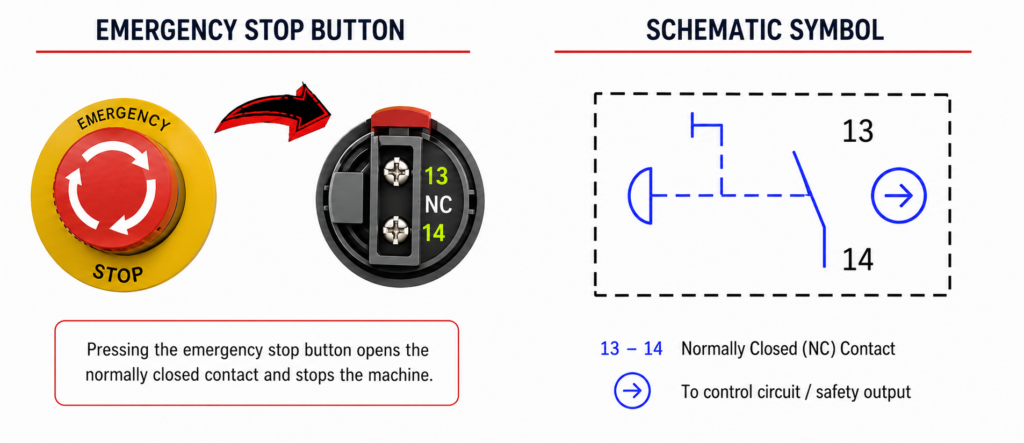
Most emergency stop buttons use one or more normally closed contacts.
During normal operation, the contact remains closed and allows current to flow through the machine’s safety circuit.
When the button is pressed:
- The normally closed contact opens.
- The safety relay or contactor loses its control signal.
- Hazardous outputs are disconnected.
- The machine stops according to its designed stop category.
The button mechanically latches in the pressed position. It usually must be released by twisting, pulling or using a key.
Releasing the E-stop should not automatically restart the machine. A separate reset and start command should normally be required.
Contact Terminals
Emergency-stop contact blocks often use IEC terminal numbers such as:
- 11–12 for a normally closed contact
- 21–22 for a second normally closed contact
- 13–14 for a normally open contact
Some manufacturers use different markings, so always confirm the contact diagram printed on the device.
Modern safety circuits commonly use two separate normally closed channels. A safety relay monitors both channels and can detect certain wiring faults, welded contacts or channel discrepancies.
Direct-Opening Contacts
Safety-rated E-stop buttons should use positively operated, or direct-opening, normally closed contacts.
This means pressing the button mechanically forces the contacts apart rather than relying only on a spring. This provides more reliable interruption if a contact becomes stuck.
Installation Considerations
An E-stop should:
- Be clearly visible and accessible
- Stop hazardous operation rapidly
- Remain latched after activation
- Require deliberate manual release
- Be monitored by an appropriate safety circuit
- Never be used as the normal machine stop button
The required safety architecture depends on the machine risk assessment and applicable safety standards.
Final Thoughts
An emergency stop button is not simply a red push button. It is part of a complete safety system that may include safety relays, contactors, feedback contacts and monitored dual-channel wiring.
Correct design ensures that pressing the E-stop stops the hazard, while releasing it does not cause an unexpected restart.