A contactor allows a small control circuit to switch a much larger electrical load. It is commonly used to start and stop three-phase motors without sending the motor’s full current through a push button, PLC output or selector switch.
The circuit is divided into two sections:
- Power circuit
- Control circuit
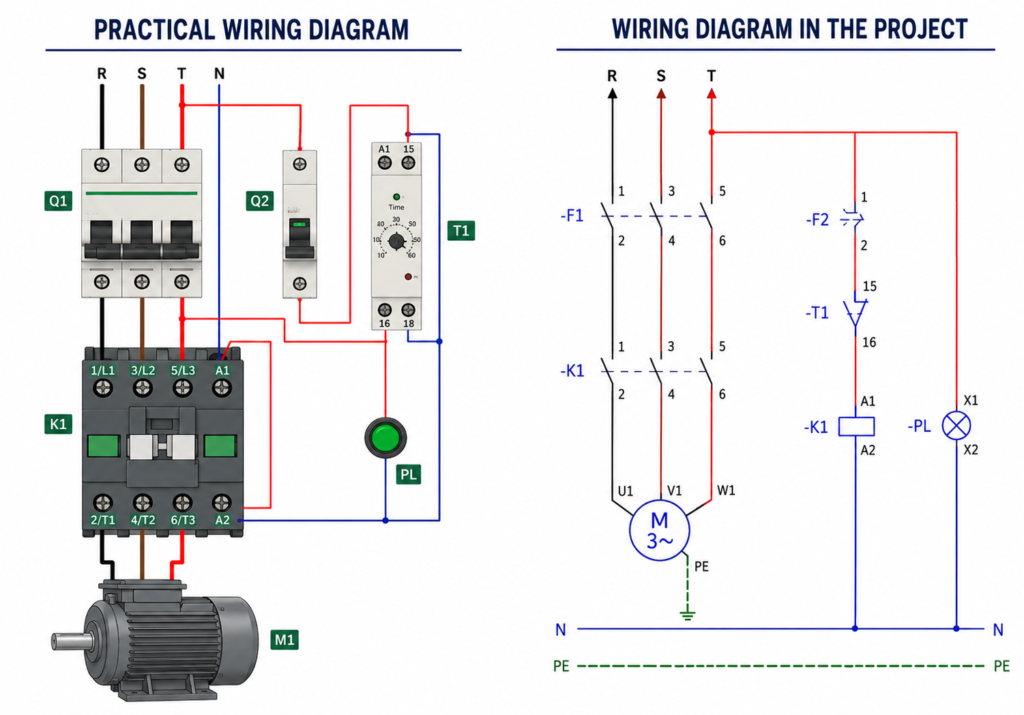
Power Circuit Connection
The three-phase supply conductors—R, S and T—first pass through a suitable three-pole protective device, such as a circuit breaker or motor protection circuit breaker.
They are then connected to the contactor’s incoming terminals:
- R → 1/L1
- S → 3/L2
- T → 5/L3
The motor is connected to the contactor’s outgoing terminals:
- 2/T1 → Motor U
- 4/T2 → Motor V
- 6/T3 → Motor W
When the contactor is de-energized, its three main contacts remain open, preventing power from reaching the motor.
When the contactor coil energizes, the contacts close simultaneously:
- L1 connects to T1
- L2 connects to T2
- L3 connects to T3
The motor then receives three-phase power and begins running.
Control Circuit Connection
The contactor coil is connected through terminals:
- A1
- A2
In the illustrated circuit, one phase is passed through a single-pole circuit breaker or control fuse and connected to A1. Terminal A2 connects to neutral.
When the correct voltage is applied across A1 and A2, the coil creates a magnetic field and pulls in the contactor mechanism.
Removing the coil voltage causes the internal spring to release the mechanism. The main contacts open, disconnecting the motor.
Check the Coil Voltage
Contactor coils are available in several voltage ratings, including:
- 12 V
- 24 V AC or DC
- 110–120 V AC
- 220–230 V AC
- 380–400 V AC
Never assume that A2 must always connect to neutral. A 400 V coil, for example, may be supplied between two phases.
Always read the coil label before wiring it. Applying the wrong voltage can prevent operation or destroy the coil.
Operating Sequence
- The three-phase supply reaches the contactor through the protective device.
- Control voltage is applied across A1 and A2.
- The coil energizes.
- The main contacts close.
- The motor receives power and starts.
- When coil voltage is removed, the contacts open and the motor stops.