A basic START push button can energize a contactor coil, but there is one obvious problem: the motor runs only while the button remains pressed.
Release the button and the circuit opens. The contactor drops out, its main contacts open, and the motor stops.
To keep the motor running after the START button is released, the control circuit uses a holding circuit, also called a latching, seal-in or self-holding circuit.
Main Components
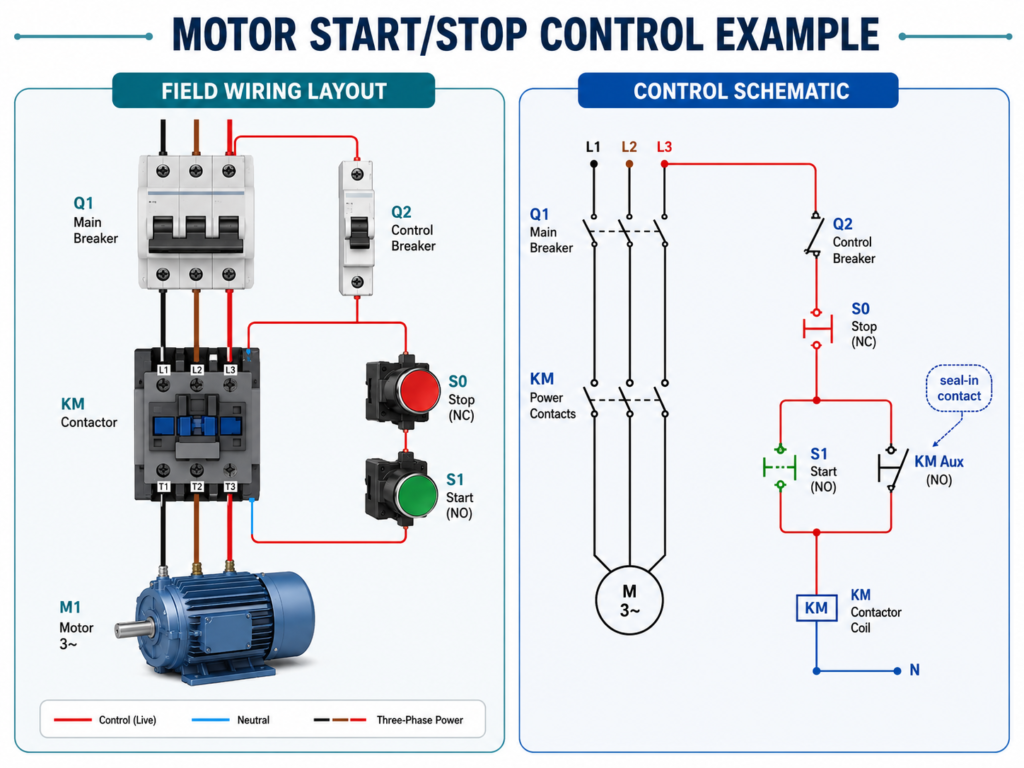
A typical start-stop holding circuit contains:
- Normally closed STOP button
- Normally open START button
- Contactor coil K1
- Normally open K1 auxiliary contact, usually 13–14
- Three contactor power contacts
- Motor and circuit protection
The K1 auxiliary contact is connected in parallel with the START button.
What Happens When START Is Pressed?
Under normal conditions, the STOP button is closed.
When the normally open START button is pressed, control current flows through the STOP button and START button to contactor coil K1.
The coil energizes and closes:
- Main contactor contacts
- Auxiliary contact K1 13–14
The main contacts connect the three-phase supply to the motor, causing it to start.
Why the Motor Keeps Running
When K1 energizes, auxiliary contact 13–14 closes and creates another path around the START button.
Once the operator releases START, the push-button contact opens again. However, current continues flowing through the closed K1 auxiliary contact.
The contactor coil therefore remains energized, and the motor keeps running.
This is the self-holding action.
What Happens When STOP Is Pressed?
The STOP button is normally closed and wired in series with the contactor coil.
Pressing STOP opens the control circuit. Coil K1 loses power, causing:
- The main power contacts to open
- The motor to stop
- Auxiliary contact 13–14 to open
- The holding circuit to be broken
When STOP is released, the contact returns to its closed position, but the motor does not restart automatically. The START button must be pressed again.
This is an important feature because it helps prevent an unexpected restart after a control-power interruption.
Final Thoughts
The holding circuit allows a momentary START button to operate a motor continuously.
The START button energizes the contactor, auxiliary contact 13–14 keeps it energized, and the STOP button breaks the circuit.
It is one of the most fundamental control circuits used in motor starters and industrial automation.