By Dovydas Kersys · Chapter 36 of 58 in Machine Commissioning.
Before you begin: Follow the machine documentation, risk assessment, site procedures and lockout/tagout requirements. Commissioning can expose personnel to electrical energy, stored pressure and unexpected motion. Never defeat a safety function merely to make a test easier. Examples and diagrams are generic and must be checked against the actual machine.
Alarm commissioning proves detection, message quality, priority, timestamp, acknowledgement, reset and expected operator response. Good alarms help maintenance isolate faults instead of adding noise.
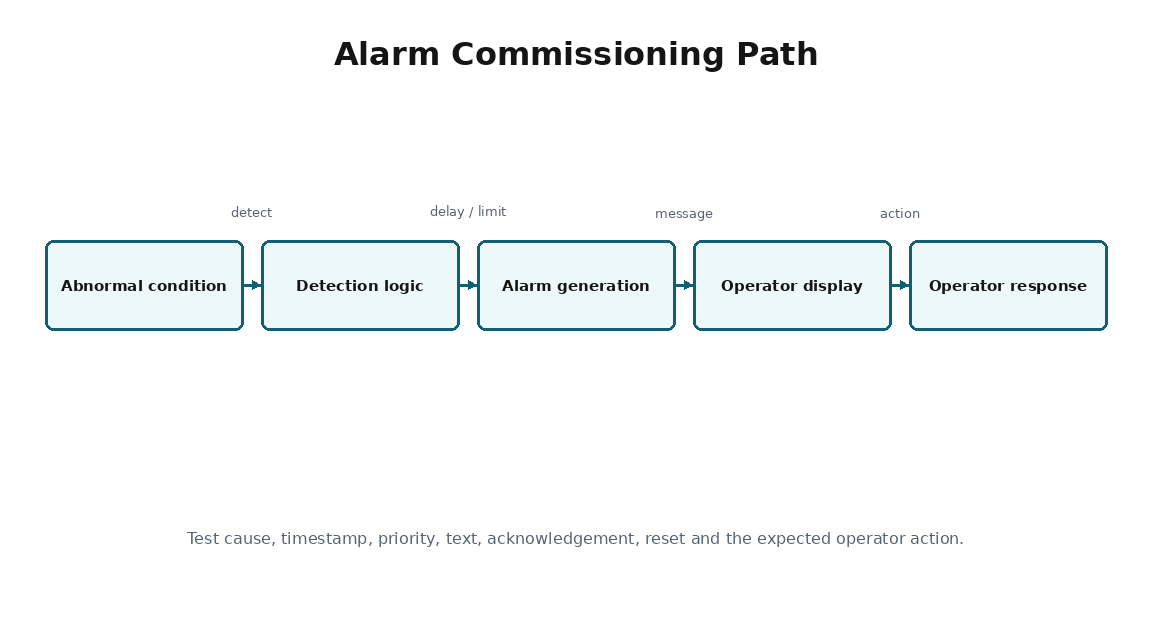
An alarm should guide the operator from symptom toward action.
Why this matters during commissioning
A technically correct but vague alarm such as “Machine Fault” wastes the diagnostic capability already available in the PLC.
Commissioning procedure
- Create or simulate the real fault condition.
- Verify the alarm triggers at the correct threshold or state.
- Check message text, equipment identity, priority and timestamp.
- Verify acknowledgement behavior does not clear the underlying fault.
- Confirm alarm resets when the real condition is corrected and reset requirements are met.
- Review alarm floods during common events such as emergency stop or power loss.
Common failure patterns
- Alarm generated from command state instead of feedback.
- Dozens of secondary alarms hide the first cause.
- Alarm says “sensor fault” when the actual condition is “no product detected.”
- Alarm disappears immediately when condition clears, leaving no history.
Evidence to record
- Measured value and test point
- Expected value / expected state
- Observed value / observed state
- Pass/fail result and any deviation
- Name/date or responsible person where required
FIELD RULE: Commission the first-out or root-cause behavior, not only the presence of alarm messages.
Continue the series
- Previous chapter: HMI and SCADA Commissioning
- Next chapter: Trends, Diagnostics and Time Synchronization: Commissioning Guide
- Browse all Machine Commissioning chapters
Adapted from Machine Commissioning for Maintenance and Automation Technicians, by Dovydas Kersys. © 2026 Dovydas Kersys. Featured cover image is an AI-generated editorial illustration.