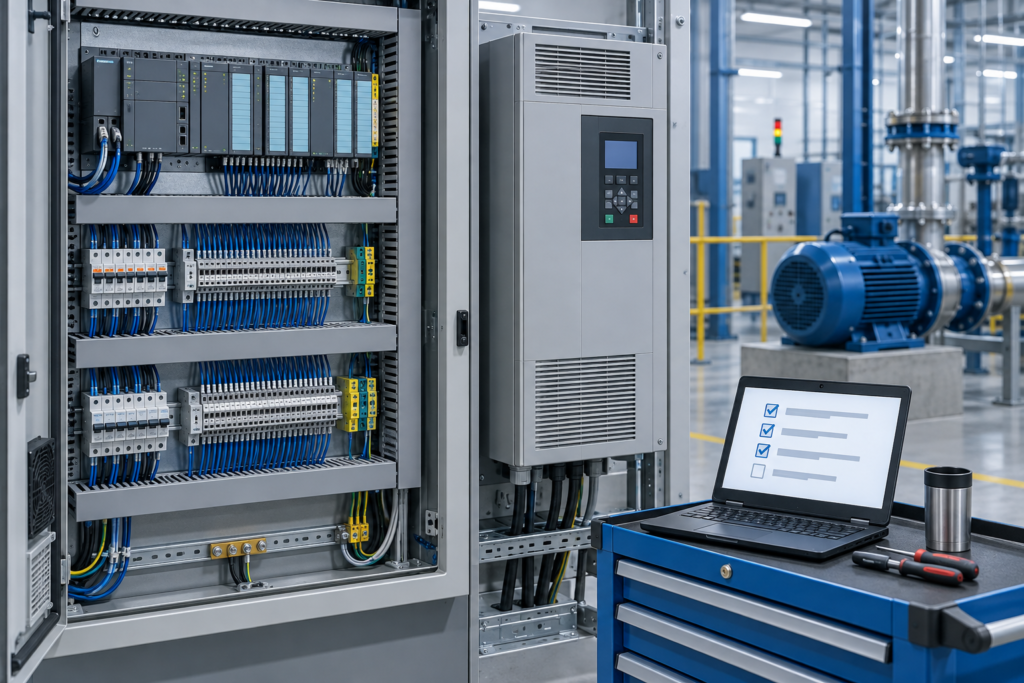
By Dovydas Kersys · Chapter 32 of 58 in Machine Commissioning.
Before you begin: Follow the machine documentation, risk assessment, site procedures and lockout/tagout requirements. Commissioning can expose personnel to electrical energy, stored pressure and unexpected motion. Never defeat a safety function merely to make a test easier. Examples and diagrams are generic and must be checked against the actual machine.
Reset logic is often treated as a minor operator-interface feature, but it determines whether a machine can restart unexpectedly after a safety event, fault or power interruption.
Why this matters during commissioning
A safe machine should make its restart conditions obvious and deliberate.
Commissioning procedure
- Test reset after emergency stop, guard opening, drive fault and sequence fault.
- Confirm reset clears only the intended latch or fault and does not create motion.
- Verify start command must be reissued where required.
- Test held start buttons, maintained HMI commands and retained PLC bits through reset.
- Test power cycle with start conditions active.
Common failure patterns
- Reset and start share one button without a safe sequence.
- Maintained HMI run bit survives controller restart.
- Fault latch clears but blocked condition remains, creating immediate refault.
- Guard closes and machine automatically resumes unexpectedly.
Evidence to record
- Measured value and test point
- Expected value / expected state
- Observed value / observed state
- Pass/fail result and any deviation
- Name/date or responsible person where required
FIELD RULE: Reset should restore readiness, not create motion unless the design explicitly requires and safely supports it.
PART VI
Networks, HMI and Alarms
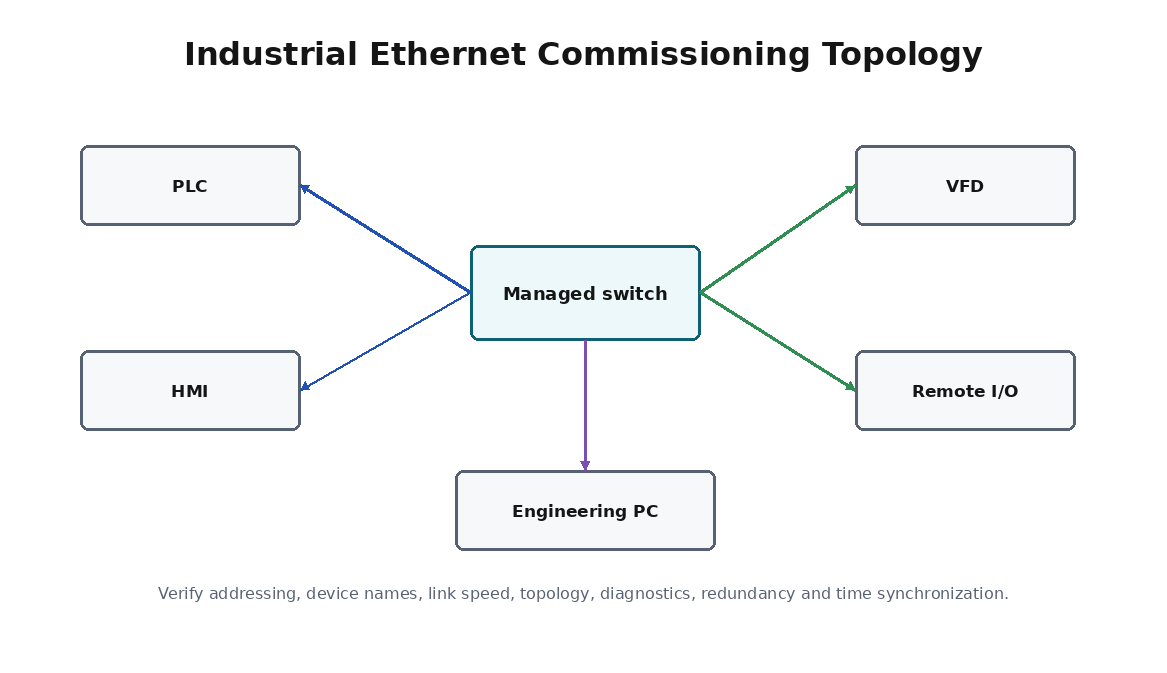
Networks, HMI and Alarms
Continue the series
- Previous chapter: Safe Torque Off and Drive Safety: Commissioning Guide
- Next chapter: Industrial Ethernet Commissioning
- Browse all Machine Commissioning chapters
Adapted from Machine Commissioning for Maintenance and Automation Technicians, by Dovydas Kersys. © 2026 Dovydas Kersys. Featured cover image is an AI-generated editorial illustration.