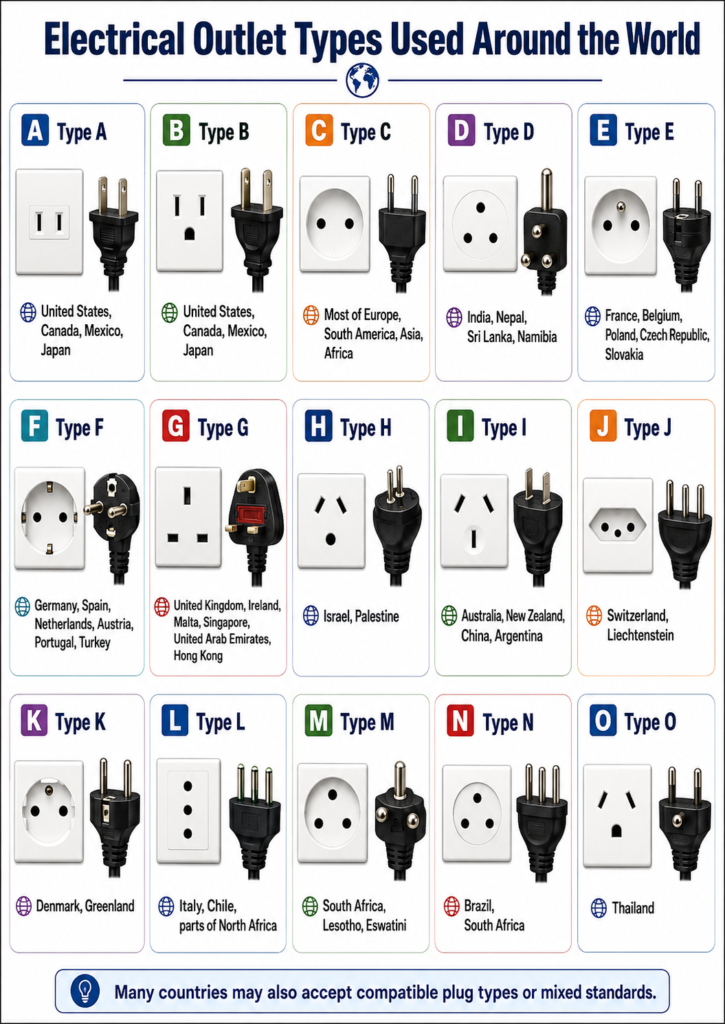
Travel plugs look simple until you actually need one.
A charger that slides neatly into a socket at home may be completely useless after crossing a border. Some countries use flat pins, others prefer round ones, and several add a third connection for protective earthing. Even plugs that appear similar may not be safely interchangeable.
This quick guide covers the main outlet types from Type A to Type O. Country lists are examples rather than absolute rules because some nations use several standards at the same time.
One important warning before we begin: a travel adapter changes the plug shape—it does not automatically change the voltage or frequency. Always check the rating printed on the appliance or charger.
Type A
Type A uses two parallel flat pins and normally has no protective-earth connection.
It is commonly found in:
- United States
- Canada
- Mexico
- Japan
- Parts of Central America
Type A plugs are usually associated with 100–127 V electrical systems. The Japanese version looks almost identical to the North American design, although voltage and socket polarization can differ.
Because Type A has no earth contact, it is mainly used for double-insulated or low-power equipment such as phone chargers, lamps and small electronics.
Type B
Type B adds a round grounding pin beneath the two flat pins used by Type A.
It is common in:
- United States
- Canada
- Mexico
- Japan
- Parts of Central America and the Caribbean
The earth pin improves protection for appliances with exposed metal parts. Type A plugs usually fit into Type B sockets, but a grounded Type B appliance should not be forced into an ungrounded Type A outlet by removing the earth pin.
That little round pin is not decorative.
Type C
Type C is the familiar two-pin Europlug. It has two thin round pins and no earth connection.
It is widely used across:
- Continental Europe
- Parts of South America
- Much of Asia
- Parts of Africa
Type C plugs are commonly used for low-power, double-insulated equipment. They fit many Type E, F, J, K, L and N sockets, although compatibility depends on the exact socket design.
Because there is no protective earth, Type C is unsuitable for appliances that require grounding.
Type D
Type D uses three round pins arranged in a triangle. The top earth pin is larger than the two current-carrying pins.
It is mainly associated with:
- India
- Nepal
- Sri Lanka
- Namibia
- Some neighbouring regions
Type D is often used in countries with 220–240 V supplies. It resembles Type M, but the pins are smaller and the two types should not be confused.
Adapters for Type D should fit firmly. Loose universal adapters can overheat, particularly with high-power appliances.
Type E
Type E uses two round current-carrying pins and an earth contact provided by a pin protruding from the socket.
It is commonly found in:
- France
- Belgium
- Poland
- Czech Republic
- Slovakia
- Parts of North Africa
The plug has a hole that receives the socket’s grounding pin.
Many modern European appliances use the hybrid CEE 7/7 plug, which works with both Type E and Type F sockets. This improves compatibility between neighbouring countries without requiring them to replace their entire outlet systems.
Type F
Type F is often called the Schuko plug, short for the German term meaning protective contact.
It is widely used in:
- Germany
- Spain
- Netherlands
- Austria
- Portugal
- Turkey
- Many other European countries
It has two round pins and grounding contacts on the sides of the plug and socket. Unlike a polarized plug, Type F can normally be inserted in either direction.
Type F sockets are robust and commonly rated for relatively high household loads, but the exact allowable current depends on the local standard and installation.
Type G
Type G uses three large rectangular pins. It is one of the easiest plug types to recognize.
It is used in:
- United Kingdom
- Ireland
- Malta
- Cyprus
- Singapore
- Hong Kong
- United Arab Emirates
- Several former British territories
Type G plugs normally contain a replaceable fuse. The earth pin is longer and often opens safety shutters inside the socket before the line and neutral pins make contact.
It is bulky, yes. It is also mechanically strong and packed with safety features.
Type H
Type H is mainly used in:
- Israel
- Palestine
The modern version uses three round pins arranged in a triangular shape. Older installations may still contain sockets designed for earlier flat-pin versions.
Type C Europlugs may fit many modern Type H sockets, but not every old outlet will accept them properly.
Travellers should avoid assuming compatibility simply because the plug appears close enough. “Almost fits” is not a recognized electrical standard.
Type I
Type I uses two flat pins set at an angle. Grounded versions include a third vertical earth pin.
It is common in:
- Australia
- New Zealand
- China
- Argentina
- Several Pacific island nations
Although these countries use the same general pin arrangement, there can be differences in plug construction, current ratings and wiring conventions.
Ungrounded Type I plugs have two angled pins, while grounded appliances use all three.
Type J
Type J is used mainly in:
- Switzerland
- Liechtenstein
It has three round pins, with the earth pin slightly offset from the centre.
The compact design resembles Type C, but Type J includes a protective-earth connection. A Type C Europlug will often fit a Type J socket, while a grounded Type J plug will not fit an ordinary Type C outlet.
Switzerland also uses more than one current rating and plug size, so high-power appliances may require a larger connector.
Type K
Type K is most closely associated with:
- Denmark
- Greenland
It uses two round pins and a separate grounding pin.
Type C plugs commonly fit Type K sockets, but they do not provide an earth connection. Older Danish sockets may therefore accept a two-pin appliance while remaining unsuitable for equipment that requires grounding.
Modern installations may also accept hybrid European plug designs, but compatibility should be checked rather than guessed.
Type L
Type L uses three round pins arranged in a straight line.
It is mainly found in:
- Italy
- Chile
- Parts of North Africa
Italy uses two main Type L sizes for different current ratings. The smaller version is commonly used for ordinary equipment, while the larger version handles heavier loads.
Some modern Italian sockets accept Type C, Type F and both sizes of Type L. Older sockets may be far less cooperative.
Type M
Type M has three large round pins arranged in a triangle.
It is used in:
- South Africa
- Lesotho
- Eswatini
- Parts of southern Africa
- Some heavy-duty applications in India
Type M resembles Type D but is larger and generally intended for higher-current equipment.
South Africa has been gradually introducing Type N for newer installations, but Type M remains widespread. Travellers may therefore encounter both.
Type N
Type N has three round pins in a compact triangular layout.
It is primarily associated with:
- Brazil
- Newer installations in South Africa
Brazil uses different Type N versions depending on the current rating. The higher-current version has thicker pins and should not be forced into a lower-rated socket.
Two-pin Type C plugs often fit Type N sockets, although the earth connection is naturally absent.
Type O
Type O is used mainly in:
- Thailand
It has two round current-carrying pins and a round earth pin arranged in a triangular layout.
Thailand has historically used several plug types, including A, B and C. Type O was introduced as a national grounded standard, so travellers may still encounter a mixture of old and new sockets.
This makes Thailand one of those places where a good-quality multi-standard travel adapter can be genuinely useful.
Why Similar-Looking Plugs May Still Be Incompatible
Two plugs can have round pins and still differ in:
- Pin diameter
- Pin spacing
- Earth-contact position
- Maximum current
- Socket depth
- Safety shutters
- Voltage rating
Forcing a plug into the wrong socket can damage the contacts and create a loose, overheating connection.
A plug fitting physically also does not prove the appliance is suitable for the local voltage.
Adapter or Voltage Converter?
A plug adapter changes the physical connection.
A voltage converter changes the electrical voltage.
Check the appliance label before travelling. A charger marked:
Input: 100–240 V, 50/60 Hz
will usually work worldwide with a suitable plug adapter.
An appliance marked only:
120 V, 60 Hz
should not be connected directly to a 230 V supply.
This is particularly important for:
- Hair dryers
- Curling irons
- Electric kettles
- Heaters
- Kitchen appliances
- Older motors and transformers
A cheap adapter cannot negotiate with the laws of physics.
Quick Outlet-Type Summary
| Type | Main pin arrangement | Grounded version | Common regions |
|---|---|---|---|
| A | Two flat parallel pins | No | North America, Japan |
| B | Two flat pins and one round pin | Yes | North America, Japan |
| C | Two round pins | No | Europe, Asia, Africa |
| D | Three round triangular pins | Yes | India, Nepal |
| E | Two round pins, socket earth pin | Yes | France, Belgium, Poland |
| F | Two round pins, side earth contacts | Yes | Germany, Spain, Netherlands |
| G | Three rectangular pins | Yes | UK, Ireland, Singapore |
| H | Three round pins | Yes | Israel, Palestine |
| I | Two angled flat pins, optional earth | Optional | Australia, China, Argentina |
| J | Three offset round pins | Yes | Switzerland |
| K | Two round pins and earth pin | Yes | Denmark |
| L | Three round pins in a line | Yes | Italy, Chile |
| M | Three large round pins | Yes | Southern Africa |
| N | Three compact round pins | Yes | Brazil, South Africa |
| O | Three round triangular pins | Yes | Thailand |
The Simple Travel Rule
Before plugging anything in, check three things:
- Does the plug physically match the outlet?
- Does the appliance support the local voltage and frequency?
- Does the adapter preserve protective earthing when the appliance needs it?
Getting two out of three is not enough.