Beyond fixing faults, keeping loops accurate and reliable involves calibration and good practice. This closing chapter covers checking a loop’s calibration and the practices that prevent problems, rounding out the practical picture of working with 4–20 mA loops over their service life.
Checking calibration
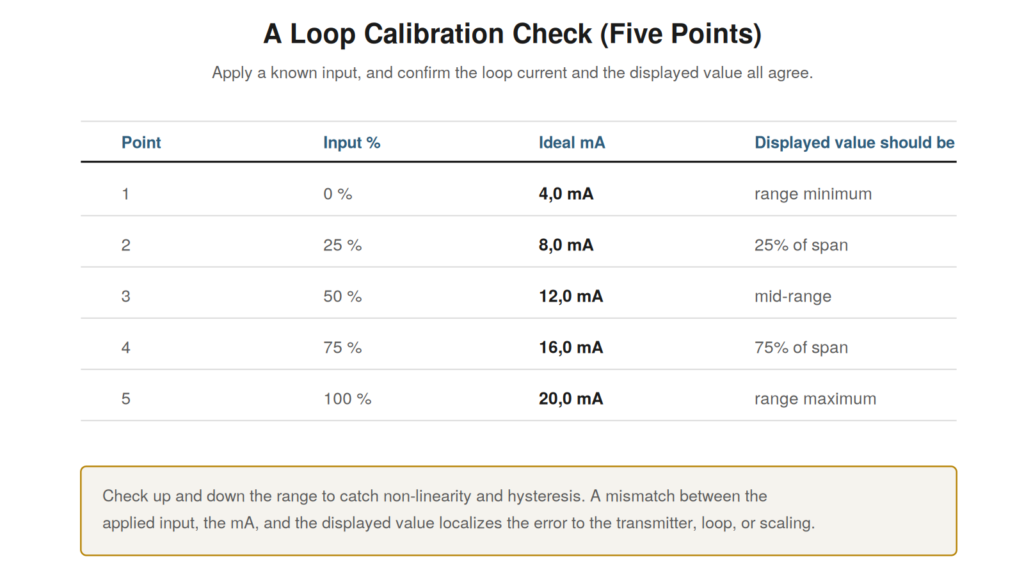
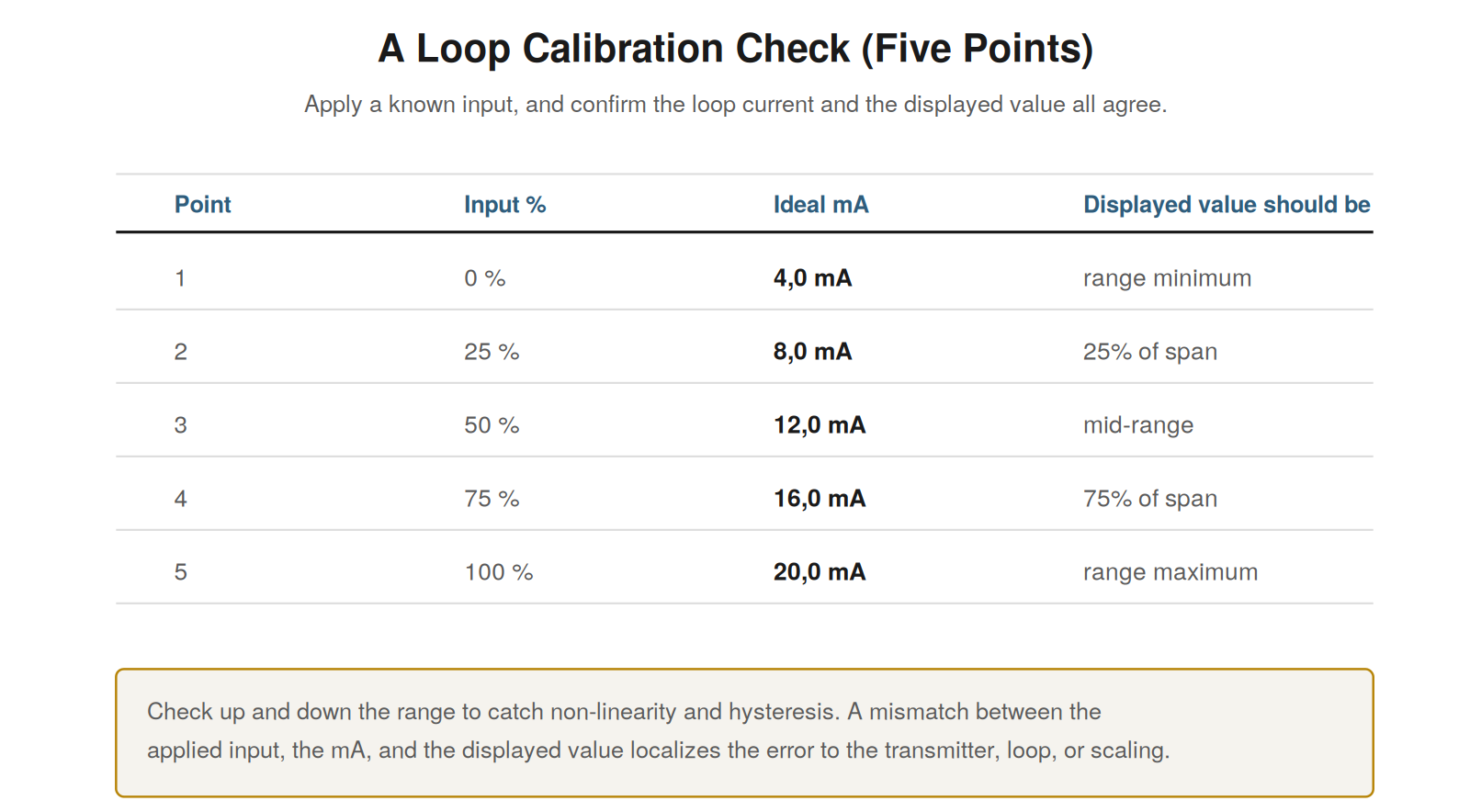
Checking a loop’s calibration means applying known inputs across the range and confirming that the loop current and the displayed value are correct at each. A typical check uses five points — 0, 25, 50, 75, and 100 percent of range — which should produce 4, 8, 12, 16, and 20 mA respectively, and displayed values matching the applied inputs. Applying a known input (with a calibrator that simulates the process or drives a known signal) and checking the current and displayed value at each point verifies the loop end to end: the transmitter converting input to current correctly, and the system converting current to displayed value correctly. Checking both up and down the range can reveal non-linearity or hysteresis. A mismatch at some point — wrong current for the input, or wrong displayed value for the current — localizes an error to the transmitter or the scaling. This structured calibration check confirms a loop’s accuracy across its range and is the systematic way to verify a loop is reading correctly, whether after a repair or as routine maintenance.
Best practices for reliable loops
A number of practices keep loops reliable and troubleshooting easy. Good wiring practice — proper terminations, correct polarity, secure connections — prevents the loose-connection faults that cause intermittent problems. Proper shielding and one-end grounding prevent noise. Adequate supply voltage and attention to the loop’s voltage budget prevent compliance problems. Sensible range selection gives good resolution and avoids frequent over-range. Clear documentation — accurate loop diagrams with correct tags, terminals, and channels — makes troubleshooting far faster when problems do occur. And keeping the documentation updated when loops are modified prevents the drawing-reality mismatches that mislead troubleshooting. These practices, applied at installation and maintained over time, reduce the faults loops develop and make the faults that do occur easier to find. Understanding them is part of working with loops competently, not just fixing them when broken but keeping them healthy and well-documented so they stay reliable and, when they do fault, are quick to diagnose.
The competent loop technician
The aim of this book has been to build competence with 4–20 mA loops from understanding through troubleshooting, and the competent loop technician combines both. They understand the loop as a simple series circuit carrying a current that represents a measurement, know why current and live zero make it robust, can wire and read loops in their various forms, and can work the scaling in both directions. On that foundation they troubleshoot systematically: reading the fault signature from the current, checking power, splitting the loop to localize, isolating and injecting to identify the faulty element, and verifying the fix including the scaling. They use the loop’s built-in diagnostics — live zero, burnout signaling, and where available HART — and they follow good practice to keep loops reliable. This combination of understanding and method is what makes loop work fast and confident rather than a matter of guesswork. The 4–20 mA loop is a simple, elegant, enduring standard, and the technician who truly understands it and can troubleshoot it methodically holds a skill that will remain valuable for as long as loops carry measurements through the world’s plants — which, for all the rise of digital alternatives, will be a very long time.
Calibration versus troubleshooting
It helps to distinguish calibration from troubleshooting, since they are related but different activities. Troubleshooting finds and fixes a fault — something is broken and you make it work. Calibration verifies and adjusts accuracy — the loop works, but you confirm it reads correctly across its range and adjust if it drifts. A loop can work (no fault to troubleshoot) yet be out of calibration (reading slightly wrong), and calibration catches that. Conversely, a calibration check can reveal a fault, when a point is not just slightly off but grossly wrong. The five-point calibration check is the systematic verification of accuracy, applying known inputs and confirming the currents and values across the range, and it is the tool for the accuracy question as split-half is for the fault-location question. Understanding the distinction — troubleshooting for faults, calibration for accuracy — clarifies which activity a situation calls for: a clearly broken loop needs troubleshooting, while a working loop suspected of reading slightly off needs a calibration check, and knowing which you are doing keeps the work focused on the actual question at hand.
The discipline that prevents faults
Much loop trouble is prevented rather than fixed, by the discipline of good practice, and it is worth appreciating how the best practices head off the very faults the book teaches you to diagnose. Secure, correct-polarity terminations prevent the loose-connection and reversed-polarity faults. Proper one-end shield grounding and sensible cable routing prevent noise. An adequate voltage budget prevents compliance failures. Good range selection prevents resolution and over-range complaints. Accurate, updated loop diagrams make any faults that do occur quick to diagnose. Regular calibration catches accuracy drift before it becomes a problem. Each practice targets a class of fault, and applying them at installation and maintaining them over time means fewer faults occur and those that do are easier to find. The competent technician thus works on two fronts: troubleshooting the faults that arise, and following the practices that prevent faults and ease future diagnosis. Understanding both the faults and the practices that prevent them completes the picture of loop competence — not only fixing loops when broken, but keeping them healthy and well-documented so they break less and are diagnosed faster when they do.
Calibration up and down the range
A refinement of the calibration check is to test both increasing and decreasing through the range, because this reveals problems a one-direction check would miss. Going up the range (0, 25, 50, 75, 100 percent) and then back down (100, 75, 50, 25, 0) checks whether the loop reads the same at each point regardless of direction. A difference between the up and down readings at the same point indicates hysteresis — the loop reading differently depending on whether the value is rising or falling — which points to a mechanical or sensor issue in the transmitter. Checking only one direction would miss this, showing correct readings at each point without revealing that they differ by direction. So a thorough calibration check goes both up and down, comparing the readings at each point in both directions to catch hysteresis as well as simple offset and span errors. This bidirectional check is more thorough than a single sweep, and it catches the direction-dependent errors (hysteresis) that a one-way check cannot. Understanding this refinement — check up and down, compare at each point — makes calibration checks catch the full range of accuracy problems, not just the simplest ones, giving a more complete verification of the loop’s accuracy across its range.
The complete loop technician
The complete loop technician — the destination this book has aimed at — combines a deep understanding of the loop with a systematic troubleshooting method and the good practices that keep loops reliable. They understand the loop as a circuit and know why its design makes it robust; they can wire and read loops of every type; they work the scaling fluently; they troubleshoot systematically, reading signatures, splitting loops, isolating elements, and verifying fixes; they use the loop’s diagnostics and HART; and they follow the practices that prevent faults and ease diagnosis. This combination — understanding, method, and good practice — is what makes loop work confident and effective rather than a matter of guesswork. The book has built each part: the fundamentals in the early chapters, the troubleshooting method in the middle, the advanced diagnostics and practices at the end. Together they form the rounded competence of the complete loop technician, equipped to understand, wire, scale, troubleshoot, and maintain 4–20 mA loops throughout their work. The 4–20 mA loop is a simple, elegant, enduring standard, and the technician who has mastered it — understanding it deeply and troubleshooting it methodically — holds a skill that will remain valuable for as long as loops carry the measurements of industry, which will be a very long time indeed.
Calibration as ongoing care
Calibration is best seen as ongoing care that keeps loops accurate over their lives, rather than a one-time event, and this perspective shapes good maintenance practice. Loops drift over time — transmitters age, sensors shift, small errors accumulate — so accuracy is not permanent but degrades gradually unless maintained. Periodic calibration checks catch this drift, verifying accuracy across the range and adjusting as needed, keeping loops reading correctly year after year. Treating calibration as ongoing care means checking loops on a sensible schedule, especially critical ones, to catch drift before it becomes a problem, rather than waiting for a reading to be noticeably wrong. This proactive maintenance keeps loops accurate and catches developing problems early, complementing the reactive troubleshooting that fixes faults when they occur. The complete approach to loop reliability includes both: troubleshooting for faults and periodic calibration for accuracy, the latter as ongoing care that prevents accuracy problems from developing unnoticed. Understanding calibration as ongoing care — not a one-time setup but a continuing verification that keeps loops accurate as they age — completes the picture of maintaining loops well over their service lives, ensuring they remain not just working but accurate, which is what a measurement loop must be to be trustworthy. Accuracy, like reliability, is maintained, and calibration is how.
A final word: the loop rewards understanding
If this book has one closing message, it is that the current loop rewards understanding: the more deeply you understand it, the better you can work with it, and the understanding is well within reach because the loop is fundamentally simple. Unlike some technologies whose complexity resists full understanding, the current loop is a simple circuit whose every aspect can be grasped — the current, the design choices, the wiring, the scaling, the faults, the diagnostics. This means the investment in understanding it pays off fully: there is no irreducible mystery, so the effort to understand the loop deeply yields genuine mastery. And that mastery makes loop work confident, efficient, and even satisfying, because you understand exactly what you are dealing with. The loop rewards understanding precisely because it is comprehensible: study it, and you can truly know it, and knowing it makes you capable with it. This book has aimed to provide that understanding — from the fundamentals through the troubleshooting to the advanced features — so that you can work with current loops from genuine understanding rather than rote procedure. The reader who has absorbed it holds a complete, reasoned understanding of a simple, elegant, enduring technology, and that understanding is the foundation of the confident, capable loop work the book has aimed to enable. The loop rewards understanding, the understanding is attainable, and attaining it is the whole purpose of this book.