By Dovydas Kersys · Chapter 10 of 12 in Pneumatic Troubleshooting.
Before you begin: The diagrams are simplified teaching illustrations. Verify the actual machine schematic and component documentation. Isolate and control stored energy before intrusive work, and use the approved machine procedure for any energized measurements. Compressed air must not be the sole support for a load where unexpected movement could cause injury.
Venturi Vacuum Generators
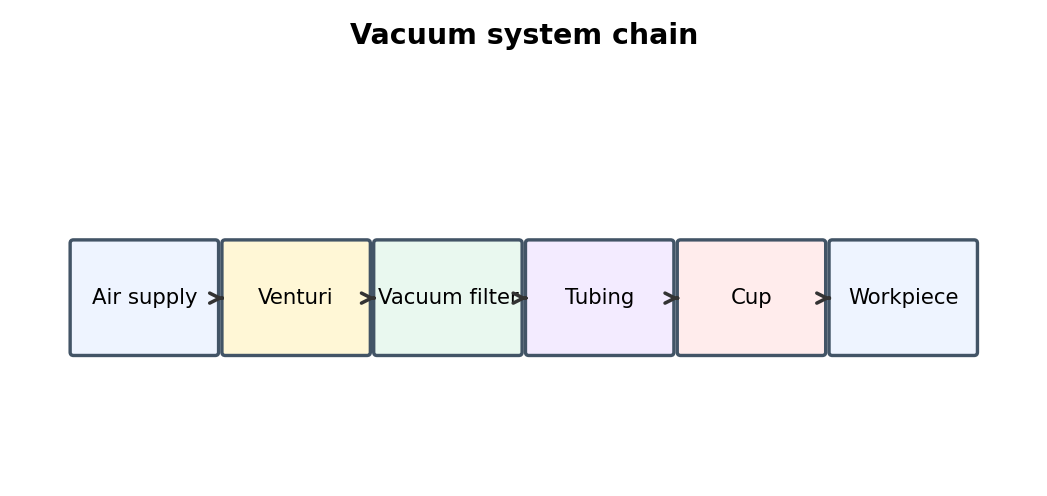
A venturi needs correct compressed-air pressure and flow plus a free exhaust before it can generate rated vacuum. Vacuum faults should be divided into generation, distribution leakage, cup/workpiece sealing, and dynamic process load.
What to check
- Measure vacuum at the source and at the cup.
- Check venturi supply pressure and exhaust.
- Inspect filters, tubing, cups, and porous workpieces.
- Verify vacuum switch setpoint against actual holding requirement.
Diagnostic sequence
- Test maximum vacuum at the source using the approved method.
- If source is good, isolate the distribution.
- Reconnect branches/cups until performance drops.
- Test during the actual pick and acceleration.
Common mistakes
Lowering switch setpoint to hide poor vacuum. • Testing only static vacuum. • Ignoring product surface and porosity.
FIELD RULE: Prove source → distribution → cup → process, in that order.
Suction Cups
Cup wear, product texture, porosity, alignment, and acceleration can cause dropped parts even with a healthy generator. Vacuum faults should be divided into generation, distribution leakage, cup/workpiece sealing, and dynamic process load.
What to check
- Measure vacuum at the source and at the cup.
- Check venturi supply pressure and exhaust.
- Inspect filters, tubing, cups, and porous workpieces.
- Verify vacuum switch setpoint against actual holding requirement.
Diagnostic sequence
- Test maximum vacuum at the source using the approved method.
- If source is good, isolate the distribution.
- Reconnect branches/cups until performance drops.
- Test during the actual pick and acceleration.
Common mistakes
Lowering switch setpoint to hide poor vacuum. • Testing only static vacuum. • Ignoring product surface and porosity.
FIELD RULE: Prove source → distribution → cup → process, in that order.
Vacuum Filters
A clogged vacuum filter may allow eventual vacuum but make evacuation too slow for the machine timeout. Vacuum faults should be divided into generation, distribution leakage, cup/workpiece sealing, and dynamic process load.
What to check
- Measure vacuum at the source and at the cup.
- Check venturi supply pressure and exhaust.
- Inspect filters, tubing, cups, and porous workpieces.
- Verify vacuum switch setpoint against actual holding requirement.
Diagnostic sequence
- Test maximum vacuum at the source using the approved method.
- If source is good, isolate the distribution.
- Reconnect branches/cups until performance drops.
- Test during the actual pick and acceleration.
Common mistakes
Lowering switch setpoint to hide poor vacuum. • Testing only static vacuum. • Ignoring product surface and porosity.
FIELD RULE: Prove source → distribution → cup → process, in that order.
Vacuum Leak Testing
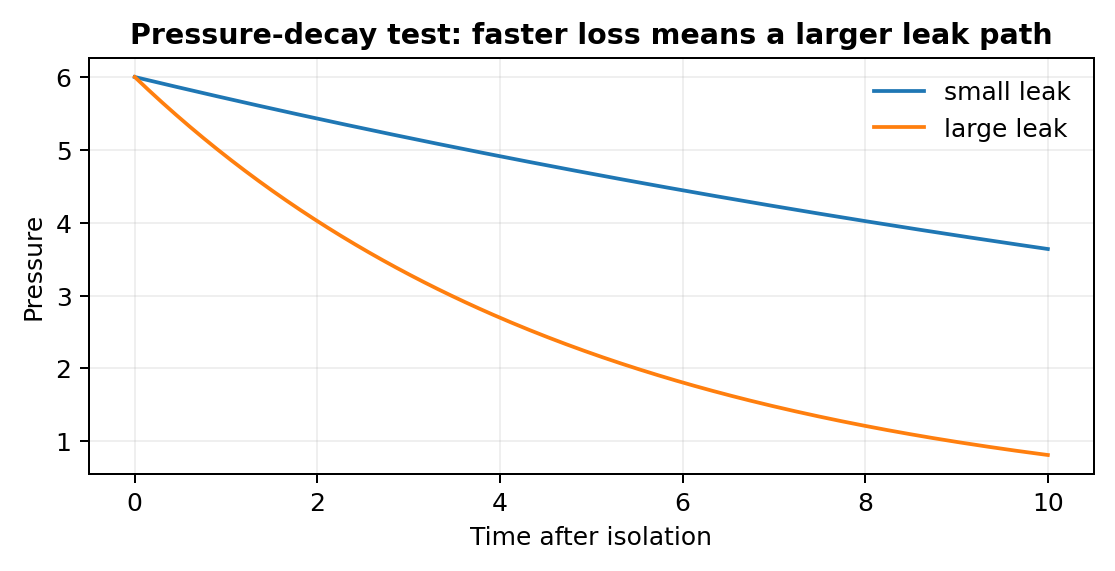
Vacuum leaks are found by isolation, capping branches, and decay testing rather than only listening for outward airflow. Vacuum faults should be divided into generation, distribution leakage, cup/workpiece sealing, and dynamic process load.
What to check
- Measure vacuum at the source and at the cup.
- Check venturi supply pressure and exhaust.
- Inspect filters, tubing, cups, and porous workpieces.
- Verify vacuum switch setpoint against actual holding requirement.
Diagnostic sequence
- Test maximum vacuum at the source using the approved method.
- If source is good, isolate the distribution.
- Reconnect branches/cups until performance drops.
- Test during the actual pick and acceleration.
Common mistakes
Lowering switch setpoint to hide poor vacuum. • Testing only static vacuum. • Ignoring product surface and porosity.
FIELD RULE: Prove source → distribution → cup → process, in that order.
Vacuum Reservoirs and Check Valves
Stored vacuum can decay through leaking check valves or reservoirs and must also be released safely for service. Vacuum faults should be divided into generation, distribution leakage, cup/workpiece sealing, and dynamic process load.
What to check
- Measure vacuum at the source and at the cup.
- Check venturi supply pressure and exhaust.
- Inspect filters, tubing, cups, and porous workpieces.
- Verify vacuum switch setpoint against actual holding requirement.
Diagnostic sequence
- Test maximum vacuum at the source using the approved method.
- If source is good, isolate the distribution.
- Reconnect branches/cups until performance drops.
- Test during the actual pick and acceleration.
Common mistakes
Lowering switch setpoint to hide poor vacuum. • Testing only static vacuum. • Ignoring product surface and porosity.
FIELD RULE: Prove source → distribution → cup → process, in that order.
Blow-Off and Fast Release
A short positive-pressure pulse can release parts quickly but must be tuned so it does not damage or eject product. Vacuum faults should be divided into generation, distribution leakage, cup/workpiece sealing, and dynamic process load.
What to check
- Measure vacuum at the source and at the cup.
- Check venturi supply pressure and exhaust.
- Inspect filters, tubing, cups, and porous workpieces.
- Verify vacuum switch setpoint against actual holding requirement.
Diagnostic sequence
- Test maximum vacuum at the source using the approved method.
- If source is good, isolate the distribution.
- Reconnect branches/cups until performance drops.
- Test during the actual pick and acceleration.
Common mistakes
Lowering switch setpoint to hide poor vacuum. • Testing only static vacuum. • Ignoring product surface and porosity.
FIELD RULE: Prove source → distribution → cup → process, in that order.
Vacuum Switch Timing
Slow vacuum buildup should be fixed at the source, filter, tubing, or leak rather than hidden with an unsafe setpoint. Vacuum faults should be divided into generation, distribution leakage, cup/workpiece sealing, and dynamic process load.
What to check
- Measure vacuum at the source and at the cup.
- Check venturi supply pressure and exhaust.
- Inspect filters, tubing, cups, and porous workpieces.
- Verify vacuum switch setpoint against actual holding requirement.
Diagnostic sequence
- Test maximum vacuum at the source using the approved method.
- If source is good, isolate the distribution.
- Reconnect branches/cups until performance drops.
- Test during the actual pick and acceleration.
Common mistakes
Lowering switch setpoint to hide poor vacuum. • Testing only static vacuum. • Ignoring product surface and porosity.
FIELD RULE: Prove source → distribution → cup → process, in that order.
Vacuum Troubleshooting Sequence
Vacuum diagnosis should prove source, distribution, cup seal, and real dynamic holding performance in sequence. Vacuum faults should be divided into generation, distribution leakage, cup/workpiece sealing, and dynamic process load.
What to check
- Measure vacuum at the source and at the cup.
- Check venturi supply pressure and exhaust.
- Inspect filters, tubing, cups, and porous workpieces.
- Verify vacuum switch setpoint against actual holding requirement.
Diagnostic sequence
- Test maximum vacuum at the source using the approved method.
- If source is good, isolate the distribution.
- Reconnect branches/cups until performance drops.
- Test during the actual pick and acceleration.
Common mistakes
Lowering switch setpoint to hide poor vacuum. • Testing only static vacuum. • Ignoring product surface and porosity.
FIELD RULE: Prove source → distribution → cup → process, in that order.
Continue the series
- Previous chapter: Pneumatic Contamination And Reliability
- Next chapter: Pneumatic Worked Troubleshooting Cases
- Browse all Pneumatic Troubleshooting chapters
Adapted from Pneumatic Troubleshooting for Maintenance Technicians, by Dovydas Kersys. © 2026 Dovydas Kersys. Featured cover image is an AI-generated editorial illustration.