By Dovydas Kersys · Chapter 19 of 58 in Machine Commissioning.
Before you begin: Follow the machine documentation, risk assessment, site procedures and lockout/tagout requirements. Commissioning can expose personnel to electrical energy, stored pressure and unexpected motion. Never defeat a safety function merely to make a test easier. Examples and diagrams are generic and must be checked against the actual machine.
Interlocks and permissives decide whether equipment may run. Commissioning must prove both the allow path and every individual inhibit condition.
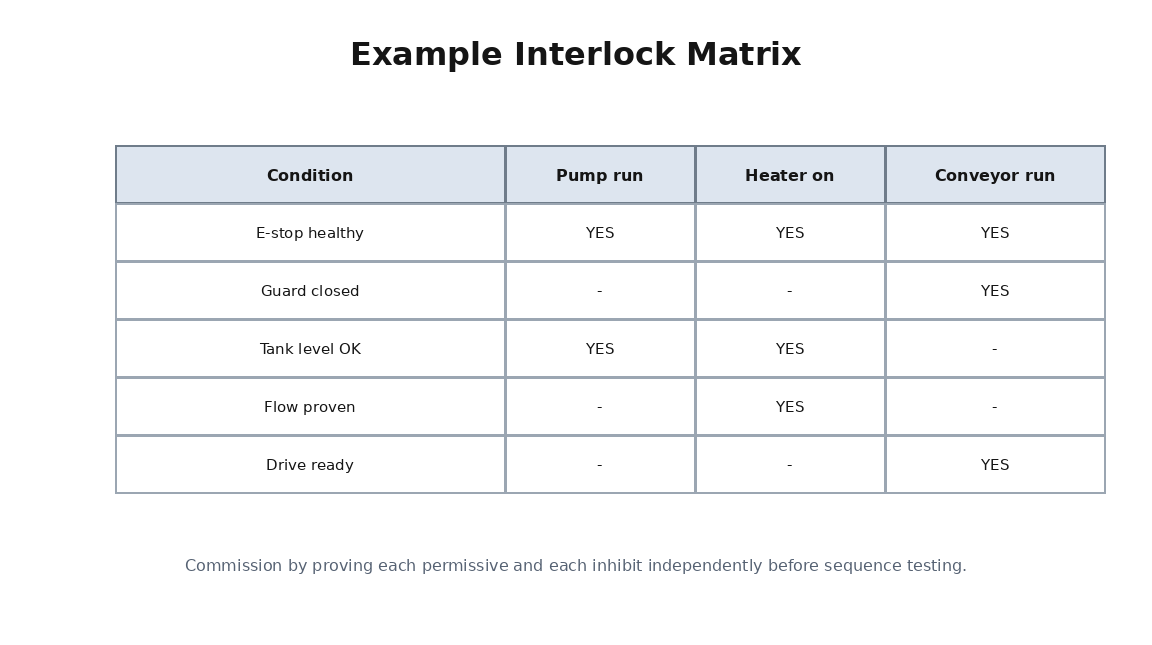
Commission interlocks one condition at a time.
Why this matters during commissioning
It is easy to prove that a pump runs when all conditions are good. The more important test is proving that it refuses to run when any required condition is bad.
Commissioning procedure
- List all start permissives and running interlocks from design intent.
- Force the process into one bad condition at a time using safe test methods.
- Confirm start is prevented or running equipment stops as intended.
- Verify alarm/message identifies the blocking condition.
- Restore the condition and verify reset/restart behavior.
Common failure patterns
- Several conditions combined into one vague “not ready” alarm.
- Interlock bypass accidentally left active.
- Start permissive checked only at start and not during run when it should remain active.
- Wrong polarity on a fail-safe contact.
Evidence to record
- Interlock condition
- Test method
- Expected reaction
- Observed reaction
- Alarm text
- Recovery behavior
FIELD RULE: An interlock is not proven because it is present in code; it is proven when the machine reacts correctly to the real condition.
Continue the series
- Previous chapter: I/O Naming, Scaling and Diagnostics: Commissioning Guide
- Next chapter: Sequence / State Testing: Commissioning Guide
- Browse all Machine Commissioning chapters
Adapted from Machine Commissioning for Maintenance and Automation Technicians, by Dovydas Kersys. © 2026 Dovydas Kersys. Featured cover image is an AI-generated editorial illustration.