By Dovydas Kersys · Chapter 20 of 58 in Machine Commissioning.
Before you begin: Follow the machine documentation, risk assessment, site procedures and lockout/tagout requirements. Commissioning can expose personnel to electrical energy, stored pressure and unexpected motion. Never defeat a safety function merely to make a test easier. Examples and diagrams are generic and must be checked against the actual machine.
Automatic sequences should be commissioned as controlled transitions between defined states. Each transition needs a condition to advance, a timeout/fault path and a clear recovery method.
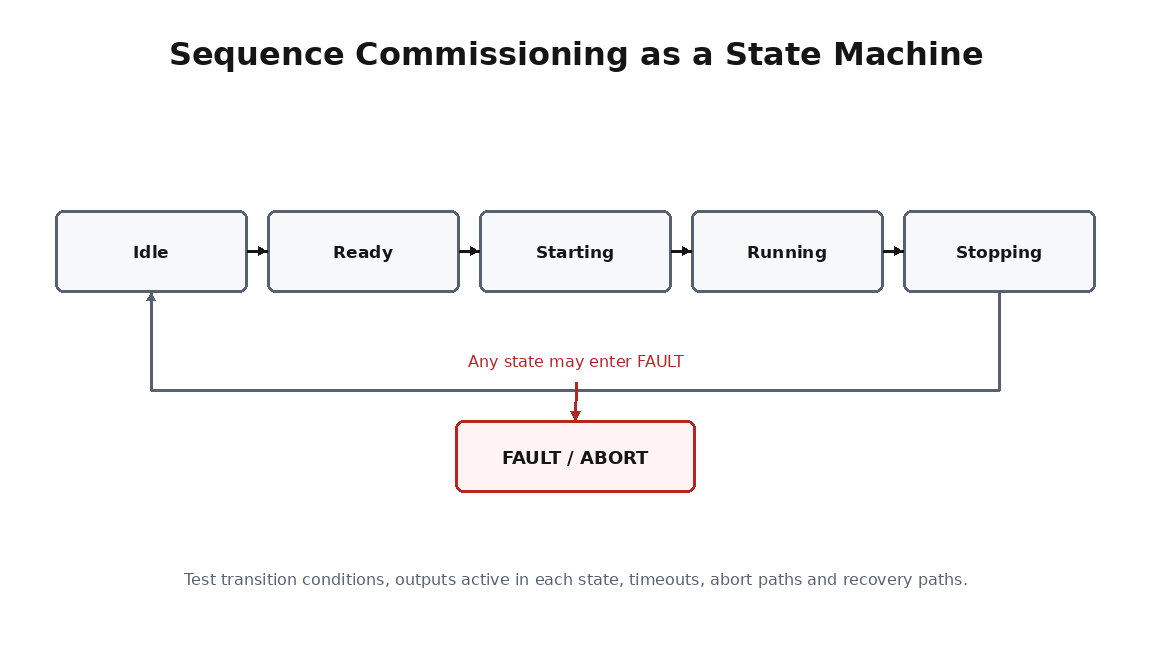
Think of automatic operation as a state machine, not a long ladder of mysterious bits.
Why this matters during commissioning
Running a full automatic cycle before individual transitions are proven hides logic defects inside a moving machine.
Commissioning procedure
- Identify the sequence states or steps and the outputs active in each.
- Start with low-risk or dry-run conditions.
- Prove one transition at a time, including sensor timing and required delays.
- Intentionally prevent feedback to verify timeout and fault behavior.
- Test stop, pause, abort and recovery paths.
- Only then run continuous automatic cycles.
Common failure patterns
- Step advances on command instead of proven feedback.
- No timeout, causing the machine to wait forever.
- Timer used to hide slow or unreliable mechanical feedback.
- Recovery returns to a state that re-energizes an unsafe actuator.
Evidence to record
- State/step number
- Entry condition
- Outputs active
- Transition condition
- Timeout behavior
- Recovery result
FIELD RULE: The best commissioning question for every sequence step is: what proves it is safe and complete to advance?
PART IV
Drives, Motors and Motion
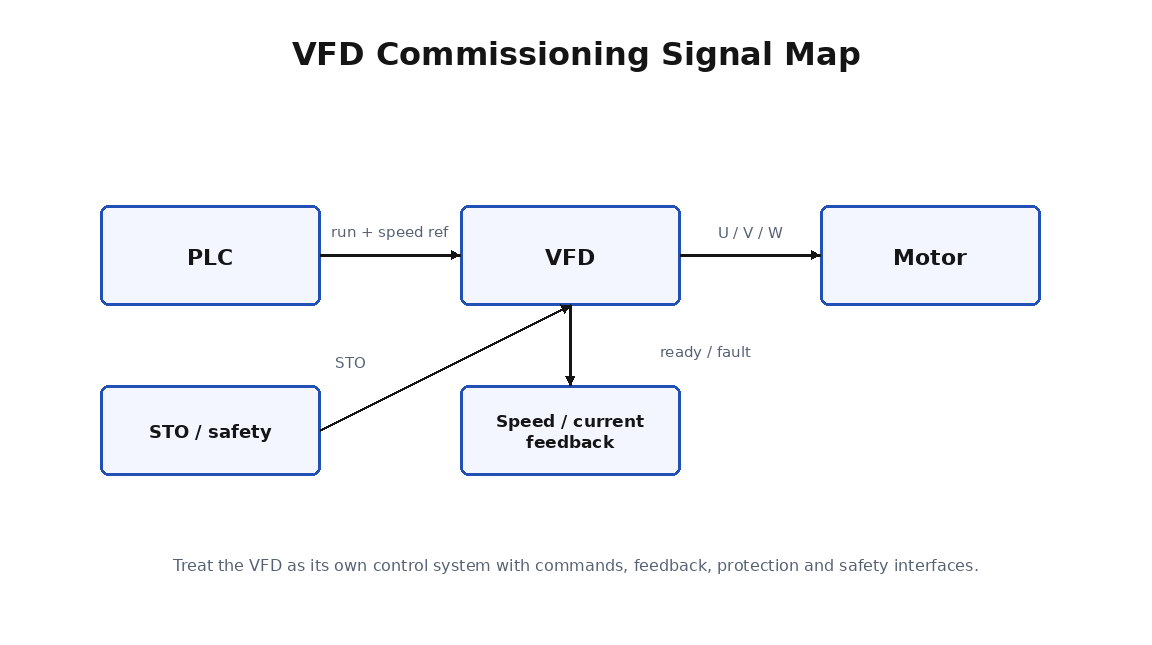
Drives, Motors and Motion
Continue the series
- Previous chapter: Interlocks and Permissives: Commissioning Guide
- Next chapter: Motor Pre-Start Checks: Commissioning Guide
- Browse all Machine Commissioning chapters
Adapted from Machine Commissioning for Maintenance and Automation Technicians, by Dovydas Kersys. © 2026 Dovydas Kersys. Featured cover image is an AI-generated editorial illustration.