Angle measuring sensors are used to measure the rotational position of a shaft, lever, valve, arm, gear, knob, or machine part.
In industrial automation, an angle sensor can tell the control system:
How far something has rotated
What position a shaft is in
Whether a valve is open or closed
The position of a flap or actuator
The angle of a machine arm
The steering angle of a vehicle or mobile machine
The position of a rotary mechanism
In simple words:
An angle measuring sensor converts rotation into an electrical signal.
This signal can then be sent to a PLC, controller, display, drive, or monitoring system.
What Is an Angle Measuring Sensor?
An angle measuring sensor is a device that measures rotational position.
It does not measure linear movement. It measures rotation.
The measured value is usually shown in:
Degrees
Percentage
Voltage
Current
Digital position value
For example:
0° = closed valve
45° = half open
90° = fully open
Or:
0° = 4 mA
180° = 12 mA
360° = 20 mA
The exact output depends on the sensor type and configuration.
Where Angle Sensors Are Used
Angle sensors are used in many applications, including:
Valve position feedback
Damper position feedback
Throttle position measurement
Rotary actuator position
Machine arm angle
Mobile machinery steering angle
Pedal position
Lever position
Packaging machines
Printing machines
Robotics
Material handling equipment
Agricultural machinery
Construction machinery
Wind turbine systems
Solar tracking systems
Industrial automation
Any machine part that rotates and needs position feedback may use an angle sensor.
Main Angle Sensor Technologies
There are several ways to measure angle.
Common technologies include:
Magnetic angle sensors
Potentiometric angle sensors
Optical encoders
Inductive angle sensors
Capacitive angle sensors
Resolvers
This article focuses mainly on magnetic angle measuring sensors, because they are widely used in industrial and mobile machine applications.
What Is a Magnetic Angular Sensor?
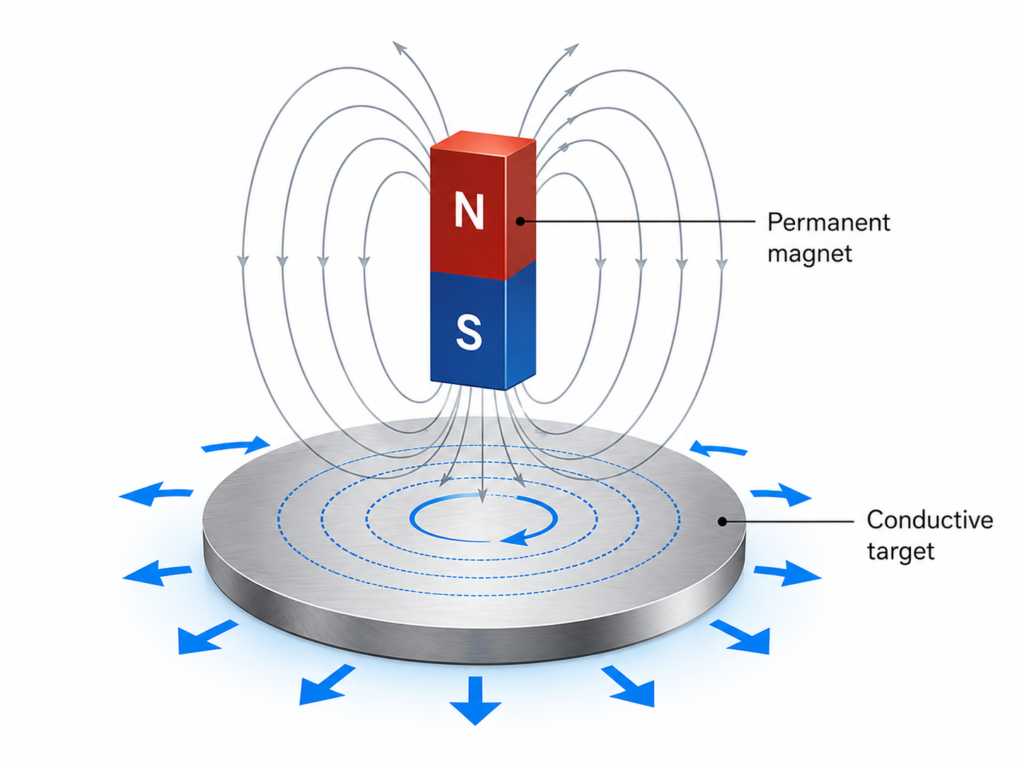
A magnetic angular sensor measures rotation using a magnetic field.
The sensor detects the direction of an external magnet.
As the magnet rotates, the magnetic field direction changes.
The sensor electronics convert this magnetic field direction into an angle value.
The key idea is simple:
A rotating magnet creates a changing magnetic field, and the sensor uses that field to calculate the rotation angle.
Basic Working Principle of a Magnetic Angle Sensor
A magnetic angular sensor usually has two main parts:
A magnet
A sensor element
The magnet is attached to the rotating shaft or rotating machine part.
The sensor is mounted close to the magnet but does not need to touch it.
When the shaft rotates, the magnet rotates with it.
The sensor detects the magnetic field direction and calculates the angle.
Simple Example
Imagine a magnet mounted on the end of a rotating shaft.
The sensor is mounted directly in front of the magnet.
When the shaft is at 0°, the magnetic field has one direction.
When the shaft turns to 90°, the field direction changes.
When the shaft turns to 180°, it changes again.
The sensor electronics detect these changes and output the corresponding angle.
Hall Effect in Magnetic Angle Sensors
Many magnetic angular sensors use Hall effect technology.
A Hall sensor can detect magnetic fields.
In angle measurement, the sensor does not only detect whether a magnet is present. It detects the direction of the magnetic field.
A more advanced magnetic angular sensor often uses a dual differential Hall element.
This allows the sensor to detect the magnetic field direction very accurately.
What Is a Dual Differential Hall Element?
A dual differential Hall element is a magnetic sensing structure inside the sensor chip.
It detects magnetic field components in different directions.
When a magnet rotates above or near the sensor, the magnetic field direction rotates around the sensor element.
The Hall element converts this changing magnetic field direction into electrical signals.
These signals can then be processed by the sensor electronics.
Why Two Signals Are Used
Inside the magnetic angle sensor, the rotating magnetic field creates two signal curves.
These two curves are sinusoidal signals.
They are shifted by 90° from each other.
They are often described as:
Sine signal
Cosine signal
This 90° shift is very important.
Because the electronics have both sine and cosine information, they can calculate the angle over the full rotation.
Simple Explanation of Sine and Cosine Signals
When the magnet rotates, the sensor receives two changing signals.
One signal behaves like a sine wave.
The other signal behaves like a cosine wave.
These two signals are shifted by 90°.
The electronics compare them and calculate the exact angle.
For example:
At one position, sine may be high and cosine may be low.
At another position, cosine may be high and sine may be low.
At another position, both values may be different.
By comparing both signals, the sensor can know where the magnet is in its rotation.
How the Sensor Calculates the Angle
The sensor electronics evaluate the sine and cosine signals.
From these two signals, the electronics calculate the magnetic field direction.
The magnetic field direction corresponds to the rotation angle.
The basic process is:
Magnet rotates.
Magnetic field direction changes.
Hall element detects field direction.
Two sinusoidal signals are generated.
Electronics evaluate the signals.
Sensor outputs an angle value.
This angle value can be sent as an analog or digital output.
Absolute Angle Detection
One important advantage of many magnetic angle sensors is absolute angle detection.
This means the sensor knows the actual angle immediately after power is switched on.
It does not need to move to find a reference point.
For example:
If the shaft is at 73° and power is lost, the sensor output disappears.
When power returns, the sensor reads the magnetic field again and immediately outputs 73°.
This is different from some incremental systems that may need movement or homing after power loss.
Why Absolute Angle Measurement Is Useful
Absolute angle measurement is useful because it gives the correct position immediately.
This is important for:
Valves
Actuators
Safety-related position monitoring
Mobile machines
Steering systems
Machine startup
Robotics
Position feedback after power failure
If a machine loses power, the control system does not want to guess the position.
An absolute angle sensor helps avoid that problem.
Output Signals From Angle Sensors
Angle measuring sensors can provide different output signals.
Common outputs include:
0–10V
0.5–4.5V
4–20 mA
PWM
SSI
CANopen
IO-Link
Modbus
Analog voltage
Analog current
Digital position value
For PLC systems, common industrial outputs are:
4–20 mA
0–10V
IO-Link
CANopen
The output signal depends on the application and control system.
Analog Output Example
A magnetic angle sensor may be configured like this:
0° = 0V
180° = 5V
360° = 10V
Or:
0° = 4 mA
180° = 12 mA
360° = 20 mA
The PLC reads the analog signal and scales it into degrees.
Example: 4–20 mA Angle Scaling
Sensor range:
0–360° = 4–20 mA
| Angle | Output |
|---|---|
| 0° | 4 mA |
| 90° | 8 mA |
| 180° | 12 mA |
| 270° | 16 mA |
| 360° | 20 mA |
If the PLC reads 12 mA, the angle is 180°.
Example: 0–10V Angle Scaling
Sensor range:
0–360° = 0–10V
| Angle | Output |
|---|---|
| 0° | 0V |
| 90° | 2.5V |
| 180° | 5V |
| 270° | 7.5V |
| 360° | 10V |
If the PLC reads 5V, the angle is 180°.
Magnetic Angle Sensor Design
A typical magnetic angular sensor system includes:
Rotating magnet
Hall sensor element
Signal processing electronics
Housing
Shaft or target mounting
Electrical connector
Output circuit
PLC or controller input
The sensor itself usually remains stationary.
The magnet or target rotates.
Because there is no mechanical contact between the rotating magnet and the sensing chip, the sensor can be very durable.
Contactless Angle Measurement
One major advantage of magnetic angle sensors is that they can measure without direct mechanical contact.
This means:
No sliding contact
Less wear
No mechanical friction
Long service life
Good for dirty environments
Good for vibration applications
Good for mobile machinery
This is different from older potentiometric sensors, where a wiper moves along a resistive track.
A potentiometer can wear over time because it has mechanical contact.
A magnetic angle sensor can avoid that problem.
Magnetic Angle Sensor vs Potentiometer
A potentiometer is also used for angle measurement.
It works by changing resistance as a shaft rotates.
Potentiometers are simple and low cost, but they have a contact element that can wear.
Potentiometer Advantages
Simple
Low cost
Easy analog signal
Common in basic applications
Potentiometer Limitations
Mechanical wear
Limited lifetime
Sensitive to vibration
Can become noisy
Can fail from dust or contamination
Contact friction
Magnetic Sensor Advantages
Contactless measurement
Less wear
Good lifetime
Good for vibration
Absolute angle possible
Suitable for harsh environments
Can provide analog or digital output
Magnetic Sensor Limitations
Needs correct magnet alignment
External magnetic fields can affect measurement
Air gap must be controlled
Sensor and magnet must match
More electronics than a simple potentiometer
Magnetic Angle Sensor vs Encoder
An encoder is another common rotation measurement device.
Encoders can be:
Incremental
Absolute
Optical
Magnetic
An incremental encoder outputs pulses as the shaft rotates.
An absolute encoder gives a position value.
Magnetic angle sensors are often simpler when only one rotation angle needs to be measured.
Use a Magnetic Angle Sensor When:
You need compact angle feedback
You need contactless measurement
You need absolute angle after power-up
You measure valve, lever, actuator, or steering position
You need analog output to PLC
Use an Encoder When:
You need high resolution
You need speed and position feedback
You need multi-turn counting
You need pulse outputs
You need precise motor position feedback
Installation of Magnetic Angle Sensors
Correct installation is very important.
The sensor must be aligned with the magnet.
Important installation points include:
Magnet position
Sensor center alignment
Air gap
Magnet strength
Rotation axis
Mounting stability
Distance from other magnets
Distance from strong currents
Cable routing
Mechanical vibration
If the magnet is not centered correctly, the angle reading may be inaccurate.
Good Installation
Magnet centered over the sensor axis
Correct air gap
Magnet rotates smoothly
Sensor mounted securely
No strong external magnetic fields nearby
Cable routed away from high-power cables
Correct output scaling in PLC
Correct mechanical angle range
Bad Installation
Magnet off-center
Air gap too large
Magnet installed backwards
Weak magnet
Sensor mounted at an angle
Shaft wobble
Strong nearby magnetic field
Motor cable routed beside sensor cable
Loose bracket
Wrong PLC scaling
Even a good sensor can give bad readings if the magnet installation is poor.
Common Problems With Magnetic Angle Sensors
Common problems include:
Wrong angle value
Output stuck
Signal jumps
Angle drifts
Reading changes with vibration
Sensor works only in part of range
Wrong direction of rotation
PLC value does not match sensor output
Incorrect angle after installation
Noise on analog output
Magnet missing or misaligned
Air gap too large
Strong magnetic interference
Many of these problems are installation or configuration related.
Temperature and Environmental Effects
Angle sensors are often installed in machines, vehicles, and outdoor equipment.
Environmental factors can affect performance.
Check:
Temperature range
Ingress protection
Vibration rating
Shock rating
Chemical exposure
Dust and dirt
Moisture
Cable protection
Connector sealing
Magnetic interference
A sensor used outdoors or on mobile machinery must be more robust than one used inside a clean control cabinet.
How Angle Sensors Connect to a PLC
A simple PLC system may work like this:
Magnet is mounted on rotating shaft.
Angle sensor measures magnetic field direction.
Sensor outputs 4–20 mA or 0–10V.
PLC analog input reads the signal.
PLC scales the signal into degrees.
HMI displays the angle.
PLC uses the angle for control or alarms.
Example logic:
If valve angle is below 5°, show “closed.”
If valve angle is above 85°, show “open.”
If angle is between 5° and 85°, show “moving” or “partly open.”
Example: Valve Position Feedback
A valve actuator rotates from 0° to 90°.
A magnetic angle sensor is installed to measure the shaft angle.
Sensor scaling:
0° = 4 mA
90° = 20 mA
Then:
| Valve Position | Angle | Output |
|---|---|---|
| Closed | 0° | 4 mA |
| 25% open | 22.5° | 8 mA |
| 50% open | 45° | 12 mA |
| 75% open | 67.5° | 16 mA |
| Fully open | 90° | 20 mA |
The PLC can use this feedback to confirm the valve position.
Example: Steering Angle Measurement
In mobile machinery, a magnetic angle sensor can measure steering position.
The sensor gives absolute angle feedback to the controller.
This helps the machine know the steering angle after startup, even if the steering position changed while power was off.
This is useful in:
Forklifts
Agricultural machines
Construction machinery
Automated guided vehicles
Mobile robots
Choosing an Angle Measuring Sensor
Before choosing an angle sensor, check:
Angle range
Single-turn or multi-turn requirement
Required accuracy
Required resolution
Output signal
PLC input type
Mechanical mounting
Magnet mounting
Air gap tolerance
Environmental protection
Temperature range
Shock and vibration
Rotation speed
Cable length
Power supply
Need for absolute position
Need for contactless measurement
External magnetic field risk
Use Magnetic Angle Sensors When:
You need contactless angle measurement
You need absolute position after power-up
The application has vibration or dirt
The rotation range is limited
You need valve or actuator position feedback
You want analog or digital position output
A potentiometer would wear too quickly
Use Potentiometric Sensors When:
The application is simple
Cost must be low
Mechanical wear is acceptable
The environment is clean
Accuracy requirements are moderate
The rotation cycles are low
Use Encoders When:
You need high resolution
You need speed feedback
You need pulse counting
You need multi-turn measurement
You need precise motion control
Advantages of Magnetic Angular Sensors
Magnetic angle sensors have several important advantages:
Contactless measurement
No mechanical wear between sensor and magnet
Absolute angle measurement possible
Correct angle available after power failure
Compact design
Good for harsh environments
Good vibration resistance
Analog and digital outputs available
Suitable for PLC and controller systems
Can be used for valves, levers, shafts, and actuators
Limitations of Magnetic Angular Sensors
They also have limitations:
Require correct magnet alignment
Air gap must be within limits
External magnetic fields can disturb measurement
Wrong magnet type can cause bad readings
Metal parts nearby may influence the field
Not always suitable for very high precision motion control
Usually limited to angular position, not full motor feedback unless designed for it
Understanding these limits helps avoid wrong sensor selection.
Final Thoughts
Angle measuring sensors are used to measure the rotational position of machine parts.
A magnetic angular sensor uses a rotating magnetic field and Hall effect technology to calculate the angle.
The heart of many magnetic angle sensors is a Hall sensing element that detects the direction of an external magnetic field.
As the magnet rotates, the sensor receives two sinusoidal signals shifted by 90°.
The electronics evaluate these signals and convert them into a linear voltage, current, or digital position value.
One of the most useful features of magnetic angle sensors is absolute angle detection.
This means the correct rotation angle is available immediately after power returns, without needing a reference movement.
The key idea is:
A magnetic angle sensor measures the direction of a rotating magnetic field and converts it into an electrical angle signal for a PLC or controller.