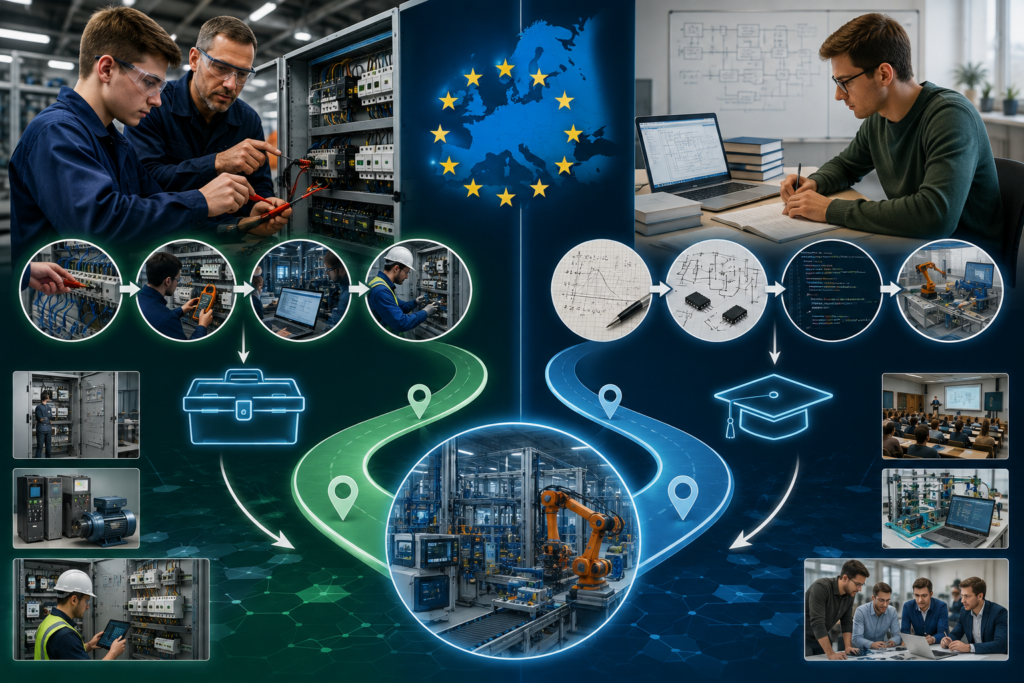
Most career advice about industrial automation is written from a US perspective:
Trade school or community college
vs
Four-year university degree
That comparison does not transfer neatly to Europe.
Across the EU, someone may enter automation through:
- A paid dual-system apprenticeship
- School-based vocational education with company placements
- A technical college or higher-VET programme
- A university of applied sciences
- A traditional engineering university
- Adult retraining after already working as an electrician or maintenance technician
The names, qualification levels and amount of workplace training vary by country.
The honest conclusion is:
An apprenticeship or vocational route usually gets you onto the factory floor faster. A university degree normally gives you easier access to engineering, design and advanced specialist positions.
Neither route automatically produces a good automation professional.
An apprentice can finish with excellent wiring skills but barely understand PLC program structure. A graduate can understand control theory but still struggle to diagnose a failed 24 V sensor.
The strongest people eventually combine practical experience with engineering knowledge—regardless of which one came first.
Quick Comparison
| Area | Apprenticeship or VET route | University route |
|---|---|---|
| Main emphasis | Practical occupational competence | Engineering theory and system design |
| Typical learning location | Company, workshop and vocational school | University, laboratory and project work |
| Time before real industrial exposure | Usually early | Depends heavily on internships |
| Income while learning | Often available in formal apprenticeships, but country-specific | Usually limited to internships or part-time work |
| Electrical installation skills | Strong | Often limited |
| Maintenance troubleshooting | Strong | Depends on industrial exposure |
| Mathematics and control theory | Basic to moderate | Strong |
| PLC programming | Highly programme-dependent | Also highly programme-dependent |
| First typical role | Electrician, mechatronics technician, automation technician | Junior controls, automation or electrical engineer |
| Access to engineering graduate schemes | More difficult | Easier |
| Ability to progress into controls engineering | Yes | Yes |
| Main risk | Becoming trapped in replacement-and-repair work | Graduating with little practical competence |
| Best result | VET plus continued technical study | Degree plus substantial factory experience |
These are general tendencies. Europe has no single apprenticeship or university system.
Why American Career Advice Often Misses the EU Reality
“Apprenticeship” does not mean the same thing everywhere
In one country, an apprentice may be an employee who spends most of the week in a company and receives formal remuneration.
In another, vocational education may remain mostly school-based, with several weeks or months of mandatory workplace training.
European apprenticeship schemes differ significantly in their target groups, employer involvement, remuneration and social-protection arrangements. A prospective student therefore needs to inspect the actual contract and curriculum rather than relying on the word apprenticeship.
Vocational education does not always end at secondary level
European VET can continue into higher education and advanced professional qualifications.
The European Qualifications Framework has eight levels and is intended to make qualifications from different countries easier to understand and compare. Bachelor’s degrees are normally placed at EQF level 6, but advanced vocational qualifications can also reach levels 5, 6 or above.
For example, Germany places advanced vocational qualifications such as the Bachelor Professional or Meister at EQF level 6. That does not make a Meister and an engineering bachelor’s degree identical. It means their learning outcomes are considered to have a comparable level of complexity and responsibility within the framework.
University does not always mean a highly theoretical institution
Europe has:
- Research universities
- Technical universities
- Universities of applied sciences
- Professional bachelor’s programmes
- Cooperative or dual-study programmes
- Short-cycle higher education
A practical engineering programme with mandatory company placements may sit somewhere between the traditional idea of an apprenticeship and a purely academic university degree.
Qualifications do not automatically transfer perfectly
The EQF helps employers compare qualifications, but it is not an automatic licence to perform every occupation in every EU country.
When a profession is regulated in the destination country, formal recognition may be required before the person can practise it. This is particularly relevant to electrical work involving public safety, legal sign-off or protected professional titles.
What the Apprenticeship Route Looks Like in Europe
The practical route is broader than one standard apprenticeship model.
You may find programmes titled:
- Industrial electrician
- Electrical engineering technician
- Electronics technician for automation technology
- Mechatronics technician
- Automation technician
- Industrial maintenance technician
- Instrumentation and control technician
- Electromechanical technician
- Process-control technician
The best route is rarely a programme called simply “PLC programming.” Industrial automation requires electrical, mechanical and process knowledge around the PLC.
Germany: the dual-system model
Germany’s dual VET system combines company employment with vocational-school education.
Apprenticeship programmes are usually around three years, are commonly placed at EQF level 4 and spend approximately 75% of their learning time in workplace-based training. Employers pay apprentice remuneration, and final examinations are normally administered through the relevant chambers.
Automation-related occupational routes include areas such as:
- Electronics for automation technology
- Industrial electrical engineering
- Mechatronics
- Information and systems technology
- Industrial mechanics with automation exposure
The main advantage is substantial real workplace experience before graduation.
The limitation is that the quality of automation exposure depends heavily on the employer. An apprentice at an advanced machine builder may work with PLCs, drives and robots. Another may spend most of the programme installing cable trays and replacing contactors.
Both can receive legitimate qualifications while graduating with different automation abilities.
Austria: apprenticeship with progression options
Austrian apprenticeships generally last between two and four years and cover roughly 230 occupations. They are normally placed at EQF level 4.
Graduates can later pursue master-craftsperson qualifications, additional technical training or higher education after meeting the relevant access requirements.
This illustrates an important European point:
Apprenticeship
does not have to mean
the end of formal education
It can be the first stage of a longer technical career.
Belgium: company and training-centre alternation
In parts of Belgium, apprenticeships or dual programmes may last two to three years, with learners spending three or four days per week at a company and one or two days at a training centre.
The school component covers general, theoretical and technical subjects while the company develops occupational competence.
Belgian VET also includes qualifications such as electronics and automation technician, with some programmes providing access to further tertiary education.
Lithuania: more school-based, but still practical
Lithuanian vocational education has traditionally been more school-based than the German dual model.
Cedefop’s Lithuania analysis reports that practical training accounts for approximately 60–70% of specialised-subject hours in initial VET, including mandatory time in a company or a realistic training environment. Graduates who also hold the necessary secondary-education certificate can progress into higher education.
For someone in Lithuania, a realistic pathway may therefore be:
Vocational electrical or mechatronics programme
→ Factory maintenance position
→ PLC and drive responsibility
→ Automation technician
→ College or university studies later
That route may not be formally called a traditional apprenticeship, but it can produce the same combination of vocational education and industrial experience.
What You Learn Well Through an Apprenticeship
A good industrial apprenticeship teaches how equipment exists in the real world.
Electrical installation
You may learn to:
- Read electrical schematics
- Install cables and cable trays
- Terminate control and power wiring
- Wire motors and sensors
- Build or modify control panels
- Test protective conductors
- Measure voltage and current safely
- Select and replace electrical components
- Follow isolation procedures
These skills remain useful even when you later spend most of your time programming.
A PLC program ultimately reaches the machine through real terminals, wires and devices.
Industrial troubleshooting
You learn that a machine fault may involve:
Power
→ Protection
→ Safety circuit
→ Sensor
→ PLC input
→ Logic
→ PLC output
→ Drive or actuator
→ Mechanical movement
This complete-chain thinking is difficult to develop from simulation alone.
Components and field devices
Practical training normally provides exposure to:
- Contactors
- Overload relays
- Circuit breakers
- Proximity sensors
- Photoelectric sensors
- Encoders
- Solenoid valves
- VFDs
- Motors
- Safety relays
- PLC I/O
- Industrial connectors
- Pneumatic equipment
Factory behaviour
You also learn things no brochure lists:
- Drawings may be outdated.
- Replacement sensors may not be adjusted correctly.
- Intermittent faults disappear when the laptop is connected.
- Production wants the machine running before the fault has been fully understood.
- The operator often knows exactly when the problem began.
- A software-looking fault is frequently a physical wiring problem.
That experience can make an apprenticeship-trained technician extremely effective during breakdowns and commissioning.
Weaknesses of the Apprenticeship Route
The practical route is not automatically complete.
PLC exposure may be shallow
Some programmes advertise automation but provide little more than:
- Basic start-stop ladder logic
- One small training PLC
- A few timers and counters
- No real HMI development
- No industrial networks
- No structured project work
Ask what platforms are actually used.
A useful programme should ideally include at least some exposure to:
- Siemens TIA Portal
- Rockwell Studio 5000 or CCW
- CODESYS
- Beckhoff TwinCAT
- Schneider EcoStruxure
- Mitsubishi GX Works
- Omron Sysmac Studio or CX-Programmer
No programme needs all of them. It should teach at least one platform beyond demonstration level.
Engineering theory may be limited
Vocational education may not cover deeply:
- Control-system modelling
- Calculus
- Signals and systems
- Advanced electronics
- Power electronics
- Control-loop design
- Advanced motion control
- Software architecture
- Functional-safety calculations
You can study these subjects later, but they may not appear naturally during ordinary maintenance work.
You can become trapped in maintenance
A competent apprentice may quickly become valuable at repairing breakdowns.
That can create an awkward situation:
You are too useful fixing machines
to be given time to design new ones.
Moving from maintenance into controls engineering often requires deliberate effort:
- Requesting programming tasks
- Assisting with commissioning
- Building projects outside work
- Moving to a system integrator
- Completing higher VET or university studies
- Learning electrical design and documentation
Some employers still require a degree
Experience may convince the engineering manager.
It may not convince the recruitment system.
Large multinational companies, graduate programmes and formal engineering departments often use a bachelor’s degree as an initial filter. The non-degree route remains possible, but you may have fewer employers from which to choose.
What the University Route Looks Like
A European bachelor’s degree normally contains either 180 or 240 ECTS credits. Sixty ECTS credits represent one full academic year, making the usual degree length approximately three or four years.
Bachelor’s degrees normally correspond to EQF level 6. The Bologna structure organises European higher education into bachelor’s, master’s and doctoral cycles and supports qualification recognition and study mobility.
Relevant degree names include:
- Electrical engineering
- Automation engineering
- Control engineering
- Mechatronics
- Electronics engineering
- Robotics
- Computer engineering
- Industrial engineering
- Process engineering
The degree title matters less than the curriculum.
An “automation engineering” degree with no PLC laboratory or industry placement may be less useful for machine controls than an electrical-engineering degree whose student completes several factory internships and automation projects.
What University Teaches Well
Mathematics and engineering fundamentals
University usually provides stronger coverage of:
- Calculus
- Linear algebra
- Differential equations
- Probability
- Circuit theory
- Electronics
- Electromagnetics
- Digital systems
- Signals and systems
- Control theory
You may not use every equation while troubleshooting a conveyor, but the foundation becomes valuable in advanced applications.
Control-system theory
A strong programme may cover:
- Open- and closed-loop control
- Transfer functions
- Stability
- PID control
- Frequency response
- State-space methods
- System identification
- Modelling and simulation
These topics matter more in:
- Process control
- Motion systems
- Robotics
- Precision positioning
- Thermal control
- Research and development
- Advanced drive applications
Structured engineering work
University can develop competence in:
- Requirements analysis
- System design
- Technical reports
- Project management
- Software development
- Testing methodology
- Data analysis
- Engineering calculations
- Research
These skills become increasingly important when you move from repairing existing machines to designing complete systems.
Easier access to engineering roles
A bachelor’s degree provides a recognised credential that is easier for employers in another country to understand.
It also improves access to:
- Graduate-engineer programmes
- Controls-design positions
- Research and development
- Engineering consultancies
- Master’s programmes
- Advanced specialist roles
- Some management pathways
Weaknesses of the University Route
PLC training may still be basic
An automation or electrical-engineering degree does not guarantee advanced PLC competence.
A student may spend months learning MATLAB and control-system modelling but only several laboratory sessions using a small PLC.
That education is valuable, but it does not automatically prepare someone to commission a packaging line.
Students may graduate without understanding field wiring
Common gaps include:
- Selecting sensors
- Reading industrial schematics
- Diagnosing 24 V control circuits
- Wiring contactors
- Configuring replacement drives
- Testing motors
- Understanding control-panel layout
- Working safely around production machinery
The graduate knows why a control loop is unstable but may not realise that the analog signal is fluctuating because its shield was terminated incorrectly.
Internships can be too general
A university internship at an industrial company may involve:
- Updating spreadsheets
- Following meetings
- Preparing documents
- Observing engineers
That is not the same as:
- Commissioning I/O
- Writing PLC code
- Testing failure modes
- Configuring a VFD
- Troubleshooting a running machine
Students need to examine what they will actually do—not merely whether a placement exists.
It delays full-time industrial experience
A graduate may begin their first full-time automation role at 22 or 23.
An apprentice of the same age may already have several years of daily factory experience.
The graduate may progress faster later, but the apprentice often begins with a substantial practical advantage.
The Underrated Third Option: Higher VET or Applied Engineering
The choice does not have to be:
Electrician apprenticeship
or
theoretical university
Many European systems offer intermediate and hybrid routes.
These may include:
- Technical colleges
- Higher vocational education
- Universities of applied sciences
- Professional bachelor’s degrees
- Dual-study degrees
- Work-based higher education
- Advanced technician qualifications
A good applied programme may combine:
- Electrical theory
- PLC programming
- Panel construction
- VFDs and servos
- Industrial networks
- Company placements
- An engineering qualification
This can be an excellent route for industrial automation because the subject itself sits between engineering theory and practical implementation.
The qualification’s EQF level can help you understand its formal position, but you should still inspect its content. The EQF is a comparison framework based on learning outcomes, not proof that two programmes teach identical subjects.
Which Route Is Better for Each Automation Career?
| Target career | Most direct route | Can the other route work? |
|---|---|---|
| Industrial electrician | Electrical apprenticeship or VET | Engineering graduate still needs practical electrical qualification where required |
| Factory automation technician | Electrical, mechatronics or automation VET | Yes; graduates may begin in technician roles |
| Maintenance technician | Industrial maintenance or electrical VET | Yes, but university is rarely necessary |
| Field-service technician | VET plus equipment experience | Yes; engineering degree can help with complex systems |
| PLC programmer | Either route plus strong projects | Yes |
| Commissioning engineer | Applied degree or VET plus extensive experience | Yes |
| Controls engineer | University is the easiest formal route | VET progression is realistic |
| Electrical designer | Degree or applied technical qualification | Varies by country and employer |
| Motion-control specialist | University strongly helps | Possible through advanced vendor experience |
| Process-control engineer | University normally preferred | Technician-to-engineer progression is possible |
| Functional-safety engineer | Engineering education plus specialist training | Experienced technicians can specialise, but formal competence matters |
| Robotics engineer | Mechatronics, robotics or automation degree | VET route can lead through integration and commissioning |
My Honest View From a Practical Route
My own route began closer to the vocational side.
I entered through industrial electrical work, machine maintenance and troubleshooting rather than completing an engineering degree first.
That gave me practical experience with:
- Electrical faults
- Sensors
- Motors
- VFDs
- PLC inputs and outputs
- Safety circuits
- Machine sequences
- Control panels
- Component selection
- Technical documentation
The advantage is that automation never appeared to me as code floating separately from the machine.
I learned to see the full chain:
Physical problem
→ Electrical signal
→ PLC logic
→ Machine response
That experience can move someone into controls work without following the traditional university route.
But I can also see the disadvantages.
Without a degree:
- Some vacancies remain closed.
- Advanced theory requires more self-study.
- Moving between countries or large employers can be harder.
- You may perform engineering work while keeping a technician-level title.
- Employers may continue seeing you primarily as the person who fixes breakdowns.
My practical route was not wrong.
It simply requires more deliberate career management than:
Bachelor’s degree
→ Graduate controls engineer
If starting again, I would seriously consider combining both routes:
Practical electrical or maintenance experience
+
Part-time electrical or automation engineering degree
That preserves the real-world foundation while removing some of the long-term qualification barriers.
When the Apprenticeship Route Is the Better Choice
Choose the practical route when:
- You learn best by building and repairing things.
- You want to begin earning sooner.
- You dislike spending several years mainly in lectures.
- You want to become an industrial electrician or technician.
- A reputable company offers genuine automation exposure.
- You are willing to continue studying independently.
- You may complete higher education later.
- You want strong field and commissioning skills.
It is especially attractive when the employer works with:
- PLC-controlled machinery
- Industrial robots
- VFDs and servo drives
- Automated warehouses
- Packaging equipment
- Process plants
- Machine building
- Panel construction
- Industrial service
An electrical apprenticeship at a domestic-installation company may be good training, but it is less direct for industrial automation than one involving factory machinery and controls.
When University Is the Better Choice
Choose university when:
- You want the clearest route to a controls-engineering title.
- You enjoy mathematics and system design.
- You want to work in advanced control, robotics or motion.
- You may pursue a master’s degree.
- You want access to multinational graduate schemes.
- International mobility is important.
- You are targeting design, consultancy or research work.
- You can obtain meaningful industrial internships.
- The financial and time commitment is manageable.
A degree is particularly valuable when your long-term goal is not merely operating automation software but designing new control architectures.
When the Hybrid Route Is Best
The hybrid route is often the strongest long-term option.
Examples include:
Apprenticeship
→ Technician employment
→ Part-time bachelor’s degree
Vocational qualification
→ Higher VET
→ Applied engineering degreeUniversity degree
→ Paid factory work during studies
→ Controls-engineering roleDual-study degree
→ Alternating company and university periodsThe hybrid route gives you:
- Practical credibility
- A recognised academic qualification
- Earlier industry contacts
- A better understanding of whether you actually enjoy automation
- Less risk of graduating without workplace experience
Its main disadvantage is workload.
Working shifts while completing an engineering degree part-time is not an easy shortcut. It may take several years and requires consistent effort.
How to Evaluate an Apprenticeship or VET Programme
Do not judge the programme from its title.
Ask these questions.
What equipment will I actually use?
Look for access to:
- Industrial PLCs
- HMI panels
- VFDs
- Servos
- Remote I/O
- Sensors
- Safety relays
- Industrial Ethernet
- Pneumatic systems
- Real control panels
A programme should involve more than simulation screenshots.
Which PLC platform is taught?
Ask whether students create complete projects or only follow prepared exercises.
Useful competence includes:
- Hardware configuration
- I/O addressing
- Ladder or Function Block programming
- Structured Text
- Online monitoring
- Diagnostics
- HMI communication
- Program backup and restoration
What does the employer actually manufacture or maintain?
A strong company placement should provide exposure to real automated systems.
Ask whether apprentices assist with:
- Commissioning
- Breakdown diagnosis
- Panel building
- PLC backups
- Drive configuration
- I/O testing
- Preventive maintenance
- Electrical modifications
What percentage is genuine workplace learning?
Do not confuse a short observation placement with an apprenticeship.
Check:
- Days per week in the company
- Length of company periods
- Whether you have employee or trainee status
- Remuneration
- Social protection
- Named workplace mentor
- Written learning plan
- Recognised final qualification
- Examination arrangements
Can the qualification lead to further education?
Check:
- National qualification-framework level
- EQF level
- Access to higher VET
- Access to universities of applied sciences
- Credit recognition
- Bridging courses
- Adult-study options
How to Evaluate a University Programme
Read the module list
Look for a balance of:
- Electrical circuits
- Electronics
- Programming
- Control systems
- PLCs
- Industrial communication
- Power electronics
- Motors and drives
- Instrumentation
- Robotics or mechatronics
- Safety
- Engineering projects
A modern-sounding programme name can hide a surprisingly generic curriculum.
Inspect the laboratories
Ask whether students can:
- Wire real I/O
- Configure a PLC
- Control a motor
- Build an HMI
- Connect a VFD
- Troubleshoot injected faults
- Use industrial networks
- Commission a complete sequence
Check the company partnerships
A good programme should have meaningful relationships with:
- Manufacturers
- System integrators
- Machine builders
- Energy companies
- Process plants
- Industrial service companies
- Automation vendors
Investigate internships and final projects
The strongest final-year project is often one completed with an industrial company.
Examples include:
- PLC retrofit
- Robot-cell integration
- SCADA monitoring
- Energy-control system
- Servo positioning
- Process-control upgrade
- Machine-vision application
- Predictive-maintenance system
Mobility Across the EU
A university qualification is generally easier to explain internationally because the Bologna cycles, ECTS and EQF provide common reference points.
Vocational qualifications can also travel well, particularly when they include:
- A clearly stated EQF level
- Europass documentation
- Detailed learning outcomes
- Employer references
- Evidence of experience
- Manufacturer training
- A project portfolio
Europass allows qualifications from national frameworks to be compared through the EQF and recommends including the relevant EQF level on applications where available.
However, three complications remain.
Local language
Industrial automation happens on the factory floor.
Even when the PLC software and manuals are in English, you may need the local language for:
- Safety instructions
- Electrical drawings
- Operator discussions
- Maintenance reports
- Shift handovers
- Legal documentation
An English-taught degree may be sufficient for university but not necessarily for factory work in that country.
Regulated electrical work
A controls engineer may be permitted to write software but not necessarily certify or independently perform all electrical installation work.
Check the destination country’s regulated-profession database rather than assuming your home qualification grants identical authority abroad.
Job titles
The same work may be advertised as:
- Automation engineer
- Controls engineer
- PLC programmer
- Electrical designer
- Commissioning engineer
- Mechatronics engineer
- Control-systems specialist
Search by skills as well as titles.
Is Industrial Automation a Good Field in Europe?
There is real demand for electrical and technical workers, although it varies by region and occupation.
Cedefop’s 2026 analysis found electricians among the VET occupations experiencing widespread shortages across EU labour markets. EURES country reports also identify shortages in electrical engineering, technical engineering, automation programming and related industrial occupations in several European regions.
That does not guarantee an attractive automation job immediately after graduation.
Employers may still expect:
- Local-language ability
- A driving licence
- Shift availability
- Travel
- Siemens or Rockwell experience
- Electrical qualifications
- Factory experience
- Willingness to commission equipment abroad
The market rewards useful combinations of skills more than certificates collected in isolation.
A Practical Apprenticeship-to-Automation Roadmap
Stage 1: Build electrical fundamentals
Learn:
- Safe isolation
- AC and DC circuits
- Three-phase systems
- Contactors and overloads
- Sensors
- Motors
- Electrical drawings
- Measurement and testing
Stage 2: Move toward automated machinery
Seek work involving:
- PLC-controlled production lines
- VFDs
- Remote I/O
- Safety systems
- Pneumatics
- Industrial networks
Stage 3: Learn one PLC platform properly
Build complete projects involving:
- Manual and automatic modes
- Interlocks
- Alarms
- Sequence control
- HMI diagnostics
- Analog scaling
- Fault recovery
Stage 4: Take controlled programming responsibility
Progress from:
Monitoring logic
→ Backing up projects
→ Small reviewed changes
→ Complete machine sections
→ Commissioning
Stage 5: Fill the theory gap
Study:
- Structured programming
- Control theory
- Industrial networking
- Electrical design
- Functional safety
- Motion control
Complete higher VET or a part-time engineering degree when it supports your career goal.
A Practical University-to-Automation Roadmap
Year 1
Focus on:
- Circuit theory
- Programming
- Electrical safety
- Basic electronics
Build simple PLC projects independently.
Year 2
Add:
- PLC hardware
- HMI development
- Motors and VFDs
- Industrial communication
Find a factory or panel-building internship.
Year 3
Learn:
- Structured Text
- Program architecture
- Analog systems
- PID control
- Industrial Ethernet
- Machine safety fundamentals
Complete a real industrial project.
Final year
Choose a company-based thesis or capstone involving:
- PLC controls
- SCADA
- Robotics
- Drives
- Machine vision
- Process control
Try to graduate with both:
Engineering qualification
+
Evidence that you can make real equipment work
Final Verdict
The best route depends on what you want from industrial automation.
Choose an apprenticeship or VET route for:
- Faster entry into employment
- Electrical installation skills
- Factory troubleshooting
- Maintenance and commissioning
- A practical route toward automation technician work
Choose university for:
- Easier access to controls-engineering positions
- Stronger mathematics and theory
- Advanced control, motion and robotics
- Internationally understandable academic credentials
- Broader long-term design and management options
Choose a hybrid route for:
- Practical competence and formal engineering recognition
- The strongest long-term flexibility
- Progression from technician to engineer
- A lower risk of becoming either overly theoretical or technically narrow
The worst apprenticeship is one where you perform cheap labour without structured training.
The worst university route is one where you graduate having never touched an industrial control panel.
The best automation education combines:
Electrical fundamentals
+
Real machinery
+
PLC and drive skills
+
Engineering theory
+
Continuous workplace learning
You do not need to begin as an engineer to end up doing engineering work.
You also should not dismiss university simply because practical experience got you through the first door.
In Europe, the routes are more connected than most US-focused career advice suggests.
Use that flexibility.