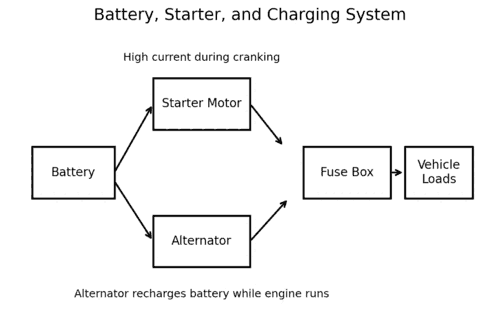
The battery provides the high current needed to crank the engine and stabilizes system voltage. Many electrical complaints begin with a battery that is weak, discharged, poorly connected, or simply not suitable for the vehicle.
A car can have enough battery power to illuminate the dashboard and play the radio but still not have enough current capability to operate the starter. Starter motors demand far more current than small interior loads. That is why ‘the lights work’ does not prove the battery is good.
What to Look For
Compare both sides of the circuit whenever possible. Two similar lamps, two power windows, or left and right wheel sensors can provide a useful reference when one side behaves differently.
Start battery diagnosis with basic observations. Are the terminals loose? Is there white or green corrosion? Is the case damaged or swollen? Has the vehicle been unused for a long period? Was the battery recently replaced? Do problems appear mainly in cold weather? These clues help separate a discharged battery from a connection problem or a charging issue.
A voltage check is useful, but battery condition is best judged with appropriate testing under load or with a battery analyzer. If a battery repeatedly becomes discharged, do not assume the battery itself is the only problem. The charging system or an excessive key-off electrical draw may be responsible.
Beginner Diagnostic Checklist
- Verify the exact symptom before touching anything.
- Check battery condition and obvious power/ground connections when relevant.
- Check the correct fuse and connector condition.
Stop and get help if: wiring is overheating, smoking, melting, or repeatedly blowing a high-current fuse.