Battery terminals are simple components, yet poor terminal contact causes a remarkable number of starting and electrical complaints. Corrosion can develop between the post and clamp where it is not obvious from above. A cable can also corrode internally under its insulation.
Symptoms of a poor battery connection include clicking with no crank, intermittent total loss of electrical power, dashboard lights that go out when the key is turned, slow cranking, modules resetting, or a vehicle that starts after the battery terminals are moved.
What to Look For
Do not confuse a reading with a conclusion. A meter showing 12 volts proves voltage is present at that moment; it does not automatically prove the circuit can deliver enough current under load.
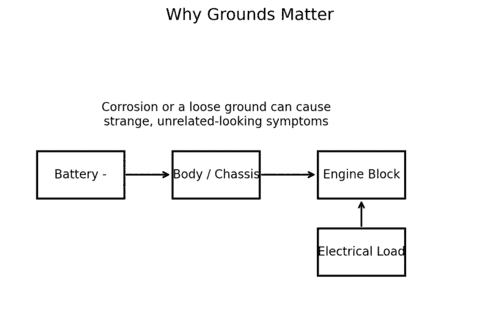
Do not rely only on appearance. A connection that looks clean can still have high resistance. Voltage-drop testing while the starter is operating can reveal resistance that a simple continuity test misses. Test the positive side and ground side separately so you know where the loss occurs.
When cleaning terminals, disconnect and reconnect according to the vehicle manufacturer’s procedure. Some cars have battery monitoring sensors, memory functions, or battery registration requirements. Never assume every modern vehicle can be treated exactly like an older one.
Beginner Diagnostic Checklist
- Verify the exact symptom before touching anything.
- Check battery condition and obvious power/ground connections when relevant.
- Check the correct fuse and connector condition.
Stop and get help if: you cannot identify a safe test point or the vehicle may move unexpectedly.