When facing an electrical complaint, use the same sequence every time. First verify the symptom yourself. Second check battery state and basic power connections. Third inspect relevant fuses and obvious connectors. Fourth obtain the wiring diagram if the circuit is not trivial. Fifth decide where to measure power, ground, command, and load behavior.
Do not skip directly to component replacement. If a blower does not run, prove whether it receives power and ground. If a starter does not crank, prove whether it receives the start command and high-current supply. If a sensor code appears, prove the reference, ground, and signal.
What to Look For
Do not confuse a reading with a conclusion. A meter showing 12 volts proves voltage is present at that moment; it does not automatically prove the circuit can deliver enough current under load.
After a repair, retest the original symptom under the same conditions. Clear codes only when appropriate, then confirm they do not return. Verify that your repair did not create new issues.
Finally, document what you found. The goal is not only to make the problem disappear—it is to understand why it happened and why your repair solved it.
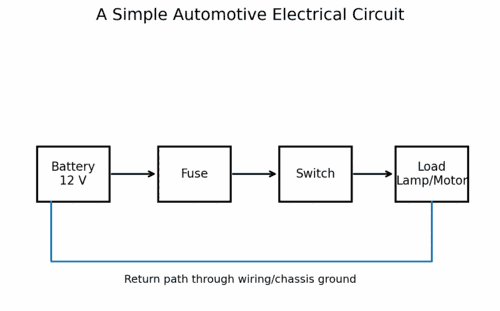
Beginner Diagnostic Checklist
- Verify the exact symptom before touching anything.
- Check battery condition and obvious power/ground connections when relevant.
- Check the correct fuse and connector condition.
Stop and get help if: you cannot identify a safe test point or the vehicle may move unexpectedly.