Affiliate disclosure: This post contains affiliate links. If you buy through my links, I may earn a small commission at no extra cost to you.
A clamp meter is one of the most useful tools for electricians, maintenance technicians, and automation technicians.
A normal multimeter is great for voltage, resistance, and continuity checks. But when you want to measure current, a clamp meter is usually much more practical.
Instead of disconnecting the wire and putting the meter in series, you simply clamp around one conductor and read the current.
That is very useful when troubleshooting:
Motors
Contactors
Overload trips
Heaters
Pumps
Fans
Compressors
Single-phasing problems
Current imbalance
Electrical panels
Machine faults
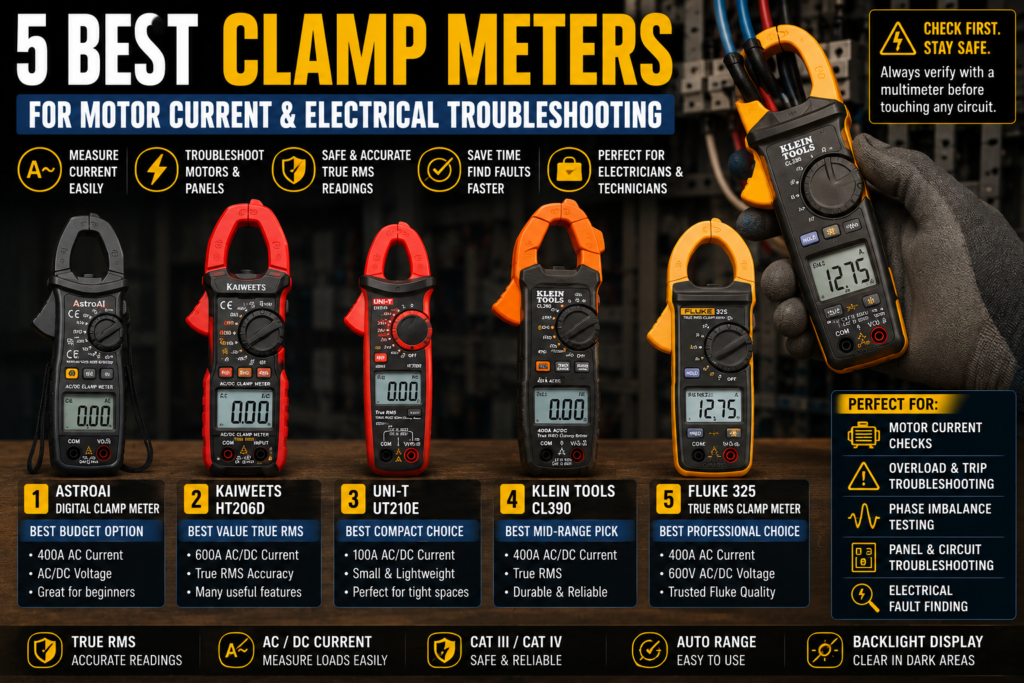
Below are 5 Amazon clamp meters I would consider, listed roughly from cheapest to more expensive.
Amazon prices change often, so always check the current price before buying.
Important Safety Note
A clamp meter is still an electrical test tool.
Before using one, check:
CAT safety rating
Maximum voltage rating
Maximum current rating
Test lead condition
Correct meter setting
Your own training and safety procedures
For industrial electrical panels, 230V/400V circuits, and motor control work, do not use random unknown tools. Use a properly rated meter and follow safe working procedures.
1. AstroAI Digital Clamp Meter — Best Cheap Beginner Option
Best for: beginners, basic AC current checks, learning electrical troubleshooting
Affiliate link: [AstroAI Digital Clamp Meter]
The AstroAI Digital Clamp Meter is one of the cheapest clamp meters I would consider for beginners.
The Amazon listing describes it as a 2000-count auto-ranging clamp meter that measures AC/DC voltage, AC current, resistance, capacitance, continuity, live wire detection, and NCV. The listing also shows a large number of customer ratings, which usually means many people are buying it for basic electrical testing.
Why I recommend it
I recommend this one only as a budget learning tool.
If you are just starting with electrical fault finding and want to understand how clamp meters work, this is a cheap way to begin.
It can be useful for:
Basic AC current checks
Simple voltage testing
Continuity checks
Resistance checks
Beginner electrical learning
Basic home or light maintenance work
For someone learning relays, contactors, and small control circuits, this can help you get started without spending much.
Main weakness
This is not the clamp meter I would choose for serious industrial work every day.
It is a budget option. If you work around motors, VFDs, 400V panels, and production machines often, I would move to a better True RMS meter with stronger safety ratings and better build quality.
2. KAIWEETS HT206D — Best Cheap True RMS All-Rounder
Best for: beginners who want more features, maintenance learning, general fault finding
Affiliate link: [Digital Clamp Meter]
The KAIWEETS HT206D is a strong budget-friendly all-rounder.
The Amazon listing says it is a True RMS clamp meter that can measure AC/DC current, AC/DC voltage, frequency, duty cycle, resistance, capacitance, diode, continuity, and temperature. True RMS is useful because it helps give more accurate readings on non-linear loads.
Why I recommend it
I like this one because it gives many features for the money.
For automation beginners, electricians, or maintenance technicians who do not want to buy a premium Fluke yet, this can be a very practical option.
You can use it for:
Relay coil voltage checks
Contactor coil voltage checks
Motor current checks
Power supply checks
Heater current checks
Continuity testing
Temperature checks
Capacitance testing
Basic troubleshooting in panels
The big advantage over the cheapest meters is that it gives you True RMS and more measurement functions.
Main weakness
It is still a budget brand compared with Klein or Fluke.
For daily professional industrial maintenance, I would personally prefer a more established professional tool brand. But for the price, this is one of the better budget options.
3. UNI-T UT210E Mini Clamp Meter — Best Compact Option
Best for: tight panels, small wires, automation technicians, compact tool bags
Affiliate link: [UNI-T UT210E Mini Digital Clamp Meter]
The UNI-T UT210E is a compact clamp meter that is useful when you want something smaller.
The Amazon listing describes the UT210E as an ultra-portable True RMS clamp meter with 100A AC/DC current measurement, 600V AC/DC voltage measurement, resistance, diode, continuity, capacitance, NCV, and backlight.
Why I recommend it
I recommend this one if you want a smaller clamp meter for control panels and automation work.
Large clamp meters can be annoying in tight electrical cabinets. A smaller clamp is easier to use around control wires, small motor feeders, and crowded panels.
It is useful for:
Small motor current checks
Control cabinet troubleshooting
PLC panel work
Automation maintenance
Compact tool bags
Low to medium current checks
The fact that it measures both AC and DC current is also useful if you work with DC loads, battery circuits, or some control applications.
Main weakness
The current range is lower than many full-size clamp meters.
If you need to measure larger motor currents, big feeders, or high-current industrial circuits, choose a larger clamp meter.
4. Klein Tools CL390 — Best Mid-Range Electrician Clamp Meter
Best for: electricians, maintenance technicians, panel troubleshooting
Affiliate link: [Klein Tools CL390]
The Klein Tools CL390 is a good mid-range clamp meter from a well-known electrical tool brand.
The Amazon listing describes it as an auto-ranging True RMS digital clamp meter. It measures AC/DC current and NCVT via the clamp, plus AC/DC voltage, DC microamps, resistance, continuity, frequency, capacitance, diodes, and temperature using test leads or a thermocouple probe. It also has a reverse contrast LCD display.
Why I recommend it
This is probably where I would start if I wanted a more serious clamp meter without going straight to Fluke prices.
It is good for:
Electrical panel troubleshooting
Motor current checks
Contactor troubleshooting
Relay and control circuit checks
HVAC and building maintenance
Automation maintenance
General electrician work
I also like that it has non-contact voltage testing integrated into the clamp jaw. That does not replace proper voltage testing, but it is convenient for quick checks.
Main weakness
It costs more than budget meters.
But for someone who uses a clamp meter often, I think the better build quality and feature set can be worth it.
5. Fluke 323 Clamp Meter — Best Professional Choice
Best for: professional electricians, serious maintenance technicians, industrial work
Affiliate link: [Fluke 323 Clamp Meter]
The Fluke 323 is the professional option on this list.
The Amazon listing describes it as a True RMS clamp meter that measures AC current up to 400A, AC/DC voltage up to 600V, and resistance up to 4 kΩ. It also has audible continuity and a jaw opening that measures current in a conductor up to 30 mm without touching or interrupting the circuit.
Why I recommend it
I recommend this one if you want a professional tool that you can trust for serious electrical troubleshooting.
Fluke tools are usually more expensive, but they are popular because they are reliable, durable, and trusted by many electricians and maintenance technicians.
This is a good choice for:
Professional electrical troubleshooting
Industrial maintenance
Motor current checks
Panel voltage checks
Contactor and overload troubleshooting
Daily tool bag use
People who want to buy once and keep the tool for years
If you are working around real machines every day, a reliable meter matters.
Main weakness
The price.
For beginners, it may feel expensive. But if you are working professionally, the cost can make sense because test equipment is not the place where I would try to save every euro.
My Final Recommendation
If you want the cheapest clamp meter for learning, I would choose the AstroAI Digital Clamp Meter.
If you want the best cheap all-rounder, I would choose the KAIWEETS HT206D.
If you want something small for automation panels, I would consider the UNI-T UT210E.
If you want a strong mid-range electrician option, I would choose the Klein Tools CL390.
If you want the professional option, I would choose the Fluke 325.
My personal pick for most beginners and maintenance technicians would be the Klein Tools CL390 if the price is reasonable. It gives a good balance between brand trust, useful features, and practical electrical troubleshooting functions.
For professional daily work, I would choose the Fluke 325.
What to Look for When Buying a Clamp Meter
When choosing a clamp meter, I would look for:
True RMS
AC current measurement
AC/DC voltage measurement
DC current measurement if needed
Continuity testing
Resistance testing
Good display
Backlight
CAT safety rating
Good test leads
Trusted brand
Comfortable jaw size
Build quality
For motor troubleshooting, current measurement is extremely useful. If a motor overload trips, a clamp meter helps you check whether the motor is actually drawing too much current or whether the fault is somewhere else.
For example, in a three-phase motor, you can clamp each phase separately.
A healthy motor may show something like:
L1 = 8.2 A
L2 = 8.1 A
L3 = 8.3 A
But if you see:
L1 = 12.5 A
L2 = 12.1 A
L3 = 0 A
That points toward a missing phase, blown fuse, bad contactor pole, loose terminal, or wiring problem.
That is why a clamp meter is one of the most useful tools for electrical fault finding.