Electricians and automation technicians rarely use a drill for only one kind of job.
On Monday, it may be drilling pilot holes in a steel enclosure. On Tuesday, mounting cable tray to brick. Later that week, the same tool may be driving panel screws, installing sensors, opening holes for cable glands or fitting brackets inside a machine where there is barely enough room for your hand.
That makes choosing the best drill for electricians more complicated than simply buying the model with the highest torque figure.
A powerful drill is useful, but so are:
- Compact dimensions
- Predictable speed control
- A durable chuck
- Low weight
- Hammer-drilling capability
- Kickback protection
- A practical battery platform
For this guide, I selected five cordless hammer drill/drivers that suit different types of electrical and industrial automation work. Some prioritize outright power, while others are better for control panels and confined machinery.
All five models were listed on Amazon.com at the time this article was prepared. Stock, sellers, kits and prices can change, so always check the current product listing before ordering.
Affiliate disclosure: This article contains affiliate links. I may earn a commission when you purchase through one of these links, at no additional cost to you. As an Amazon Associate I earn from qualifying purchases. Amazon requires Associates to display this identification clearly and conspicuously.
Quick Comparison
| Drill | Best for | Platform | Main advantage |
|---|---|---|---|
| Milwaukee M18 FUEL 2904-20 | Best overall | M18 18V | Very high power with kickback protection |
| DEWALT DCD805B | Best compact 18/20V option | DEWALT 20V MAX | Strong performance without excessive size |
| Milwaukee M12 FUEL 3404-20 | Best for automation technicians | M12 12V | Excellent access inside machines and panels |
| Makita XPH14Z | Best for demanding hole drilling | Makita 18V LXT | High torque and strong hammer-drilling performance |
| Bosch GSB18V-65N | Best for control and safety | Bosch 18V | Lightweight design with KickBack Control |
The best choice depends heavily on the battery system you already own.
Buying a bare drill for a battery platform you do not use can become expensive once you add batteries and a charger. An electrician already using DEWALT 20V MAX tools may get more practical value from the DCD805B than from changing brands for a slightly different specification.
1. Milwaukee M18 FUEL 2904-20
Best Overall Drill for Electricians
Model: Milwaukee 2904-20
Type: 18V cordless brushless hammer drill/driver
Best for: Cable installations, hole saws, masonry anchors and demanding daily use
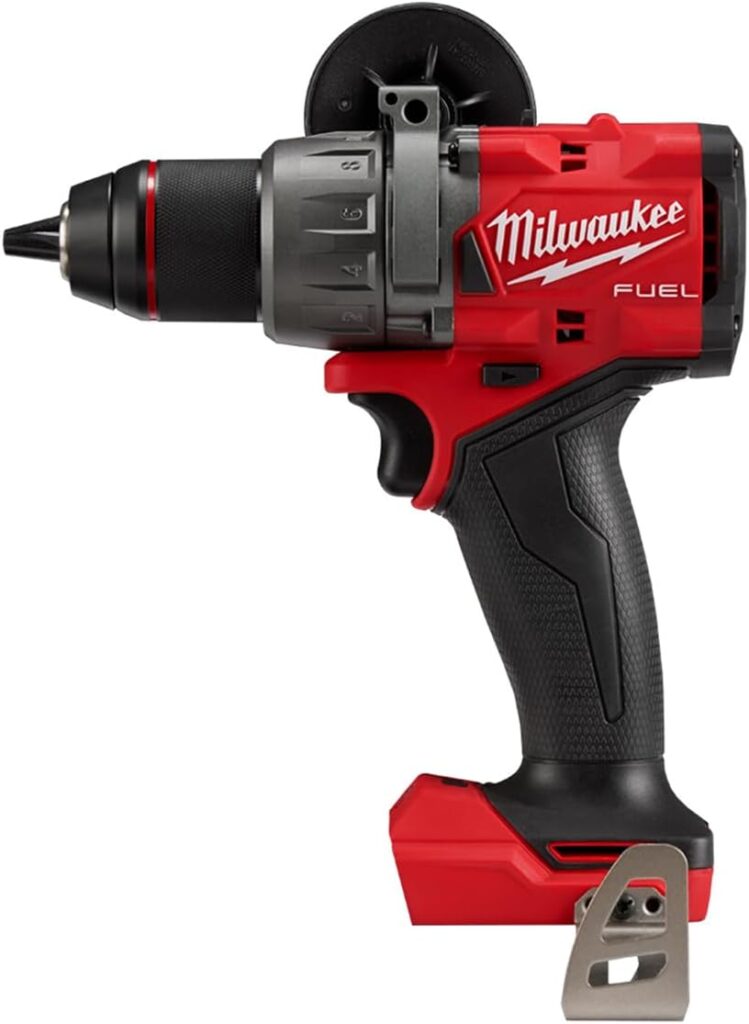
[Milwaukee Electric – M18 Fuel. 1/2 Hammer Drill/Driver]
The Milwaukee M18 FUEL 2904-20 is the strongest all-round recommendation for an electrician who wants one drill capable of handling both ordinary installation work and more demanding drilling.
Milwaukee rates the 2904-20 at up to 1,400 in-lbs of torque and 2,100 RPM. It measures 6.9 inches in length and includes AutoStop control, which is designed to reduce dangerous tool rotation when a bit binds. The drill also has a brushless motor and a half-inch all-metal chuck.
Those specifications make it particularly suitable for tasks such as:
- Large hole saws through timber
- Step drilling in metal
- Drilling through structural wood
- Installing cable supports
- Masonry anchor holes
- Mounting heavy electrical equipment
- Drilling holes for conduit and cable routes
The AutoStop feature deserves attention.
Powerful drills can twist suddenly when a large bit catches. That becomes especially unpleasant when working from a ladder, between pipework or in a position where the drill body has nowhere to move except directly into your wrist.
AutoStop does not remove the need for a side handle and correct technique, but it adds another useful layer of protection.
Why It Suits Electrical Work
Electricians regularly use hole saws and self-feed bits that demand considerably more torque than an ordinary screwdriver task.
The 2904-20 offers enough power to avoid immediately reaching for a larger corded drill during many common jobs. Its relatively short body also helps when working between joists, inside service spaces or near existing pipework.
The M18 battery platform is another advantage for tradespeople who may also need compatible:
- Cable cutters
- Knockout tools
- Band saws
- Lights
- Vacuum cleaners
- Rotary hammers
- Crimping tools
Battery-platform value matters more than one isolated drill specification. A battery that also powers several specialist electrical tools is likely to spend much less time sitting in the van.
Possible Disadvantages
The Milwaukee is powerful, but that power may be excessive for delicate control-panel work.
Even though it has a clutch and variable-speed trigger, a smaller drill may feel more natural when installing terminal-rail accessories or drilling tiny pilot holes in thin sheet metal.
It is also heavier once fitted with a large M18 battery. For overhead fastening or all-day service work, the difference between an M18 drill and a subcompact 12V model becomes noticeable.
Who Should Buy It?
Choose the Milwaukee 2904-20 when your work includes a broad mixture of:
- Commercial electrical installation
- Industrial maintenance
- Heavy hole-saw work
- Wood framing
- Masonry anchors
- Cable-tray installation
- Larger brackets and supports
It is the best choice here for someone who wants maximum capability from one cordless drill.
Pros
- Extremely strong torque
- Compact for its power class
- AutoStop bind-up protection
- All-metal half-inch chuck
- Useful hammer-drilling mode
- Large professional battery ecosystem
Cons
- Heavier than a 12V drill
- More power than many panel tasks require
- Tool-only versions require an existing M18 battery and charger
The 2904-20 was listed on Amazon when this guide was prepared. Check that the listing is for the genuine Milwaukee model and confirm whether it includes batteries, as several listings are tool-only.
[INSERT AMAZON AFFILIATE LINK HERE]
2. DEWALT DCD805B
Best Compact 18/20V Drill for Electricians
Model: DEWALT DCD805B
Type: 20V MAX XR brushless hammer drill/driver
Best for: Electricians wanting full-size capability in a relatively compact tool
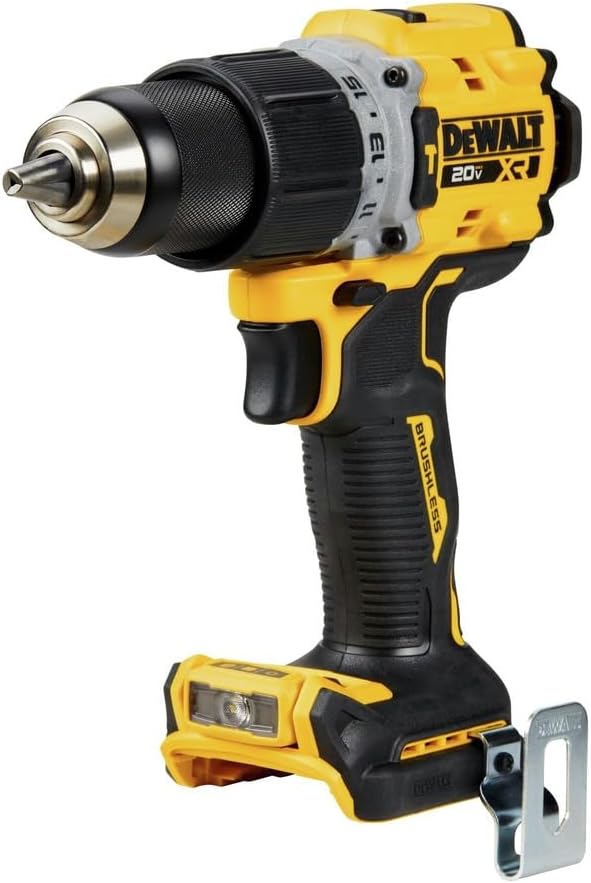
The DEWALT DCD805B occupies a useful middle ground.
It is more capable than a small installation drill, but it is not as bulky as some traditional heavy-duty hammer drills. That balance makes it a sensible everyday tool for electricians who move between first-fix installation, maintenance and panel work.
The DCD805B is a brushless, two-speed half-inch hammer drill/driver with a maximum no-load speed of 2,000 RPM. DEWALT offers it as a bare tool and in kits with batteries and a charger, while the Amazon listing identifies it as part of the 20V MAX platform.
Why It Suits Electricians
A maintenance electrician rarely knows exactly what the next breakdown will require.
One call may involve removing seized machine screws. Another may require drilling a bracket for a photoelectric sensor. The next could involve mounting an enclosure on a block wall.
The DCD805B can handle:
- General drilling in wood and metal
- Controlled screwdriving
- Small and medium hole saws
- Light masonry drilling
- Cable-support installation
- Mounting junction boxes
- Installing machine guards and brackets
Its compact format is particularly helpful inside utility rooms and industrial machinery, where a larger drill may technically have enough power but physically cannot line up with the hole.
Better for Daily Carry Than the Largest Drills
The most powerful drill is not automatically the best drill to carry around a factory for eight hours.
A tool becomes irritating when it is too heavy for small tasks but still gets carried because nobody wants to walk back to the workshop.
The DCD805B makes sense as a primary drill because it provides substantial capability without moving fully into oversized heavy-duty territory.
Pairing it with a smaller battery can keep the tool compact for routine work. A larger-capacity battery can be fitted when drilling bigger holes or working away from a charger.
What About Masonry?
The hammer mode is useful for occasional holes in:
- Brick
- Block
- Light concrete
- Masonry walls
For repeated concrete drilling or larger anchors, use an SDS-plus rotary hammer instead.
A hammer drill/driver achieves its impact action through a relatively small mechanical hammering mechanism. An SDS rotary hammer strikes much more effectively and is normally the better choice for sustained concrete work.
The hammer mode on the DCD805B adds versatility.
It does not secretly transform the drill into a demolition machine.
Who Should Buy It?
The DCD805B is a strong choice when you:
- Already own DEWALT 20V MAX batteries
- Want one compact full-voltage drill
- Perform both installation and maintenance
- Need hammer mode occasionally
- Prefer a lighter everyday tool over the most powerful available option
Pros
- Compact full-size platform
- Brushless motor
- Two-speed gearbox
- Hammer, drill and driving functions
- Widely used battery system
- Good balance between power and portability
Cons
- Not as powerful as the Milwaukee 2904-20
- A kit can be more economical than buying batteries separately
- Still larger than a true 12V subcompact drill
The DCD805B and DCD805D2 kit were listed on Amazon when checked. Verify whether you are selecting the bare tool or the kit, as the similar product names can make the difference easy to miss.
[INSERT AMAZON AFFILIATE LINK HERE]
3. Milwaukee M12 FUEL 3404-20
Best Drill for Automation Technicians and Control-Panel Work
Model: Milwaukee 3404-20
Type: 12V subcompact brushless hammer drill/driver
Best for: Control cabinets, sensor installation, machine servicing and confined spaces
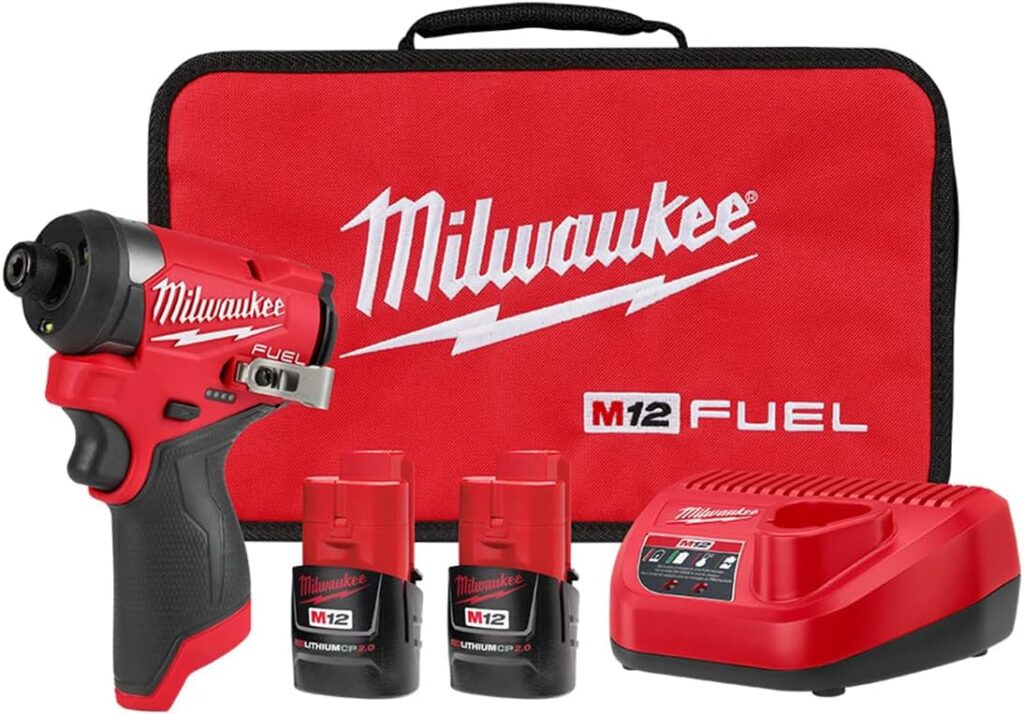
[Milwaukee Electric – M12 Fuel. 1/4 HEX Impact Driver KIT]
The Milwaukee M12 FUEL 3404-20 is arguably the most relevant option on this list for an automation technician.
Automation work often involves less timber framing and more time spent reaching around:
- Pneumatic tubing
- Cable ducts
- Machine guards
- Sensors
- Control boxes
- Conveyor frames
- Existing wiring
A shorter, lighter drill can be much easier to use than a full-size model.
Milwaukee states that the 3404-20 is only six inches long and weighs 2.6 pounds as a bare tool. It produces up to 400 in-lbs of torque and uses an all-metal half-inch chuck and gearcase. Milwaukee also describes it as part of a system containing more than 125 compatible M12 tools.
Where the M12 Model Makes Sense
The 3404-20 is well suited to:
- Drilling pilot holes in metal enclosures
- Installing DIN rail
- Mounting sensors
- Fitting small brackets
- Driving machine screws
- Installing cable glands
- Working inside machinery
- Service and diagnostic work
- Light masonry anchoring
- Overhead fastening
Its 400 in-lbs of torque is far below the M18 model’s headline figure, but that does not make it weak.
For a technician drilling six-millimetre holes in a machine frame or driving small enclosure screws, 1,400 in-lbs of torque provides no special reward.
Control is often more valuable than brute force.
Why the Half-Inch Chuck Matters
Many compact 12V drills use a smaller chuck.
The 3404-20 has a half-inch all-metal chuck, allowing it to accept a broad range of normal drill bits, step bits and hole-saw arbors.
That makes it more useful as a genuine primary service drill rather than merely an electric screwdriver.
It can handle many everyday electrical tasks while remaining noticeably easier to carry and position than a full-size tool.
Where It Reaches Its Limit
The M12 model would not be my first choice for:
- Large self-feed bits
- Repeated large hole-saw drilling
- Thick structural steel
- Heavy masonry work
- Long periods of high-load drilling
It may complete some of those tasks, but a larger 18V drill will usually do them faster and place less thermal stress on the smaller tool and battery.
A practical professional setup is often:
Compact 12V drill for daily service work
+
Powerful 18V drill or rotary hammer for heavy work
That combination is more useful than expecting one oversized drill to feel perfect in every situation.
Who Should Buy It?
Choose the M12 FUEL 3404-20 when your work focuses on:
- PLC and automation systems
- Machine maintenance
- Control-panel construction
- Sensors and instrumentation
- Small electrical installations
- Confined spaces
- Lightweight mobile tool kits
Pros
- Very compact six-inch body
- Low bare-tool weight
- Half-inch all-metal chuck
- Brushless motor
- Mechanical clutch
- Hammer mode included
- Excellent for service bags and tool belts
Cons
- Less power than 18V alternatives
- Not intended as the fastest option for large holes
- Requires M12 batteries rather than M18 batteries
The Milwaukee 3404-20 was available through Amazon listings at the time of writing. Pay close attention to listing details because some versions include only the drill and belt clip, while others may be bundles assembled by marketplace sellers.
[INSERT AMAZON AFFILIATE LINK HERE]
4. Makita XPH14Z
Best for Powerful Drilling and Large Hole Saws
Model: Makita XPH14Z
Type: 18V LXT brushless hammer driver-drill
Best for: High-torque drilling, metalwork, timber and demanding installations
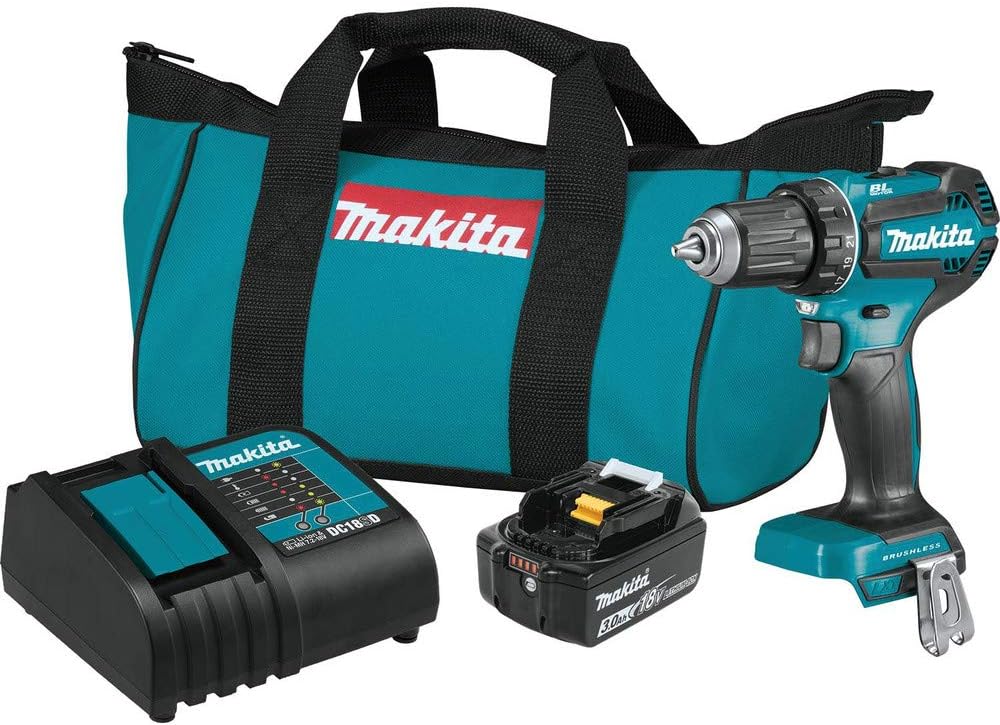
The Makita XPH14Z is a serious drill for electricians who regularly make larger holes.
Makita specifies a maximum torque of 1,250 in-lbs, a two-speed transmission with ranges of 0–550 and 0–2,100 RPM, and up to 31,500 blows per minute in hammer mode. It measures approximately seven inches long and has a half-inch all-metal self-ratcheting chuck.
That combination makes it suitable for:
- Hole saws through wood
- Step bits in metal
- Large cable-entry holes
- Masonry anchors
- Drilling structural timber
- Mounting electrical cabinets
- Installing cable tray and supports
A Strong Choice for Panel Builders Too—With One Qualification
The XPH14Z has more than enough power for drilling mild-steel enclosures.
With the correct bit, cutting lubricant and speed, it can work effectively with:
- Twist drills
- Step drills
- Hole saws
- Countersinks
However, high torque must be treated carefully.
A large step bit or hole saw can catch as it breaks through sheet metal. Use the side handle where appropriate, clamp loose work securely and keep your hands away from sharp swarf.
The drill is powerful enough to turn a routine hole into a surprisingly energetic event when the workpiece is not secured.
Makita LXT Battery Compatibility
The XPH14Z belongs to Makita’s 18V LXT platform.
That makes it particularly attractive to technicians already using Makita equipment. Batteries are a major part of the purchase cost, so changing platforms purely because another model has a slightly higher specification is rarely efficient.
A Makita user can add the bare XPH14Z without duplicating chargers and battery packs.
Someone starting from zero should compare the cost of a complete kit rather than only the bare-tool price.
Is It Too Powerful for Small Screws?
It has an adjustable clutch and variable-speed trigger, but this is still a high-performance hammer drill.
For repeated terminal-panel screws or small fasteners, a compact drill or electric screwdriver will feel lighter and provide more delicate control.
The XPH14Z is at its best when the hole itself is the difficult part of the job.
For tiny fastening, it is rather like arriving with a forklift to move a chair.
It will work.
There may simply be a more graceful option.
Who Should Buy It?
The Makita XPH14Z is ideal for electricians who:
- Already use Makita LXT batteries
- Frequently drill larger holes
- Need high torque
- Work with wood, metal and masonry
- Want a robust half-inch chuck
- Prefer a powerful traditional hammer-drill format
Pros
- Up to 1,250 in-lbs of torque
- 2,100 RPM maximum no-load speed
- High hammering rate
- Compact seven-inch body for its power
- All-metal half-inch chuck
- Strong fit for demanding electrical installation
Cons
- Heavier than a compact service drill
- Considerably more power than small control work needs
- Batteries and charger are not included with the XPH14Z bare tool
The exact XPH14Z model was listed on Amazon when researched. The Amazon listing describes the same 1,250 in-lbs rating, two-speed gearbox and all-metal half-inch chuck published by Makita.
[INSERT AMAZON AFFILIATE LINK HERE]
5. Bosch GSB18V-65N
Best for Lightweight Control and Kickback Protection
Model: Bosch GSB18V-65N
Type: 18V brushless hammer drill/driver
Best for: Maintenance electricians wanting a light drill with useful safety features
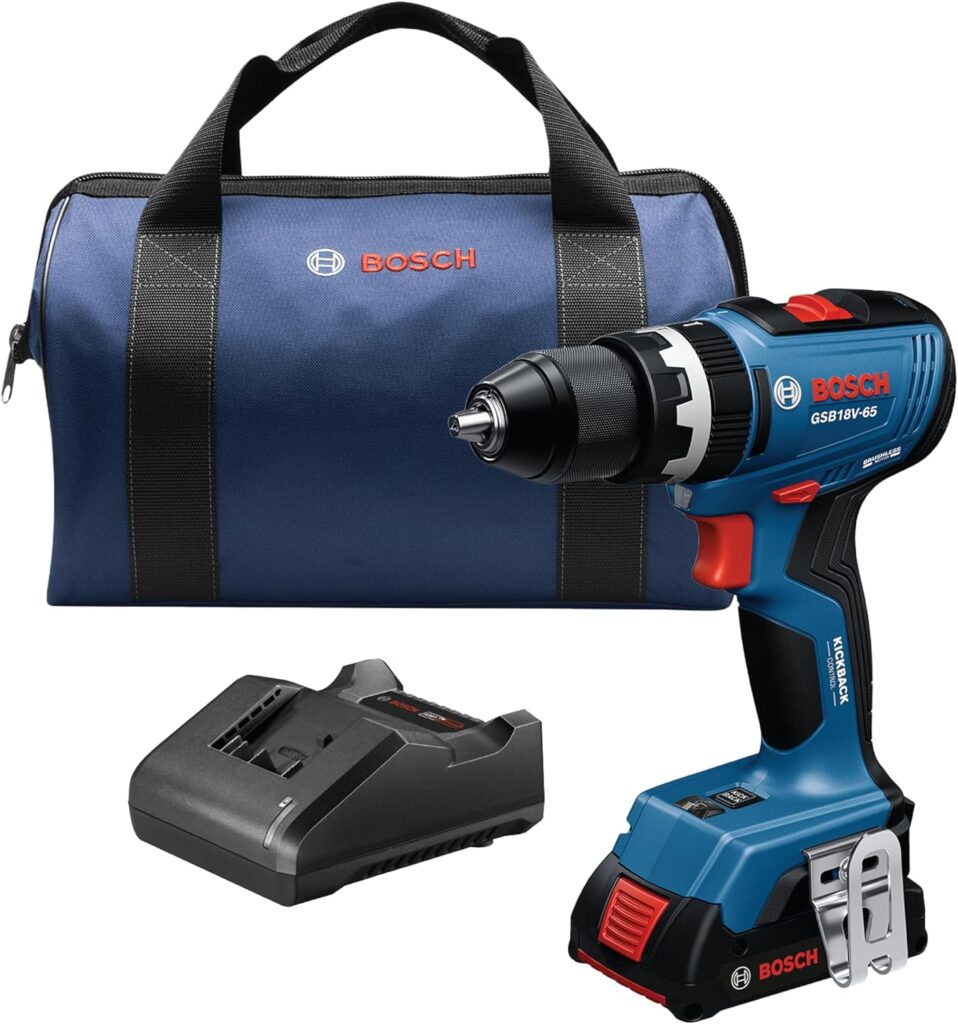
[BOSCH Cordless Drill GSB18V-65B12]
The Bosch GSB18V-65N is not trying to win the torque competition.
Instead, it offers a balanced combination of compact dimensions, low tool weight, useful power and bind-up protection.
Bosch lists the tool at 6.9 inches long and 2.5 pounds without a battery. It produces up to 575 in-lbs of torque, reaches 2,100 RPM and provides up to 27,000 blows per minute. It also includes switchable KickBack Control, a rapid mode selector, dual LED work lights and an all-metal half-inch chuck.
Why It Works Well for Maintenance
The 575 in-lbs torque rating is lower than the heavy Milwaukee and Makita models.
For many maintenance tasks, that may be an advantage rather than a weakness.
The Bosch has enough output for:
- Normal metal drilling
- Electrical-enclosure work
- General fastening
- Small and medium hole saws
- Light masonry anchoring
- Mounting machine components
- Daily maintenance calls
At the same time, the low bare-tool weight makes it easier to carry and use overhead.
KickBack Control
Bosch’s switchable KickBack Control is intended to reduce the risk of a sudden reaction when the bit binds.
This matters when using:
- Hole saws
- Large twist drills
- Step bits
- Auger bits
- Masonry bits
No electronic system makes poor technique safe. The workpiece still needs to be secured, and a side handle should be used where required.
However, a system that can recognize an abrupt bind-up is a worthwhile feature on a professional drill.
Rapid Mode Selection
The GSB18V-65N separates its drilling, driving and hammering mode selection from the clutch adjustment.
That makes it easier to move between jobs without losing the previously selected screwdriving setting.
For example, a technician can switch from controlled fastening to drill mode, make a hole and return to driving mode without searching for the old clutch position.
It is a small usability detail.
Small usability details become more important after the fiftieth fastener.
Dual LED Lighting
Electrical work has an unusual ability to take place in dark corners.
The Bosch uses dual LED work lights to illuminate the drilling area.
An LED cannot replace proper task lighting, but it is helpful inside:
- Machine frames
- Utility cupboards
- Service shafts
- Ceiling spaces
- Electrical cabinets
Who Should Buy It?
Choose the Bosch GSB18V-65N when you:
- Want a lighter 18V drill
- Value kickback protection
- Work mainly in maintenance and automation
- Need more power than a 12V model
- Do not regularly drill very large holes
- Already own Bosch 18V batteries
Pros
- Lightweight for an 18V hammer drill
- Compact 6.9-inch length
- Switchable KickBack Control
- Half-inch all-metal chuck
- Rapid mode selector
- Dual work lights
- Good balance of control and performance
Cons
- Less torque than the Milwaukee M18 and Makita
- Bare tool does not include battery or charger
- Heavy-duty electricians may eventually want a more powerful second drill
The current GSB18V-65N appeared in Amazon’s Bosch hammer-drill listings when this guide was prepared. Confirm the exact model number, as Amazon also sells older Bosch drills with similar names and specifications.