Affiliate disclosure: This post contains affiliate links. If you buy through my links, I may earn a small commission at no extra cost to you.
An insulation resistance tester, also called a megohmmeter or megger tester, is one of the most useful tools for finding hidden electrical faults.
A normal multimeter is good for checking voltage, continuity, and resistance. But it cannot properly test insulation condition on motors, cables, windings, heaters, compressors, and electrical equipment.
That is where an insulation tester becomes useful.
It applies a higher DC test voltage and measures how well the insulation resists leakage current. This can help find problems like moisture, damaged insulation, aging cables, dirty motor windings, or phase-to-ground faults before they become serious failures.
You can use an insulation tester for:
Motor windings
Motor cables
Pump motors
Fan motors
Compressors
Heaters
Electrical panels
Long cable runs
VFD motor circuits
Preventive maintenance
Troubleshooting ground faults
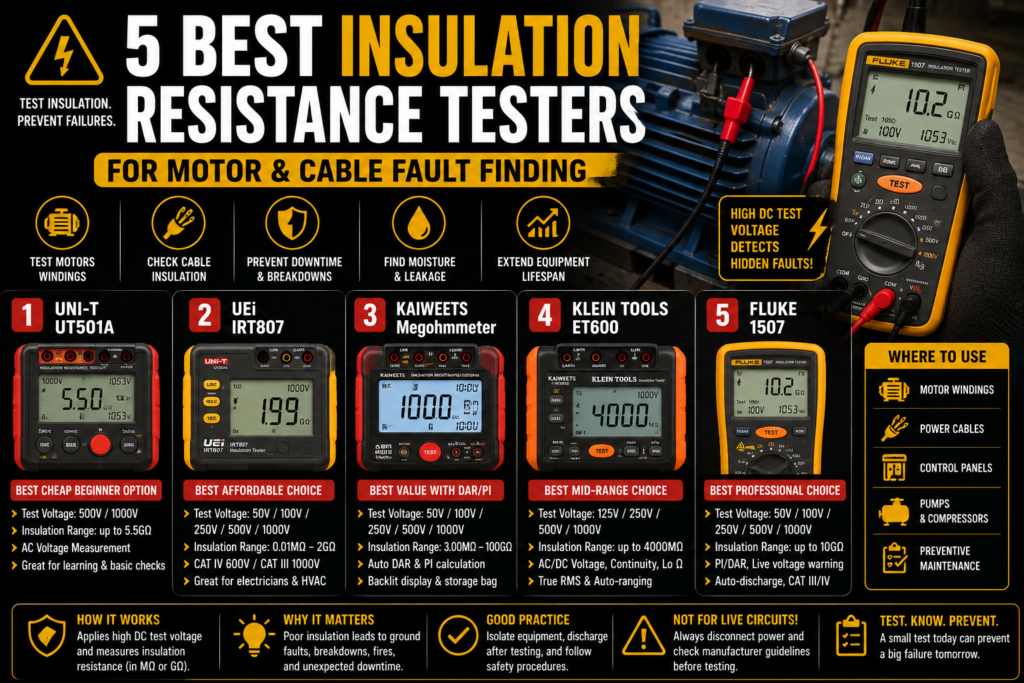
Below are 5 Amazon insulation resistance testers I would consider, listed roughly from cheaper to more expensive.
Amazon prices change often, so always check the current price before buying.
Important Safety Note
An insulation resistance tester is not like a normal multimeter.
It can output high DC test voltage, often 250V, 500V, 1000V, or even higher. That means it can be dangerous if used incorrectly.
Before using one:
Disconnect the equipment from power.
Verify the circuit is de-energized.
Disconnect sensitive electronics if needed.
Do not insulation-test PLC cards, VFD outputs, sensors, or electronic circuits unless the manual allows it.
Discharge the circuit after testing.
Follow the tester manual and your company safety procedure.
This tool is mainly for testing insulation on motors, cables, windings, and similar equipment — not for random live circuit testing.
1. UNI-T UT501A — Best Cheap Beginner Insulation Tester
Best for: beginners, students, basic motor and cable checks
Affiliate link: [UNI-T Insulation Tester]
The UNI-T UT501A is one of the cheaper insulation resistance testers I would consider for learning and basic fault finding.
Amazon listings show the UT501A as a 1000V-class insulation resistance tester / megohmmeter, with versions listed for insulation testing up to around 5.5GΩ and AC voltage measurement functions.
Why I recommend it
I recommend this one for beginners because it gives you a low-cost way to start learning insulation testing.
It can be useful for:
Basic motor insulation checks
Cable insulation testing
Learning how megohm testing works
Simple electrical maintenance practice
Automation students and beginners
If you are just learning about motors, contactors, VFDs, and electrical fault finding, this type of tester can help you understand insulation problems better.
Main weakness
It is a budget option.
For professional daily work, I would prefer a stronger brand or a tester with better safety features, better build quality, and more advanced functions.
But as a first insulation tester for learning, it can be a useful starting point.
2. UEi IRT807 — Best Affordable Professional-Style Option
Best for: electricians, HVAC technicians, maintenance beginners
Affiliate link: [UEi IRT807 Insulation Resistance Tester]
The UEi IRT807 is a good affordable option if you want something more serious than the cheapest testers.
The Amazon listing says the IRT807 provides selectable insulation test voltages of 50V, 100V, 250V, 500V, and 1000V, with an insulation resistance range of 0.01MΩ to 2GΩ. It is also listed with CAT IV 600V and CAT III 1000V safety ratings.
Why I recommend it
I like this one because the test voltage options are practical.
The 50V and 100V ranges can be useful for lower-voltage equipment where you do not want to immediately apply 500V or 1000V. The 500V and 1000V ranges are useful for many common motor and cable insulation checks.
It is good for:
Electricians
HVAC technicians
Maintenance technicians
Motor troubleshooting
Cable checks
Preventive maintenance
Beginner industrial fault finding
For the price range, this looks like a useful practical tester.
Main weakness
Its insulation resistance range is lower than some other models on this list.
For many basic motor and cable checks, 2GΩ is enough. But if you want higher range readings, DAR/PI features, or more advanced preventive maintenance tools, you may want another option.
3. KAIWEETS Megohmmeter — Best Value with DAR/PI Features
Best for: automation learners, electricians, maintenance technicians who want more features
Affiliate link: [KAIWEETS Megohmmeter]
The KAIWEETS Megohmmeter is interesting because it offers more advanced features at a budget-to-mid price level.
One Amazon listing says it measures insulation resistance from 3.00MΩ to 100.0GΩ with selectable test voltages of 50V, 100V, 250V, 500V, and 1000V. It also includes automatic DAR and PI calculation.
Another KAIWEETS model listed on Amazon offers up to 200GΩ and test voltage ranges of 100V, 250V, 500V, 1000V, and 2500V.
Why I recommend it
I recommend this one if you want more than just a basic insulation test.
DAR and PI are useful because they help evaluate insulation condition over time, not just from one instant reading. That can be useful for motor and cable preventive maintenance.
It is good for:
Motor insulation checks
Cable testing
HVAC motors
Solar-related testing
Maintenance work
Learning DAR and PI testing
People who want more features without Fluke pricing
For the money, it gives a lot of features.
Main weakness
It is not as trusted as Fluke, Megger, or Hioki for professional industrial testing.
If you are doing critical maintenance work every day, I would still consider a more established test-equipment brand.
But for learning and general troubleshooting, it looks like a strong value option.
4. Klein Tools ET600 — Best Mid-Range Choice for Electricians
Best for: electricians, panel work, motor testing, general maintenance
Affiliate link: [Klein Tools ET600]
The Klein Tools ET600 is one of the best mid-range options for electricians and maintenance technicians.
The Amazon listing says the ET600 measures insulation resistance up to 4000MΩ at 125V, 250V, 500V, and 1000V DC. It also has test and lock buttons, a warning alarm / high-voltage icon, AC/DC voltage measurement up to 1000V, low resistance, continuity, and auto-ranging True RMS technology.
Why I recommend it
This is probably the one I would recommend to many electricians who want a useful tool without going straight to Fluke prices.
It is practical because it works as both an insulation tester and a general electrical tester.
You can use it for:
Motor insulation testing
Cable insulation testing
Control panel troubleshooting
AC/DC voltage checks
Continuity checks
Low resistance checks
General electrical maintenance
I also like that it has simple test and lock buttons. That makes repeated testing easier.
Main weakness
Its insulation range is not as high as some of the 100GΩ or 200GΩ testers.
But for many common electrical maintenance tasks, especially low-voltage motors and cables, it is still a very practical choice.
5. Fluke 1507 — Best Professional Insulation Tester
Best for: professional electricians, industrial maintenance, serious motor and cable testing
Affiliate link: [Fluke 1507]
The Fluke 1507 is the professional pick on this list.
The Amazon listing says the Fluke 1507 offers multiple insulation test voltages: 50V, 100V, 250V, 500V, and 1000V. It also lists useful safety and testing features such as live circuit detection above 30V, auto-discharge of capacitive voltage, AC/DC voltage measurement to 600V, 200mA continuity, and automatic calculation of PI and DAR.
Fluke’s own insulation tester guide also lists the 1507 as a dedicated insulation resistance tester with test voltages of 50V, 100V, 500V, and 1000V, plus PI/DAR, auto discharge, pass/fail comparison, and voltage warning above 30V.
Why I recommend it
I recommend this one if you want a serious insulation tester for real maintenance work.
Fluke tools are expensive, but they are trusted by many electricians and industrial technicians because they are reliable and durable.
This is a good choice for:
Industrial maintenance
Motor preventive maintenance
Cable insulation testing
VFD motor circuit checks
Professional electricians
Facilities maintenance
People who want a tool they can trust long-term
The live circuit detection and auto-discharge features are very important because insulation testing can leave stored charge on some equipment.
Main weakness
The price.
For beginners, it may be too expensive. But if you work professionally and use insulation testing often, it makes sense to buy a trusted tool.
My Final Recommendation
If you want the cheapest option for learning, I would look at the UNI-T UT501A.
If you want an affordable practical tester from a more electrician-focused brand, I would consider the UEi IRT807.
If you want more features like DAR/PI without spending Fluke money, the KAIWEETS Megohmmeter is worth checking.
If you want a strong mid-range option, I would choose the Klein Tools ET600.
If you want the professional choice, I would choose the Fluke 1507.
My personal pick for most electricians and maintenance beginners would be the Klein Tools ET600, because it has practical test voltages, good electrical testing functions, and a more reasonable price than premium professional testers.
For serious industrial maintenance, I would choose the Fluke 1507.
What to Look for When Buying an Insulation Resistance Tester
When choosing an insulation tester, I would look for:
Selectable test voltages
500V and 1000V test ranges
Lower voltage ranges like 50V, 100V, or 250V if needed
Good insulation resistance range
Live voltage warning
Auto-discharge function
DAR / PI functions if doing preventive maintenance
AC/DC voltage measurement
Continuity testing
Good safety rating
Good test leads and clips
Backlit display
Trusted brand
Rugged build quality
For motor and cable fault finding, an insulation tester can save a lot of time.
A motor may look fine with a normal multimeter, but still have poor insulation to ground. A megohmmeter can reveal that problem much better.
That is why every serious electrician, maintenance technician, or automation technician should understand insulation testing.
Check the recommended insulation testers here: