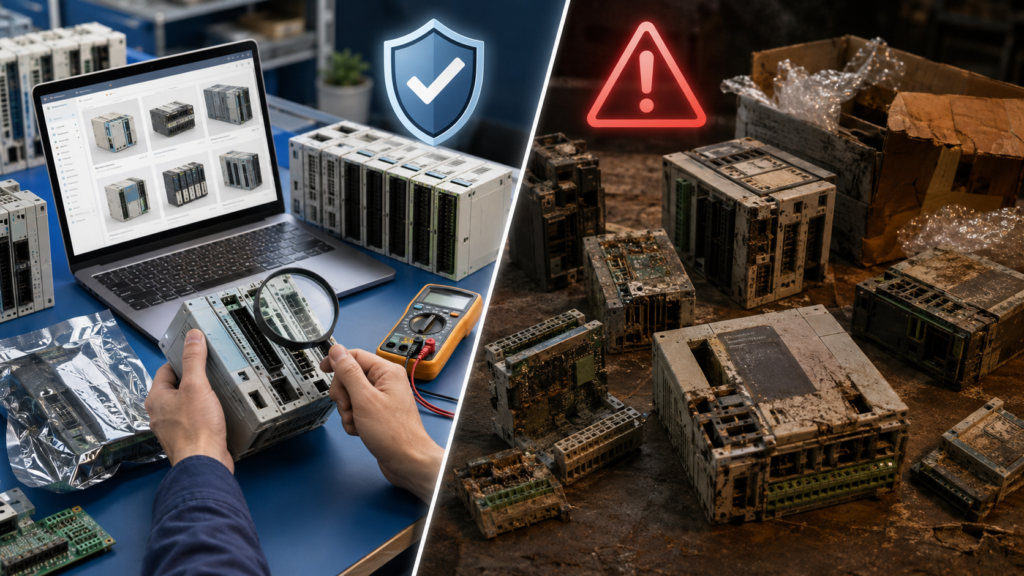
Used PLC hardware can be an affordable way to build a home training setup, replace an obsolete module, or experiment with industrial automation without spending thousands of euros.
It can also become an expensive collection of dead outputs, missing connectors, incompatible firmware, password-protected CPUs, and components that were removed from a machine because they were already causing intermittent faults.
The safest approach depends on the intended use. A scratched PLC that occasionally loses communication may be acceptable for troubleshooting practice. The same PLC would be a terrible choice for controlling production equipment.
What Is Usually Safe to Buy?
For a student or home laboratory, ordinary PLC CPUs, digital I/O modules, basic HMIs, communication adapters, power supplies, and programming cables can all be reasonable used purchases.
The best listings normally contain:
- The complete manufacturer part number
- Clear photographs of the actual item
- Photographs of the terminals and connectors
- A description of how the item was tested
- Confirmation that the CPU can enter run mode
- Confirmation that a program can be downloaded
- A seller specialising in industrial equipment
- A return option
A listing that says a Siemens S7-1200 CPU was powered, factory-reset, connected to TIA Portal, programmed, and tested is far more useful than one that merely says “green lights come on.”
Powering up proves very little. A PLC can power on while having damaged communication ports, failed memory, bad outputs, or intermittent internal faults.
Basic digital input modules are often among the lower-risk purchases. Their operation is relatively easy to test using a 24 V DC supply and the PLC diagnostics.
Relay output modules deserve more caution because their contacts have a limited mechanical and electrical life. Transistor outputs can also be damaged by incorrect wiring, short circuits, or inductive loads.
Search by Exact Part Number
Never buy industrial hardware based only on a title such as “Siemens PLC,” “Allen-Bradley controller,” or “S7-300 module.”
Search using the complete catalogue number printed on the label.
Two modules that look almost identical may use different supply voltages, output types, network protocols, firmware generations, or connector arrangements. One small change in the part number can determine whether the module works with your system.
Check:
- Supply voltage
- Number and type of inputs and outputs
- Relay or transistor outputs
- Sourcing or sinking logic
- Communication interface
- Hardware revision
- Firmware revision
- Required software version
- Included terminal blocks and connectors
Rockwell Automation provides compatibility and lifecycle tools for checking firmware revisions, programming-software versions, downloads, and product status. Using those tools before purchasing can prevent buying hardware that your existing software cannot support.
The “Untested” Trap
“Untested” often means exactly what it says: the seller has not tested it.
It can also mean the seller tested it, discovered a problem, and does not want to describe it as defective.
An untested module may still be worth buying if the price is extremely low and you want repair or diagnostic practice. It should be treated as faulty until proven otherwise.
Other phrases that require caution include:
- Removed from working environment
- Was working when removed
- Powers on
- Unable to test
- Sold as pictured
- No further testing performed
- Surplus stock
- No returns
“Removed from a working machine” does not prove that the individual module works. The machine may have been dismantled because it failed, became unreliable, or was replaced after a fault nobody fully diagnosed.
Watch for Obsolete Hardware
Old hardware is not automatically bad. Legacy PLCs can be valuable for training or maintaining equipment that still uses them.
The problem is buying an old platform without understanding its lifecycle.
Rockwell classifies products as Active, Active Mature, End of Life, or Discontinued. Discontinued products are no longer manufactured, although repair or exchange services may sometimes remain available.
Siemens ended the SIMATIC S5 lifecycle in 2020, including its standard spare-parts availability. A cheap S5 CPU may therefore be interesting for a collector or legacy specialist but is usually a poor first training PLC.
Before buying an obsolete system, check whether you can realistically obtain:
- Programming software
- A legal software licence
- A compatible programming cable
- Documentation
- Memory cards
- Replacement batteries
- Connectors and terminal blocks
- Additional matching modules
A €40 CPU is not cheap if the programming cable costs €200 and the required software will not run easily on your computer.
Firmware and Software Compatibility
A newer-looking CPU may still be incompatible with the software version you own.
Hardware revision, firmware version, and engineering-software version must be checked together. Siemens documentation specifically directs users to verify compatibility between S7-1200 firmware, CPU hardware, STEP 7 versions, and project versions.
Ask the seller for a clear photograph of the full product label. Do not rely on a stock image or a partially visible catalogue number.
Also check whether the CPU is password-protected. Before paying, ask whether it has been factory-reset and whether the seller has successfully downloaded a new test program.
Missing Parts Can Cost More Than the PLC
Industrial modules are frequently sold without removable terminal blocks, front connectors, bus connectors, memory cards, mounting clips, or side covers.
These missing pieces may appear unimportant in the photographs, but replacing them can destroy the value of the deal.
Check what is included before purchasing. “PLC module only” usually means exactly that.
Programming cables deserve similar caution. Very cheap unbranded cables may use unreliable electronics or unsupported drivers. For a home laboratory, a third-party cable may be acceptable, but it should not be your only way to access a production controller.
Counterfeit and Grey-Market Equipment
Popular automation products can be copied, relabelled, repaired poorly, or presented as new despite previous use.
Siemens warns that products from unauthorised channels may lack clear traceability and can sometimes be counterfeit products marketed as genuine. It also links grey-market and used products with risks including equipment failure, downtime, and extra repair costs.
Warning signs include:
- A supposedly new module at an impossibly low price
- Poor label printing
- Incorrect fonts or colours
- Damaged or replaced seals
- Scratched serial-number labels
- Packaging that does not match the product
- One stock photograph used for many listings
- A seller offering large quantities without explaining their source
For a production machine, critical spare, or safety-related application, buy through an authorised distributor or established industrial refurbisher that provides testing, traceability, and warranty support.
Avoid unknown used safety PLCs, safety I/O, and safety relays for real machinery unless their origin, condition, suitability, and validation can be established properly.
Test the Hardware Immediately
Do not place the package on a shelf for three months. Test it while return protection is still available.
After checking for physical damage:
- Verify the part number and supply voltage.
- Inspect terminals for burns, corrosion, and broken screws.
- Power the device using a protected current-limited supply.
- Check diagnostic LEDs.
- Connect using the correct programming software.
- Factory-reset the CPU where appropriate.
- Download and run a small test program.
- Test every input and output.
- Test communication ports.
- Leave the device powered for several hours.
Record the unpacking and testing process when buying an expensive module. Save the listing description and photographs.
eBay’s Money Back Guarantee generally covers qualifying purchases when an item arrives broken, faulty, damaged, or materially different from the description, even when a seller states that returns are not accepted. It does not turn a clearly described “for parts or not working” purchase into a guaranteed working device.
The Practical Verdict
Used PLC equipment makes the most sense for training, experiments, non-critical test rigs, and carefully selected legacy spares.
The safest purchase is a common platform with a complete part number, available software, clear testing evidence, included connectors, and a return policy.
The biggest traps are not always completely dead modules. They are devices that almost work: an intermittent Ethernet port, one damaged output, corrupt memory, unstable power supply, or a hidden compatibility problem.
Do not ask only whether the PLC is cheap. Ask what it will cost to make it usable—and what it will cost if it fails.