Most electrical wiring depends on one reassuring fact: ordinary air does not conduct electricity very well.
That is why two exposed conductors can sit a short distance apart without current continuously flowing between them. It is also why power lines do not simply pour electricity into the open sky.
But then lightning crosses several kilometres of atmosphere.
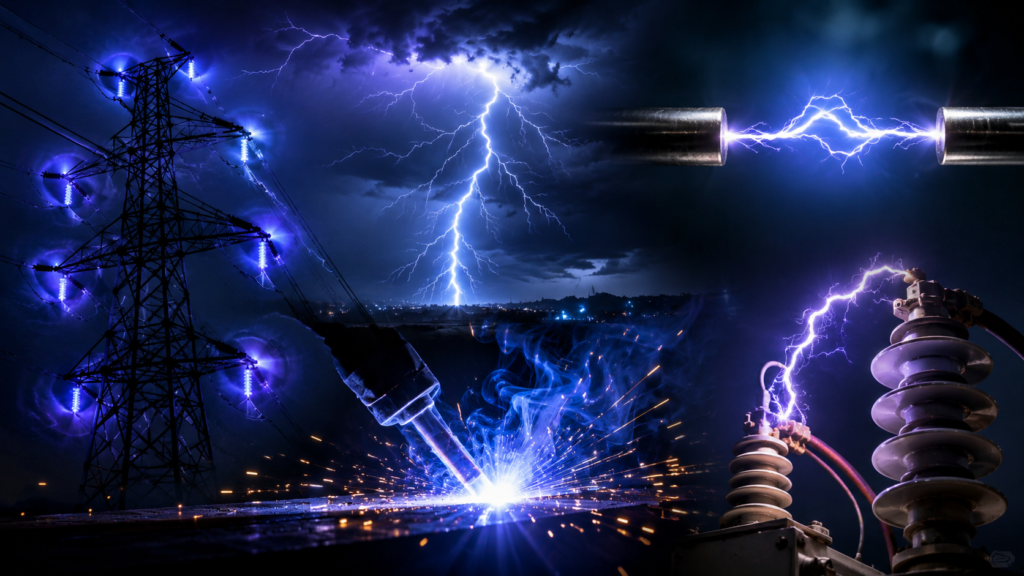
A spark jumps from your finger to a metal handle. An arc welder sends a fierce electrical current through a visible gap. High-voltage equipment sometimes glows, crackles, or hisses even though nothing appears to touch it.
So, can electricity travel through air?
Yes—but usually only after the air stops behaving like a normal insulator.
A sufficiently strong electric field can tear electrons away from air molecules. The air becomes ionised, producing charged particles that can carry current. Once a conductive path develops, electricity may cross the gap as a spark, arc, corona discharge, or lightning channel.
The basic process is called electrical breakdown.
Air Is Normally an Insulator
Air contains mostly nitrogen and oxygen molecules.
Under ordinary conditions, their electrons remain bound to their atoms and molecules. There are not enough freely moving charge carriers for air to conduct a significant electric current.
This makes normal air a useful electrical insulator.
It separates:
- Overhead power-line conductors
- Switch contacts
- Relay contacts
- Busbars
- Transformer terminals
- Circuit-breaker components
- High-voltage equipment
If air conducted as easily as copper, exposed electrical systems would be practically impossible. Current would spread through the surrounding atmosphere rather than following the intended conductors.
Fortunately, air resists current—up to a point.
Voltage Creates an Electric Field
When a voltage exists between two conductors, an electric field develops in the space between them.
The field strength depends partly on:
- The voltage difference
- The distance between the conductors
- The shape of their surfaces
- The surrounding material
- Environmental conditions
A high voltage across a large distance may create a manageable electric field.
The same voltage across a tiny air gap creates a much stronger field.
This is why a spark may jump between two contacts separated by a millimetre but not between conductors separated by several metres.
Electric-field strength is often expressed in volts per metre.
As the field becomes stronger, it pushes more forcefully on any free electrons already present in the air.
There are always at least a few. Cosmic radiation, ultraviolet light, natural radioactivity, flames, and other processes create small numbers of ions and free electrons in the atmosphere.
Normally, these charge carriers do not cause much trouble.
Under a strong electric field, however, they become the beginning of something larger.
What Is Air Ionisation?
Ionisation occurs when an atom or molecule gains or loses electrons.
A neutral air molecule contains equal amounts of positive and negative charge. If an electron is removed, the remaining molecule becomes a positive ion.
The freed electron can move through the electric field.
If the field is strong enough, that electron accelerates and collides with another air molecule. The collision may knock loose another electron.
Now there are two free electrons.
Those electrons accelerate and create more collisions. The number of charge carriers rises rapidly in a process called an electron avalanche.
The once-insulating air becomes a conductive plasma containing:
- Free electrons
- Positive ions
- Excited molecules
- Neutral gas particles
Current can now flow through the ionised path.
This transition from insulating behaviour to conduction is electrical breakdown.
The Breakdown Strength of Air
Dry air at normal atmospheric pressure is often said to break down at approximately 3 million volts per metre, or roughly 3 kilovolts per millimetre, in a relatively uniform electric field.
That figure is useful, but it is not a universal rule.
Real breakdown voltage depends on many factors, including:
- Electrode shape
- Gap distance
- Air pressure
- Humidity
- Temperature
- Dust and pollution
- Voltage waveform
- How quickly voltage rises
- Existing ionisation
- Nearby surfaces
A sharp metal point can create an extremely concentrated electric field even when the average field across the whole gap is much lower.
That is why sparks and corona often begin at:
- Needle points
- Wire strands
- Damaged conductors
- Bolt edges
- Corners
- Scratches
- Loose fittings
Electric charge crowds around areas with a small radius of curvature, increasing the local field.
Smooth, rounded conductors are therefore preferred in high-voltage equipment. Engineers are not rounding everything off merely to make substations look friendlier.
What Happens During a Spark?
A spark is a brief electrical discharge through a gas.
Suppose two conductive objects have different electrical potentials. As they move closer, the electric field across the air gap becomes stronger.
Eventually, the field becomes sufficient to ionise the air.
A narrow conductive channel forms, and charge rushes through it.
The current heats the channel rapidly, producing:
- Visible light
- A sharp sound
- Local heating
- Expansion of the surrounding air
- Electromagnetic interference
Once the available charge has equalised or the voltage falls below the level required to sustain the channel, the spark disappears.
That is why a static-electricity spark is so brief.
Your body may be charged to several thousand volts, but it stores only a tiny amount of energy. The spark transfers that charge quickly, the voltage collapses, and the event ends.
A power supply is another story. If it can maintain the voltage and provide enough current, the initial spark may develop into a sustained arc.
Spark Versus Arc
The words spark and arc are sometimes used interchangeably, but they usually describe different types of discharge.
A spark is generally short-lived. It appears when voltage breaks down an air gap, charge transfers, and the current quickly stops.
An arc can continue.
Once an arc channel has formed, its hot ionised gas conducts electricity relatively well. The voltage required to keep the arc burning may be much lower than the voltage needed to start it.
This creates an important and slightly unpleasant situation:
The air gap may initially resist current, but once breakdown occurs, the hot plasma can maintain a powerful conductive path.
A sustained arc may reach temperatures of several thousand degrees Celsius. It can melt metal, ignite nearby material, destroy insulation, and produce intense ultraviolet radiation.
That destructive ability is deliberately useful in arc welding.
Elsewhere, less so.
Arc Welding: Electricity Deliberately Crossing Air
Arc welding uses an electrical arc to generate enough heat to melt metal.
The welding power source creates a voltage between an electrode and the workpiece.
When the electrode touches the workpiece and is then pulled slightly away, current continues through the ionised gap. A stable arc forms between the electrode and the metal.
The arc temperature becomes high enough to melt:
- The edge of the workpiece
- Filler metal
- Part of the electrode in consumable-electrode processes
As the molten metal cools, it forms the welded joint.
Depending on the welding method, shielding gas or flux protects the weld pool from oxygen, nitrogen, and contamination.
Common arc-welding processes include:
- Shielded metal arc welding
- Gas metal arc welding
- Gas tungsten arc welding
- Flux-cored arc welding
- Submerged arc welding
The arc is not current moving through ordinary cold air.
It is current flowing through a hot, ionised plasma channel.
That distinction matters.
Why Welding Arcs Are So Bright
A welding arc emits an enormous amount of visible, infrared, and ultraviolet radiation.
The bright light comes from:
- Hot plasma
- Excited atoms and ions
- Molten metal
- Vaporised electrode material
Looking directly at an arc without proper protection can damage the eyes.
Ultraviolet exposure can cause a painful condition commonly known as arc eye or welder’s flash. The skin can also be burned in a way similar to severe sunburn.
A welding helmet is not there merely because the light is annoying. It protects against radiation, sparks, hot metal, and flying debris.
The electricity crossing that small gap is turning the surrounding gas into something closer to a miniature artificial lightning channel.
Lightning: A Giant Electrical Breakdown
Lightning is the most dramatic example of electricity travelling through air.
Inside storm clouds, collisions between ice particles, water droplets, and hail help separate electric charge.
Different regions of the cloud develop different electrical potentials. Charge may also be induced on the ground below.
As the electric field grows, the air begins to break down.
The discharge does not usually leap from the cloud to the ground in one neat, instant line.
A branching ionised path known as a stepped leader moves from the cloud in a series of jumps. At the same time, upward streamers may rise from trees, buildings, towers, and other objects on the ground.
When a descending leader connects with an upward path, a highly conductive channel is completed.
A powerful return stroke then travels through that channel, producing the brilliant flash we recognise as lightning.
The current heats the air extraordinarily quickly. The heated air expands almost explosively, creating the pressure wave heard as thunder.
Lightning may look like electricity casually crossing empty space.
In reality, it has created a temporary plasma conductor through the atmosphere.
Why Lightning Follows a Crooked Path
Lightning channels are rarely straight.
The electric field in a storm is not perfectly uniform. The atmosphere contains variations in:
- Moisture
- Pressure
- Temperature
- Dust
- Ice particles
- Existing ions
- Local electric charge
The developing discharge searches through regions where breakdown is easiest.
Each branch changes the local electric field, influencing where the next step forms.
The result is the familiar jagged path.
Lightning does not necessarily choose the shortest geometric route. It follows the evolving path of successful ionisation through a complicated electric field.
A useful life lesson, perhaps. Also a rather violent one.
Can Lightning Travel Upward?
Yes.
Lightning is often pictured as something that only travels down from a cloud, but upward lightning can begin from tall structures such as:
- Communication towers
- Wind turbines
- Skyscrapers
- Mountain installations
Strong electric fields around the top of a tall object may launch an upward leader.
Charge motion within the complete lightning event can also be more complicated than the visible direction of the developing channel suggests.
The important point is that a conductive plasma path forms between regions of different electrical potential.
Once the path exists, a very large current can flow.
Corona Discharge
Not every electrical discharge becomes a full spark or arc.
Sometimes the electric field near a conductor is strong enough to ionise the surrounding air locally, but not strong enough to break down the entire gap to another conductor.
This partial discharge is called corona discharge.
Corona commonly forms around high-voltage conductors, especially near sharp or irregular surfaces.
It may produce:
- A faint blue or violet glow
- A buzzing or crackling sound
- Ozone
- Radio-frequency interference
- Power loss
- Gradual insulation damage
On a dark, damp night, corona may sometimes be visible around high-voltage equipment.
The conductor is not necessarily arcing directly to ground. Instead, the air close to its surface is repeatedly becoming ionised.
Why High-Voltage Power Lines Sometimes Buzz
The buzzing or crackling heard near high-voltage transmission lines can partly come from corona discharge.
The electric field around the conductors interacts with the surrounding air. Tiny local discharges form, collapse, and repeat.
Moisture makes the effect more noticeable.
Water droplets on the conductor create small irregular surfaces where the electric field becomes concentrated. Rain, mist, fog, and high humidity can therefore increase corona noise.
The sound may be especially noticeable beneath very high-voltage lines during wet weather.
Corona represents a small power loss, but the larger concerns may include:
- Audible noise
- Radio interference
- Ozone production
- Insulation ageing
- Surface damage
Transmission systems are designed to limit it.
Bundled Conductors Reduce Corona
Extra-high-voltage transmission lines often use two, three, four, or more sub-conductors for each electrical phase.
These are called bundled conductors.
Bundling increases the effective diameter of the phase conductor and reduces the electric-field concentration at each conductor’s surface.
This helps reduce:
- Corona discharge
- Audible noise
- Radio interference
- Certain electrical losses
Bundling also changes the line’s inductance and capacitance, improving its power-transfer characteristics.
From a distance, the multiple cables may look unnecessarily elaborate.
They are solving several high-voltage problems at once.
Insulation Breakdown
Air is only one type of electrical insulation.
Cables, motors, transformers, circuit boards, and switchgear use solid or liquid insulating materials such as:
- PVC
- Rubber
- Polyethylene
- Cross-linked polyethylene
- Varnish
- Epoxy resin
- Transformer oil
- Ceramic
- Glass
- Paper
Every insulating material has a limit.
If the electric field becomes too strong, the material may break down and begin conducting.
Insulation breakdown can occur because of:
- Excessive voltage
- Ageing
- Heat
- Moisture
- Contamination
- Mechanical damage
- Chemical exposure
- Partial discharge
- Manufacturing defects
Once a conductive path forms, current can produce heat and carbonise the material.
Carbonised insulation may remain conductive even after the original arc disappears, making the damage permanent.
Air often recovers after a discharge because the ionised gas cools and fresh air replaces it.
Solid insulation usually does not get that luxury.
Air Can Recover After Breakdown
One useful feature of air insulation is that it can be self-restoring.
After a spark or arc stops, the ionised channel cools. Electrons and ions recombine, and the air returns toward its normal insulating state.
This does not mean every air breakdown is harmless.
An arc may damage nearby conductors, leave metal vapour behind, ignite material, or create enough heat to alter surfaces.
Still, the air itself does not usually retain a permanent burnt channel once the plasma disappears.
Solid insulation behaves differently. An arc through plastic, paper, or resin may leave a carbon track that provides an easier path for future current.
The next breakdown then occurs at a lower voltage.
And the one after that may be easier still.
Partial Discharge Inside Insulation
A high-voltage cable or transformer may contain a tiny air bubble or void inside its solid insulation.
Air has a lower dielectric strength than many solid insulating materials.
When voltage is applied, the electric field across that small void may become strong enough to ionise the trapped gas.
A tiny internal spark occurs.
It may be too small to cause immediate failure, but repeated partial discharges gradually erode the surrounding insulation.
Over months or years, they can create branching conductive damage known as electrical treeing.
Eventually, complete insulation breakdown may occur.
This is one reason high-voltage insulation must be manufactured carefully, with minimal voids and contamination.
A defect too small to see can spend years quietly chewing through an insulation system.
Tracking Across a Surface
Electricity may also travel along the surface of an insulator.
Moisture, salt, dust, oil, metal particles, and industrial pollution can create a partially conductive layer.
Small leakage currents flow through the contamination. Local heating dries some areas, producing dry bands with higher resistance.
Voltage concentrates across these dry bands, causing small arcs.
Repeated arcing carbonises the surface and develops a conductive track.
This process is called tracking.
Tracking can occur on:
- Insulators
- Circuit boards
- Motor terminal blocks
- Cable terminations
- Switchgear
- Outdoor equipment
That is why electrical designs specify both clearance and creepage distances.
Clearance and Creepage Distance
Clearance is the shortest distance through air between two conductive parts.
Creepage distance is the shortest path along the surface of an insulating material.
These distances are not always the same.
A ribbed insulator may have a relatively modest direct air gap but a much longer surface path. The extended path helps prevent contamination from creating a continuous conductive route.
Required clearance and creepage depend on factors such as:
- Working voltage
- Expected surges
- Pollution level
- Insulation material
- Altitude
- Equipment category
- Applicable standards
At higher altitudes, air density is lower, so electrical breakdown can occur across larger gaps or at lower voltages than it would near sea level.
High-voltage design changes with geography. Even the atmosphere refuses to remain a fixed engineering constant.
Sparks in Switches and Relays
When a switch opens while current is flowing, a small arc may form between the separating contacts.
The current does not always stop the exact instant the metal surfaces move apart.
As the gap widens, the electric field rises. The air breaks down and current continues through the arc for a short time.
This can erode the contacts.
The problem is particularly severe with inductive loads such as:
- Motors
- Solenoids
- Relays
- Contactors
- Transformers
- Coils
An inductive load resists sudden changes in current. When the circuit opens, the collapsing magnetic field can generate a high voltage that tries to keep current flowing.
That voltage may produce a larger arc across the switch contacts.
Suppression devices such as diodes, resistor-capacitor networks, varistors, and snubbers are used to reduce these transients.
Why DC Arcs Can Be Difficult to Stop
Alternating current passes through zero twice during every electrical cycle.
On a 50 Hz system, the current crosses zero 100 times per second. On a 60 Hz system, it crosses zero 120 times per second.
These natural current zeros help an AC arc extinguish.
Direct current does not have regular zero crossings. Once a DC arc forms, it may continue as long as the power source can maintain it.
This makes DC switching particularly demanding at higher voltages.
DC circuit breakers, disconnectors, relays, and fuses may use:
- Larger contact gaps
- Magnetic arc blowout
- Arc chutes
- Special chamber designs
- Multiple series contacts
- Faster interruption mechanisms
A device rated for 230 V AC is not automatically safe for 230 V DC.
The voltage number may look the same. The arc behaviour is not.
Arc Flash
In high-power electrical equipment, an accidental arc can release enormous energy.
This event is known as an arc flash.
The arc may vaporise copper, melt steel, create a pressure wave, and throw molten material outward.
Temperatures in the arc can become far hotter than the surface of the Sun.
Potential injuries include:
- Severe burns
- Eye damage
- Hearing damage
- Lung injury
- Impact injuries
- Fatal electrocution
Arc flash can begin because of:
- Dropped tools
- Loose connections
- Insulation failure
- Animals or debris
- Incorrect switching
- Equipment defects
- Accidental contact during maintenance
Electricity travelling through air is not always a neat blue spark in a science demonstration.
With a powerful supply behind it, the air can become part of an explosive fault.
Why Birds Can Sit on Power Lines Without Causing an Arc
A bird sitting on one conductor normally has both feet at nearly the same electrical potential.
There is little voltage difference across its body, so no significant current flows through it.
The bird also does not usually create a small enough air gap to another phase conductor or grounded object for breakdown to occur.
The situation becomes dangerous if the bird touches:
- Two conductors at different voltages
- One conductor and grounded equipment
- Another object close enough for an arc to jump
Large birds are at greater risk because their wings can reduce the distance between electrical points.
The air gap protects the bird—until it becomes too small for the voltage involved.
Why Sparks Jump Before Contact
You do not always need to touch an energised object for a discharge to occur.
As your finger approaches a charged metal surface, the gap becomes smaller.
The voltage may remain roughly the same, but the electric field across the shrinking gap becomes stronger.
Eventually, the field exceeds the breakdown strength of the air.
A spark jumps before physical contact.
This is why very high voltage is dangerous even at a distance.
The required safe clearance depends on the voltage, equipment geometry, environmental conditions, and possible transient overvoltages.
With sufficiently high voltage, the air itself stops being reliable protection.
The Role of Pressure
The breakdown behaviour of a gas depends on pressure and distance.
At lower pressure, gas molecules are farther apart. Electrons may travel farther between collisions, but there are fewer molecules available to ionise.
At higher pressure, collisions happen more often, but electrons may have less distance to gain energy.
The relationship is described by Paschen’s law, which shows that breakdown voltage depends on the product of gas pressure and gap distance.
This produces some unintuitive results. A vacuum is not automatically perfect insulation at every pressure and gap.
Electrical discharge in gases is a whole field of study by itself—because apparently sparks were not complicated enough already.
Neon Signs and Gas-Discharge Lamps
Electricity travelling through gas is not limited to destructive arcs.
Neon signs deliberately pass current through a low-pressure gas sealed inside a glass tube.
A high voltage ionises the gas, and excited atoms emit light as they return to lower-energy states.
Different gases and coatings produce different colours.
Fluorescent lamps operate on a related principle. An electrical discharge through low-pressure mercury vapour produces ultraviolet radiation, which then excites a phosphor coating inside the tube.
These devices do not rely on ordinary atmospheric air, but they demonstrate the same broad idea:
A gas can become electrically conductive when enough charge carriers are created.
Air Is an Insulator, Until It Isn’t
Whether electricity can cross an air gap depends on the electric field and the conditions around it.
At low voltage and sufficient distance, the air remains insulating.
As voltage rises or distance falls, the field becomes stronger.
First, small local ionisation may appear as corona.
Then streamers or tiny sparks may develop.
If a complete conductive channel forms and the source can supply enough current, the discharge may become a sustained arc.
The progression can look like this:
- Normal insulating air
- Local ionisation
- Corona discharge
- Streamers
- Spark breakdown
- Sustained arc
The exact sequence varies, but the underlying mechanism is the creation of free charge carriers in the gas.
The Main Examples
Static spark
A high voltage breaks down a tiny air gap, but the stored charge is small. The discharge ends almost immediately.
Arc welding
A power source maintains current through a deliberately created plasma channel, generating enough heat to melt metal.
Corona discharge
Air ionises locally around a high-voltage conductor without forming a complete arc to another object.
Insulation breakdown
An electric field exceeds the ability of air or another insulating material to resist current, producing a conductive path.
Lightning
A vast voltage difference creates an ionised channel through the atmosphere, allowing an enormous current to flow.
Different scale. Same basic physics.
The Main Point
Electricity can travel through air, but ordinary air must usually be ionised first.
Under normal conditions, air is a good insulator because it contains very few free charge carriers.
A strong electric field accelerates the small number of available electrons. Their collisions release more electrons, creating an avalanche of charged particles.
The air becomes plasma and begins conducting electricity.
A weak, short-lived discharge appears as a spark.
Localised ionisation produces corona.
A sustained conductive channel becomes an arc.
On an enormous atmospheric scale, the same breakdown process produces lightning.
So electricity does not normally flow through air as though the air were an invisible copper wire.
It changes the air first.
Then the air becomes the wire.