
By Dovydas Kersys · Chapter 51 of 58 in Machine Commissioning.
Before you begin: Follow the machine documentation, risk assessment, site procedures and lockout/tagout requirements. Commissioning can expose personnel to electrical energy, stored pressure and unexpected motion. Never defeat a safety function merely to make a test easier. Examples and diagrams are generic and must be checked against the actual machine.
Symptom
A new pump motor starts correctly from the PLC and the drive shows no fault, but flow is almost zero and the pump sounds abnormal.
Diagnostic approach
The first instinct is often to search drive parameters or process valves. The better approach is to verify the simplest physical requirement: rotation direction.
What the team found
The technician stops the motor, checks the direction arrow on the pump, performs a controlled jog and confirms the shaft is turning opposite to the required direction. The motor lead arrangement is corrected according to the drive/machine procedure, then direction is retested before the pump is loaded.
Commissioning lesson
The lesson is that “electrically running” is not the same as “mechanically correct.” Commissioning checklists should require direction verification before process operation.
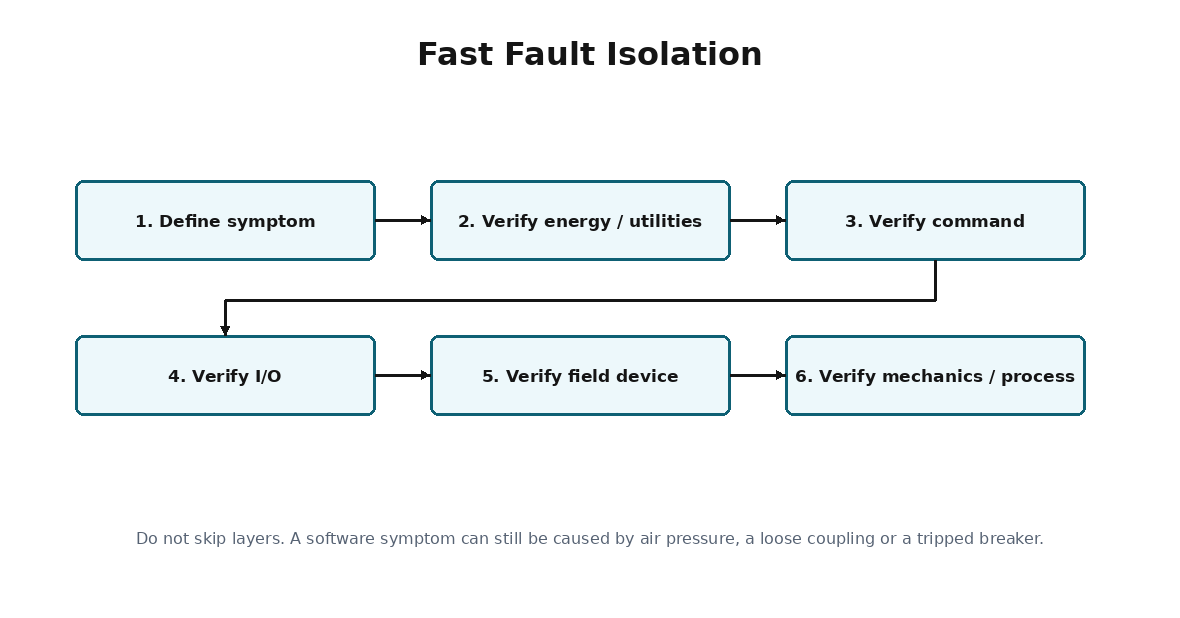
Use the same layered isolation method even when the symptom seems to point at software.
FIELD RULE: Preserve evidence before making changes: values, states, diagnostics, timestamps and the exact machine condition.
Continue the series
- Previous chapter: Final Acceptance and Handover: Commissioning Guide
- Next chapter: Input Works at Sensor but Not in PLC — Commissioning Case Study
- Browse all Machine Commissioning chapters
Adapted from Machine Commissioning for Maintenance and Automation Technicians, by Dovydas Kersys. © 2026 Dovydas Kersys. Featured cover image is an AI-generated editorial illustration.