By Dovydas Kersys · Chapter 50 of 58 in Machine Commissioning.
Before you begin: Follow the machine documentation, risk assessment, site procedures and lockout/tagout requirements. Commissioning can expose personnel to electrical energy, stored pressure and unexpected motion. Never defeat a safety function merely to make a test easier. Examples and diagrams are generic and must be checked against the actual machine.
Handover is the point where responsibility moves from commissioning to operations and maintenance. The technical package must allow another technician to understand, restore and troubleshoot the machine.
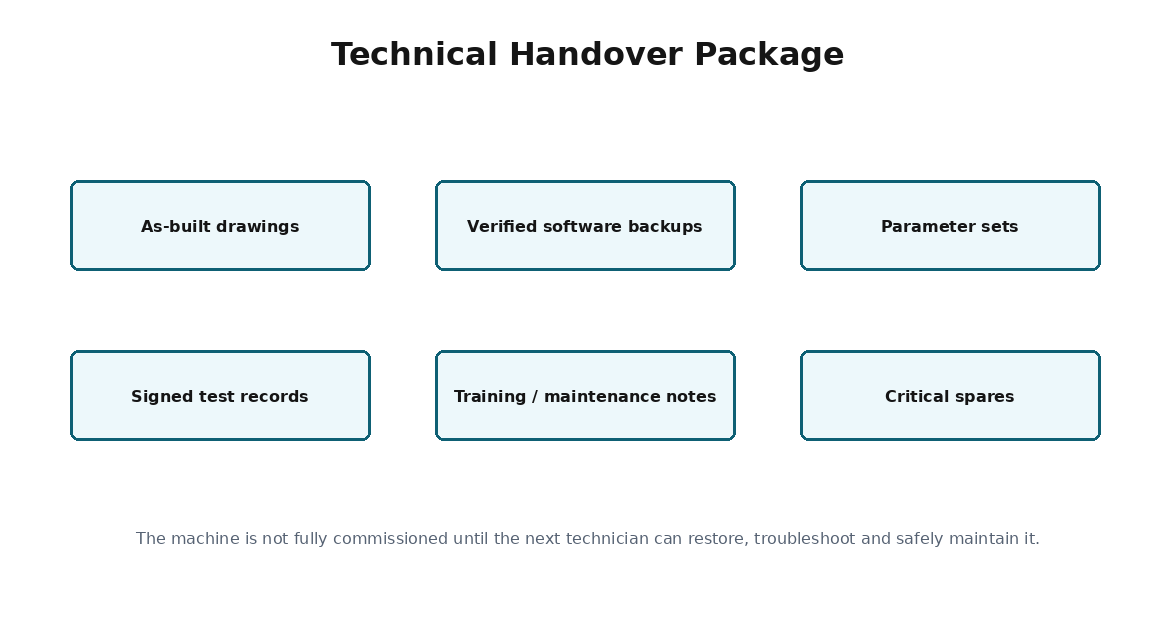
A good handover makes the commissioning team replaceable.
Why this matters during commissioning
A machine that runs but cannot be restored after a failed PLC or drive is not fully handed over.
Commissioning procedure
- Close or formally accept remaining punch items.
- Freeze and archive final PLC, safety, HMI, drive, servo and network backups.
- Complete as-built drawings and parameter records.
- Deliver signed test records and acceptance results.
- Train maintenance on normal startup, fault recovery, backups and critical adjustments.
- Confirm critical spare parts and special cables/software are available.
Common failure patterns
- Final software exists only on one engineer laptop.
- Drive replacement parameters not documented.
- Maintenance receives manuals but no explanation of actual machine-specific changes.
- Open safety punch item buried in a general list.
Evidence to record
- Final software package
- As-built documentation
- Acceptance record
- Training attendance/notes
- Open-item disposition
- Spare/restore information
FIELD RULE: Leave the machine in a state that another competent technician can support without calling the original programmer for every fault.
PART IX
Real Commissioning Cases
Real Commissioning Cases
Appendix F. SAT / Handover Checklist
Use this before final site acceptance and technical handover.
☐ All critical safety functions proof-tested and accepted.
☐ Digital and analog loop checks complete.
☐ Interlocks/permissives tested for both allow and inhibit conditions.
☐ Drives, servos and motors have recorded final parameters.
☐ Automatic sequences, stop modes and recovery paths tested.
☐ Alarm messages and root-cause behavior reviewed.
☐ Network diagnostics and recovery tested.
☐ Power-loss recovery tested where applicable.
☐ Performance / cycle-time / process acceptance complete.
☐ Extended run completed with no unresolved critical faults.
☐ Final PLC, HMI, safety, drive, servo and network backups archived.
☐ As-built drawings updated and controlled.
☐ Maintenance training completed.
☐ Critical spares, software tools and cables identified.
☐ Open punch items formally accepted with owner/date.
FIELD RULE: Add site-specific requirements and measured values. A checkbox alone is weak evidence when a numeric measurement is available.
Final Note
Good commissioning is not the art of making a machine run once. It is the discipline of proving that the machine is safe, understandable, repeatable and supportable. The strongest technicians do not rush past evidence. They use measurements, state-by-state testing and controlled changes to reduce uncertainty until the system behaves predictably.
Commissioning is complete when the machine and its technical information are ready for the people who will own it next.
FIELD RULE: Leave behind a machine that maintenance can restore and troubleshoot without depending on commissioning memories.
Continue the series
- Previous chapter: Nuisance Fault Elimination: Commissioning Guide
- Next chapter: Motor Runs Backwards — Commissioning Case Study
- Browse all Machine Commissioning chapters
Adapted from Machine Commissioning for Maintenance and Automation Technicians, by Dovydas Kersys. © 2026 Dovydas Kersys. Featured cover image is an AI-generated editorial illustration.