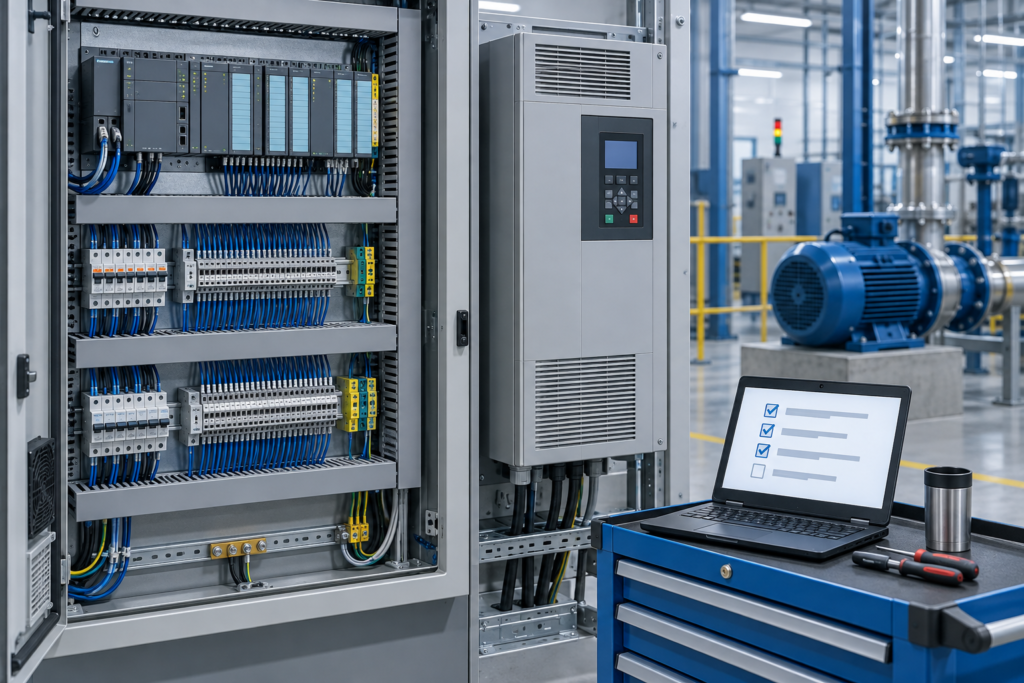
By Dovydas Kersys · Chapter 7 of 58 in Machine Commissioning.
Before you begin: Follow the machine documentation, risk assessment, site procedures and lockout/tagout requirements. Commissioning can expose personnel to electrical energy, stored pressure and unexpected motion. Never defeat a safety function merely to make a test easier. Examples and diagrams are generic and must be checked against the actual machine.
Commissioning repeatedly moves between de-energized inspection and controlled energized testing. Energy control must be deliberate because stored pressure, gravity, springs, rotating inertia and DC bus energy can remain after electrical isolation.
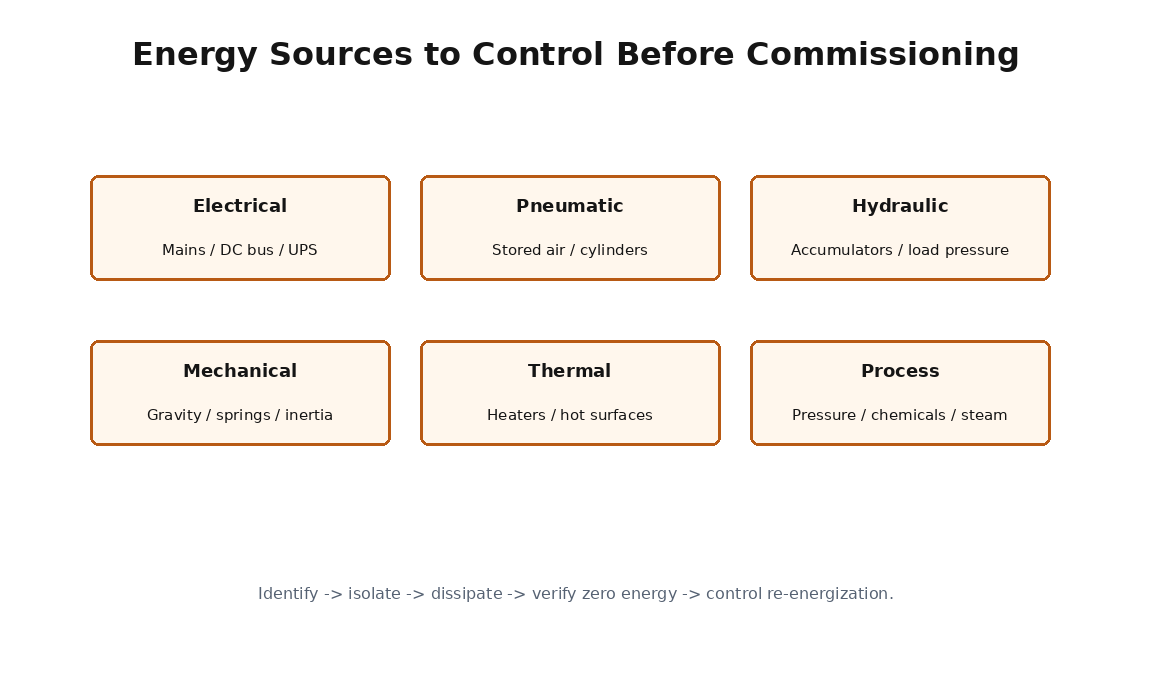
Commissioning requires control of electrical and non-electrical energy.
Why this matters during commissioning
The unusual state of an incomplete machine makes normal operating assumptions unreliable. A valve may be manually shifted, a cylinder may move when air is restored, or a drive may retain bus voltage after mains isolation.
Commissioning procedure
- Identify every hazardous energy source for the planned task.
- Apply site lockout/tagout and verify isolation.
- Dissipate stored pneumatic, hydraulic, gravitational, spring and electrical energy.
- Verify zero-energy state with an appropriate method.
- Before re-energization, restore guards and tools, clear people, announce the test and control who may energize.
Common failure patterns
- Isolating only the main electrical disconnect.
- Assuming pressure is gone because a gauge reads zero.
- Forgetting an external UPS, servo bus, or second panel feed.
- Restoring energy while a temporary mechanical restraint is still installed.
Evidence to record
- Isolation points
- Zero-energy verification method
- Stored-energy controls
- Test authorization
- Temporary exceptions
FIELD RULE: Never let the need to “just see what happens” replace a controlled re-energization plan.
Continue the series
- Previous chapter: Startup Readiness Reviews: Commissioning Guide
- Next chapter: Electrical Panel Inspection: Commissioning Guide
- Browse all Machine Commissioning chapters
Adapted from Machine Commissioning for Maintenance and Automation Technicians, by Dovydas Kersys. © 2026 Dovydas Kersys. Featured cover image is an AI-generated editorial illustration.