By Dovydas Kersys · Chapter 10 of 58 in Machine Commissioning.
Before you begin: Follow the machine documentation, risk assessment, site procedures and lockout/tagout requirements. Commissioning can expose personnel to electrical energy, stored pressure and unexpected motion. Never defeat a safety function merely to make a test easier. Examples and diagrams are generic and must be checked against the actual machine.
Incoming power should be verified before sensitive loads are connected or enabled. Check voltage magnitude, phase-to-phase balance, phase sequence, neutral where used, and expected grounding arrangement.
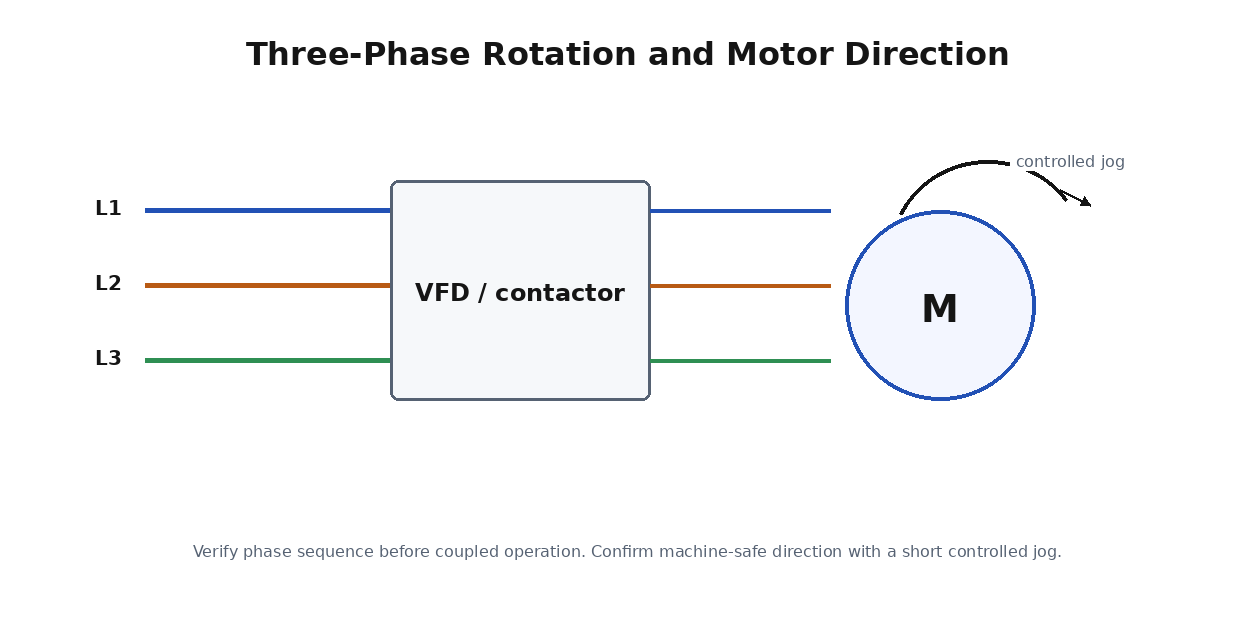
Verify phase sequence before running mechanically coupled three-phase loads.
Why this matters during commissioning
Wrong supply voltage, lost phase or incorrect phase sequence can immediately damage equipment or make pumps and fans run backwards.
Commissioning procedure
- Verify supply matches design nameplate values.
- Measure phase-to-phase and phase-to-neutral voltages where applicable.
- Check phase rotation using an appropriate tester.
- Confirm control transformers and power supplies are connected to the intended taps.
- Energize distribution progressively, watching for abnormal current, noise, odor, heat or trips.
Common failure patterns
- Incorrect transformer tap.
- Phase loss due to fuse or terminal problem.
- Neutral missing on a circuit that requires it.
- Unexpected backfeed from another panel.
Evidence to record
- Measured voltages
- Phase rotation
- Transformer tap / supply configuration
- Breaker/fuse state
- Abnormal observations
FIELD RULE: When possible, energize from upstream to downstream instead of bringing the whole machine live at once.
Continue the series
- Previous chapter: Protective Earth and Bonding: Commissioning Guide
- Next chapter: 24 VDC Control Power: Commissioning Guide
- Browse all Machine Commissioning chapters
Adapted from Machine Commissioning for Maintenance and Automation Technicians, by Dovydas Kersys. © 2026 Dovydas Kersys. Featured cover image is an AI-generated editorial illustration.